
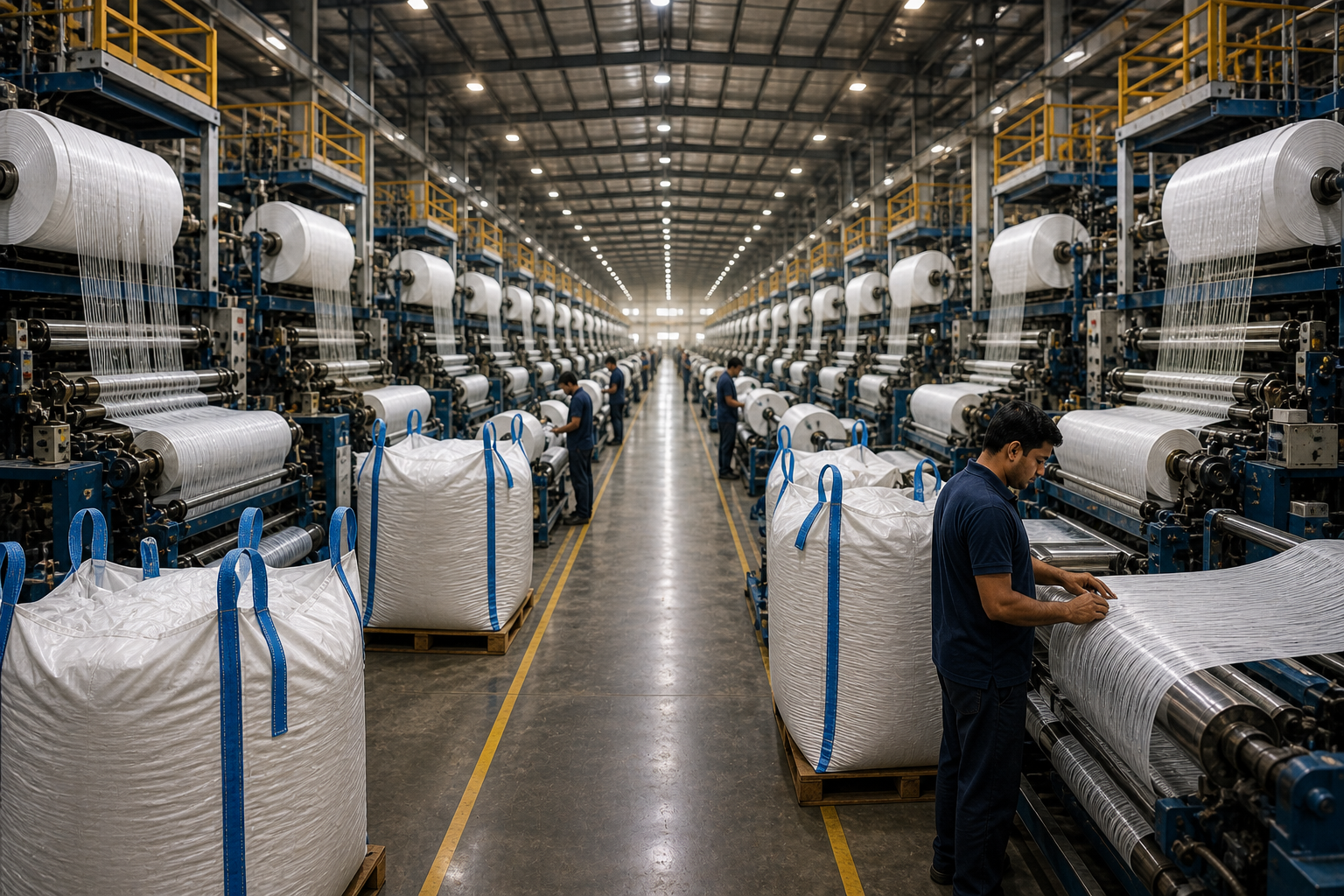
Why Do FIBC Bags Fail And Why It’s Almost Always the Manufacturer’s Fault
FIBC bag failures are rarely accidents. They’re engineered mistakes. When a bulk bag tears, leaks, or collapses under load, the immediate assumption is misuse — overloading, improper handling, or harsh conditions.
But in over 80% of documented failure cases, the root cause traces back to one place:
Manufacturing decisions made long before the bag ever reached the customer. And most buyers never see them.
—
Where Things Actually Go Wrong
FIBC bag failures rarely originate from usage conditions alone. In most cases, the root cause lies in subtle manufacturing decisions that are not visible to the buyer. These hidden variables — material quality, stitching precision, testing standards, and production consistency — collectively determine whether a bag performs reliably or fails under normal conditions.
Fabric GSM Manipulation (The Invisible Downgrade)
Polypropylene fabric weight (GSM) determines the bag’s strength.
But here’s the problem:
Two bags can look identical yet perform completely differently.
Some manufacturers quietly reduce GSM to lower cost:
- 180 GSM quoted → 150 GSM delivered
- No visible difference
- Significant strength loss
Result: Bag fails under normal load.
This is the #1 hidden cause of failure globally.
Because GSM differences are not visually obvious, this becomes the easiest variable to manipulate without immediate detection. Buyers relying only on visual inspection or supplier claims often miss this downgrade, which directly impacts tensile strength, load-bearing capacity, and long-term durability of the bag.
Weak Seam Engineering
The strongest fabric means nothing if the seams fail.
Common issues:
- Incorrect stitch density
- Low-grade thread
- Improper loop attachment
Most failures occur at stress concentration points:
- Lifting loops
- Bottom discharge seams
Why? Because seam engineering is skill-based — not machine-based.
Seam strength depends heavily on operator skill, thread quality, and stitching consistency. Even minor variations in stitch pattern or tension can create weak points that fail under load. Since seams carry the highest stress during lifting and transport, poor seam engineering is one of the fastest ways a structurally sound bag can fail.
Poor UV Stabilisation
FIBC bags exposed to sunlight degrade over time.
Without proper UV stabilisers:
- Fabric becomes brittle
- Strength drops dramatically
The issue:
Most buyers don’t specify UV hours.
So manufacturers default to minimum-cost UV protection.
A bag rated for 6 months may fail in 6 weeks outdoors.
UV degradation is a silent failure mechanism — it doesn’t show immediately but progressively weakens the material. Without clearly defined UV resistance requirements, manufacturers optimize for cost rather than performance, resulting in bags that fail prematurely in outdoor storage or transit conditions.
Lack of Real Testing (Not Just Certification)
Many buyers assume:
“Certified = tested”
That’s not always true.
Some manufacturers:
- Show old certificates
- Skip batch-level testing
- Avoid third-party verification
Real quality requires:
- Top lift tests
- Drop tests
- Safety factor validation
Without this:
Certification becomes paper compliance, not performance assurance.
Certification alone does not guarantee consistency across production batches. Without ongoing testing, there is no validation that current production meets the same standards as previously certified samples. This gap between certification and actual performance is a major cause of unexpected failures in real-world conditions.
Inconsistent Production at Scale
Producing 1,000 good bags is easy.
Producing 100,000 identical bags is not.
Failure happens when:
- Yarn quality varies
- Loom settings fluctuate
- QC checks are skipped under pressure
Result:
Same order. Same specs. Different performance.
At scale, even small inconsistencies multiply into significant quality variation. Without strict process control and continuous quality monitoring, manufacturers struggle to maintain uniformity across large batches. This inconsistency leads to unpredictable performance, where some bags perform perfectly while others fail under identical conditions.
The Real Problem: Buyers Don’t See These Variables
Most procurement decisions are made on:
- Price
- Lead time
- Basic certification
But failure doesn’t come from visible specs.
It comes from:
- What wasn’t checked
- What wasn’t specified
- What was quietly downgraded
Procurement decisions often prioritize measurable factors while overlooking process-level variables that are harder to evaluate. This creates a gap between perceived quality and actual performance. Without deeper verification, buyers unknowingly accept risks that only become visible after failure occurs.
Real-World Scenario · Failure That Wasn’t “Misuse”
A European agricultural exporter reported recurring bag failures during transport.
Initial assumption:
Handling issue.
Actual cause (after audit):
- Fabric GSM was 12% lower than declared
- UV stabilisation below requirement
- No batch testing conducted
After switching to a verified manufacturer:
- Failure rate dropped to near zero
- No change in handling process
This case highlights how operational issues are often misdiagnosed when the root cause lies in manufacturing quality. Without a structured audit, failures are incorrectly attributed to logistics or handling, delaying the identification of actual production deficiencies.
How to Prevent FIBC Failures (What Smart Buyers Do)
Instead of asking:
“Is this bag strong enough?”
Ask:
- What is the actual tested GSM, not just quoted?
- When was the last batch test conducted?
- Which lab issued the certification?
- What UV hours rating is guaranteed?
- Can you show recent test reports (last 90 days)?
These questions filter serious manufacturers instantly.
Effective procurement is not about finding the lowest price, but about asking the right technical questions. Buyers who focus on verification rather than assumptions significantly reduce failure risk and ensure consistent performance across supply cycles.
The Bigger Insight
FIBC failures are not random.
They are predictable outcomes of:
- Cost-cutting decisions
- Lack of process control
- Weak quality systems
And all of these originate at the manufacturing level.
Understanding this shifts the focus from reactive problem-solving to proactive risk prevention. Instead of dealing with failures after they occur, businesses can eliminate them at the source by selecting the right manufacturing partner and enforcing strict quality standards.
—
Final Thought
A bulk bag is not just packaging.
It is a load-bearing safety system.
When it fails, it’s not because the bag was used.
It’s because it was built to fail.
—
At UWON, every FIBC bag is:
– Batch-tested
– Fully traceable
– Built to declared GSM — not estimated
– Certified through verified third-party labs
Because in bulk packaging: Failure is not a risk. It’s a decision.