

FIBC Lifting Loops: 7 Types & Selection Tips
FIBC Lifting Loops: Choose the Right Configuration
FIBC lifting loops play a critical role in how a bulk bag is lifted, moved and positioned. The correct loop configuration helps the bag work with the intended handling equipment while supporting the load through the designed lifting points.
However, choosing lifting loops should never come down to selecting the most common option. The right configuration depends on the FIBC construction, Safe Working Load (SWL), bag dimensions, handling method, lifting equipment and the way the filled bag moves through the supply chain.
For buyers, understanding cross-corner loops, side-seam loops and four-loop configurations can make FIBC specifications much more precise. It can also help prevent costly handling problems caused by choosing a loop arrangement that does not match the actual operation.
Why the Right Lifting Loop Matters
A filled FIBC can carry hundreds or thousands of kilograms of dry bulk material. During lifting, the load transfers from the bag body into the lifting loops and then into the forklift attachment, hook, lifting frame or other approved handling equipment.
Therefore, the lifting configuration can influence:
- How the bag connects to lifting equipment
- How the load transfers through the bag structure
- How the filled bag hangs during lifting
- How easily operators can connect the bag
- Which handling equipment can work with the FIBC
- How consistently the bag can be positioned
FIBCA’s FIBC Design Guide treats the top-lift arrangement as an important part of the FIBC specification and lists options such as four-point lift and cross-corner loops. See the FIBCA FIBC Design Guide.
Common FIBC Loop Types Explained
FIBC manufacturers offer several lifting configurations. Although some designs look similar, their attachment points and intended handling methods can differ.
The three configurations most relevant to many industrial buyers are cross-corner loops, side-seam loops and four-loop configurations.
Cross-Corner Loops: A Practical Choice
Cross-corner lifting loops attach to the FIBC in a configuration that allows the lifting points to work across the bag’s corners. This arrangement is widely used for industrial bulk bags and can provide a practical solution for compatible lifting systems.
Cross-corner loops can work well when:
- The handling system uses corner lifting points
- The operator needs convenient loop access
- The bag requires a straightforward lifting configuration
- The existing equipment already supports this arrangement
However, buyers should confirm the exact loop attachment and approved lifting method with the manufacturer. The term “cross-corner” describes a configuration, but it does not by itself define the complete lifting capability of the FIBC.
For example, FIBC manufacturers commonly specify cross-corner loops separately from other options such as four-loop, side-seam, sleeve or stevedore configurations. :contentReference[oaicite:0]{index=0}
Side-Seam Loops: When They Fit
Side-seam loops attach along the side structure or seams of the FIBC. This configuration can suit applications where the handling equipment or bag construction requires lifting points positioned along the side structure.
Side-seam loops may make sense when:
- The handling equipment approaches from a particular direction
- The bag construction requires specific load-transfer points
- The buyer already uses compatible lifting equipment
- The FIBC needs a particular lifting arrangement for the application
Because the attachment position affects how forces move through the bag, buyers should specify the complete lifting configuration rather than simply asking for “strong loops.”
Four-Loop FIBCs: Four Defined Points
A four-loop FIBC uses four separate lifting loops, typically positioned around the four corners of the bag. This arrangement provides four defined connection points for compatible lifting equipment.
Four-loop configurations can work particularly well when:
- The operation uses four-point lifting equipment
- A lifting frame connects to all four loops
- The buyer wants clearly defined corner lifting points
- The handling system already follows a four-point lifting process
FIBCA’s design guidance lists 4-point lift as a standard top-lift option alongside other configurations. :contentReference[oaicite:1]{index=1}
Still, four loops do not mean that operators can use any four hooks or straps. The equipment, attachment method and rated lifting configuration must match the manufacturer’s instructions.
Cross-Corner vs Four-Loop Configurations
| Factor | Cross-Corner Loops | Four-Loop Configuration |
|---|---|---|
| Lifting points | Corner-based lifting arrangement | Four individual lifting points |
| Typical use | Compatible general industrial handling | Four-point lifting systems |
| Equipment | Suitable hooks, frames or approved lifting attachments | Four-hook or four-point lifting equipment |
| Main selection factor | Bag design and handling method | Handling equipment and lifting arrangement |
Neither configuration is automatically better. Instead, the correct option depends on the equipment, FIBC construction and intended lifting process.
How SWL Affects Loop Selection
One of the biggest mistakes buyers make is treating lifting-loop strength as an isolated specification.
Safe Working Load (SWL) applies to the FIBC as a complete handling system under its specified conditions. The loops, seams, fabric and bag construction all need to work together for the rated application.
Therefore, buyers should provide the manufacturer with:
- Required SWL
- Required safety factor
- Target fill weight
- Material characteristics
- Bag dimensions
- Lifting method
- Handling equipment
- Required number of lifting points
For example, a 1,000 kg FIBC requires more than a statement saying “use heavy-duty loops.” The manufacturer needs to understand how the bag will carry and transfer that load during the intended handling operation.
Why Load Distribution Matters During Lifting
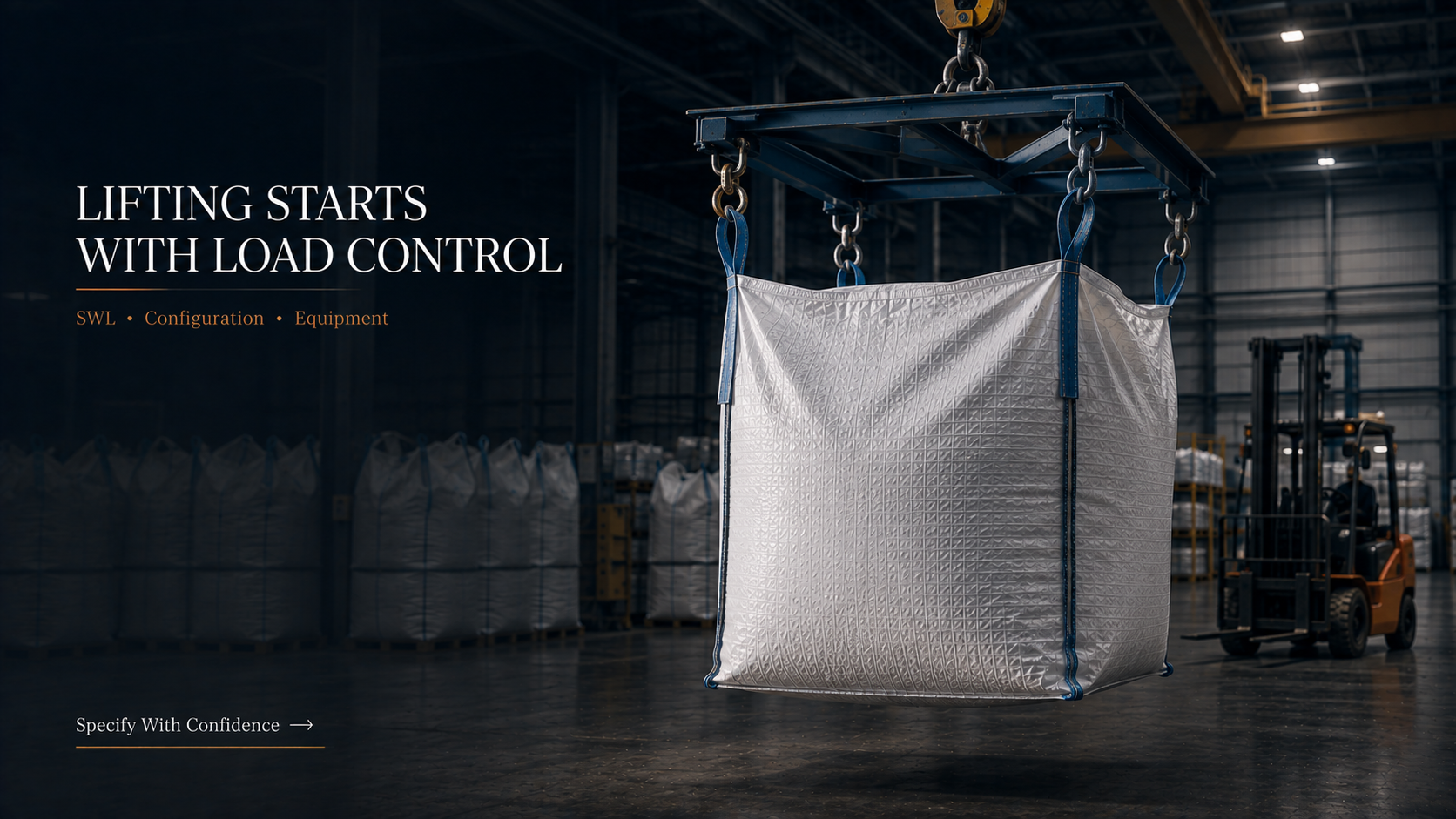
When operators lift a filled FIBC, forces travel through the lifting points and reinforced sections of the bag. The lifting arrangement should therefore match the bag’s engineered construction.
An unsuitable or improvised lifting method can create uneven loading and place unnecessary stress on the bag structure.
For this reason, operators should never:
- Lift the bag from fewer loops than the design requires
- Use damaged lifting loops
- Exceed the stated SWL
- Drag a filled FIBC by its lifting loops
- Attach hooks or straps in an unintended configuration
- Stand beneath a suspended FIBC
FIBCA’s safe-handling guidance specifically addresses correct lifting practices and warns against unsafe lifting arrangements. Review FIBCA’s FIBC Safe Handling Guidelines.
Forklift Handling: Specify the Equipment
Forklifts are common in FIBC handling. However, the forklift itself does not determine whether a particular loop configuration is suitable.
The buyer should consider the complete handling setup.
For example, check:
- Forklift type
- Fork attachment
- Loop position
- Loop access
- Bag dimensions
- Filled-bag weight
- Lifting height
- Warehouse handling process
Some FIBCs also use sleeve or tunnel-style lifting arrangements that allow forklift tines to engage a dedicated lifting feature. These designs can provide a different handling solution from traditional individual loops.
Several Indian FIBC suppliers currently list cross-corner, side-seam, sleeve and other lifting configurations, which shows why buyers should specify the actual handling requirement rather than simply requesting a generic “jumbo bag.” :contentReference[oaicite:2]{index=2}
Crane Handling Requires More Precision
Crane handling introduces another important consideration: the lifting equipment must connect correctly to the FIBC’s designated lifting points.
Before approving a crane-handled FIBC, specify:
- Number of lifting points
- Hook arrangement
- Lifting frame requirements
- SWL
- Safety factor
- Bag construction
- Required lifting height
In addition, operators should use the lifting method specified by the manufacturer. A crane can generate substantial forces, so improvised connections can create unnecessary risk.
What Buyers Should Specify Clearly
A strong FIBC purchase specification should give the manufacturer enough information to design the lifting arrangement around the actual operation.
At minimum, specify:
| Specification | What to Provide |
|---|---|
| SWL | Required working load in kilograms |
| Safety factor | Required factor according to the application |
| Loop configuration | Cross-corner, side-seam, four-loop or another approved design |
| Handling method | Forklift, crane, lifting frame or other equipment |
| Bag construction | U-Panel, 4-Panel, Circular, Baffle or other design |
| Bag dimensions | Length, width and height |
| Material weight | Expected filled weight |
| Application | Storage, transport, processing or discharge requirements |
FIBCA’s design guide also asks buyers to specify the top-lift feature together with transport, shipping and storage information. Therefore, lifting loops should form part of the complete FIBC design brief rather than appear as an afterthought. :contentReference[oaicite:3]{index=3}
Common Loop Selection Mistakes to Avoid
Choosing the Cheapest Loop
Price alone should never determine the lifting configuration. A cheaper loop arrangement can become expensive if it does not work with the existing handling system.
Specifying Only the Bag Weight
A target weight does not tell the manufacturer how operators will lift the FIBC. Always specify the lifting method and equipment as well.
Assuming Four Loops Fit Every System
Four loops provide four lifting points, but the equipment still needs to engage them correctly. Therefore, the number of loops alone does not define suitability.
Ignoring the Bag Construction
The same loop configuration can behave differently depending on the FIBC body, seams and attachment method. Match the loops with the complete bag design.
Using Only Some Loops
If the manufacturer specifies a particular lifting arrangement, operators should follow it. Using fewer lifting points than intended can change the load path.
Overlooking Damaged Loops
Before lifting, inspect the FIBC and its lifting components. FIBCA identifies lift-strap damage among the conditions that can make a bag unsuitable for reuse. :contentReference[oaicite:4]{index=4}
What to Ask FIBC Manufacturers in India

India has a large FIBC manufacturing base serving domestic and international bulk-packaging markets. However, buyers should compare manufacturers based on technical capability rather than location alone.
When evaluating FIBC manufacturers in India, ask:
- Which lifting-loop configurations can you manufacture?
- How do you match the loop design to the required SWL?
- How do you verify loop and seam performance?
- Can you manufacture cross-corner and four-loop configurations?
- Can you provide side-seam or specialised lifting options?
- Which handling equipment does the proposed design support?
- Can the lifting configuration be customised?
- What inspection and testing do you perform?
These questions help separate a supplier that simply produces standard bags from a manufacturer that can engineer the FIBC around the customer’s handling process.
How UWON Approaches Loop Configuration
UWON includes lifting-loop configuration among the technical specifications considered when developing FIBC solutions. Its product range includes different FIBC constructions and customised configurations for industrial applications.
This approach matters because lifting loops should work together with the bag body, dimensions, filling system, discharge configuration and intended handling method.
For buyers who need a specific lifting arrangement, UWON Packaging’s FIBC solutions can be evaluated around the complete application rather than around a standard loop option alone.
Choose Loops Around the Workflow
The best FIBC lifting loops are not necessarily the strongest-looking or most common ones. Instead, the right configuration is the one that matches the FIBC’s rated load, construction and actual handling process.
Before placing an order, confirm:
- Required SWL
- Safety factor
- Bag construction
- Loop configuration
- Forklift or crane method
- Number of lifting points
- Bag dimensions
- Handling environment
When buyers define these requirements clearly, manufacturers can develop a more suitable FIBC specification and reduce the risk of handling problems later.
Frequently Asked Questions
What are FIBC lifting loops?
FIBC lifting loops are reinforced lifting features attached to a bulk bag that allow compatible equipment to lift and move the filled container.
What are cross-corner FIBC loops?
Cross-corner loops use a corner-oriented lifting arrangement designed to connect the FIBC to suitable handling equipment. The exact attachment and approved lifting method depend on the manufacturer’s design.
What are side-seam lifting loops?
Side-seam loops attach along the side structure or seams of the FIBC. They can suit applications where the handling system requires lifting points in those positions.
Are four-loop FIBCs better than cross-corner FIBCs?
Not necessarily. Both configurations can suit different handling systems. The correct choice depends on the FIBC construction, lifting equipment, SWL and intended handling method.
Can FIBC lifting loops be customised?
Yes. Manufacturers can develop different lifting configurations based on the bag construction, handling equipment, load requirements and application.
How does SWL affect FIBC lifting loops?
SWL defines the rated working load of the FIBC under specified conditions. The loops, seams, fabric and complete bag construction must support the intended handling configuration.
Can a forklift lift any FIBC by its loops?
No. The forklift attachment and lifting method must match the FIBC’s intended design. Buyers and operators should follow the manufacturer’s handling instructions.
What should I tell an FIBC manufacturer before ordering?
Provide the required SWL, safety factor, bag dimensions, material weight, handling equipment, lifting method, loop configuration and application requirements. This information allows the manufacturer to develop the appropriate specification.