
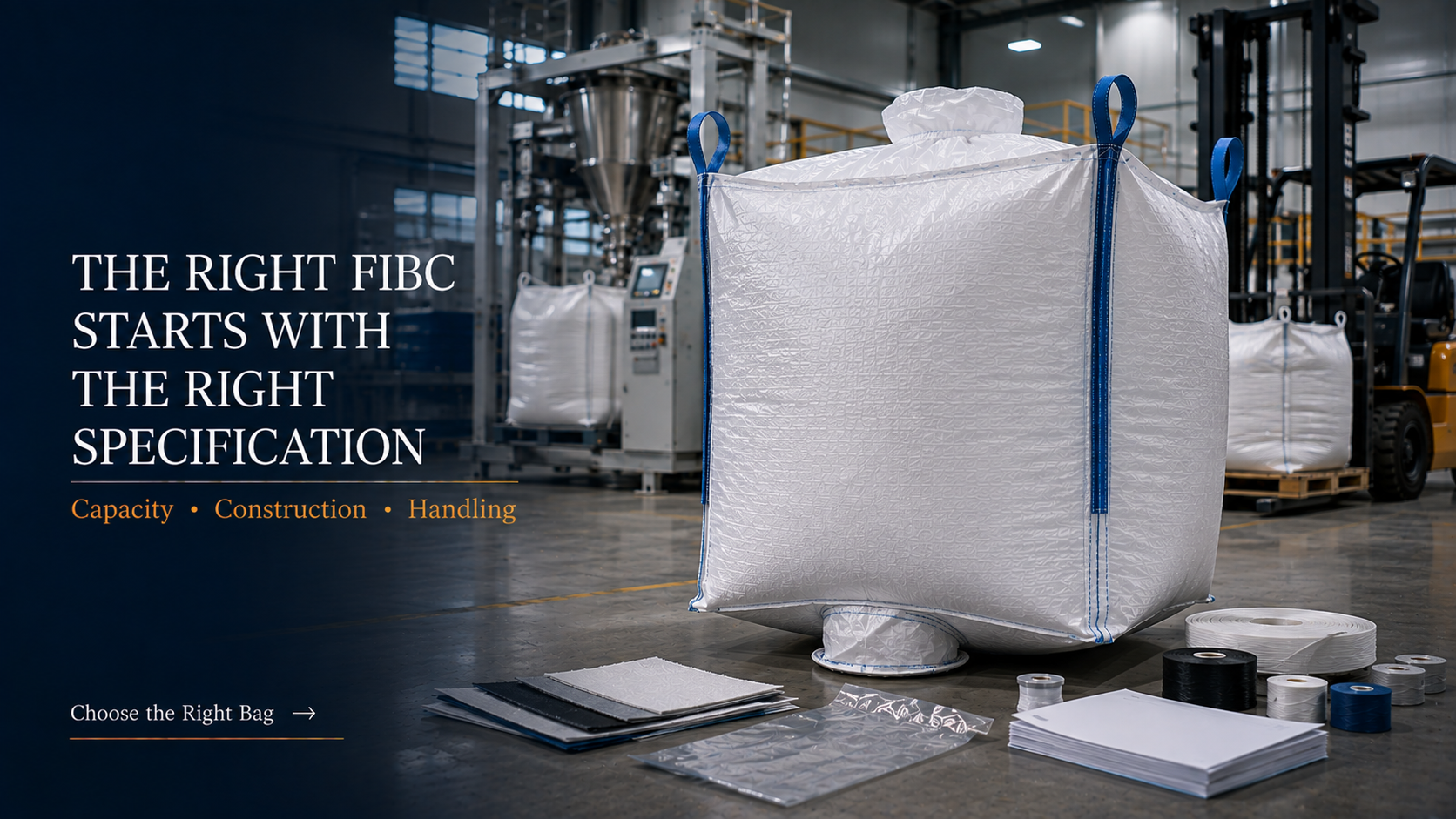
How to Choose FIBC Bags: 9 Specs Buyers Should Check
How to Choose FIBC Bags: 9 Specifications That Matter
Knowing how to choose FIBC bags is about much more than selecting a size and asking for the lowest quotation. The right FIBC specification should match the material, filling process, lifting equipment, storage conditions, transportation method and discharge requirements.
FIBC bags, also known as Jumbo Bags, Bulk Bags or Big Bags, are used across agriculture, chemicals, construction, food, pharmaceuticals, minerals, plastics and other industries for storing and transporting dry bulk materials. Industry sources identify FIBCs as a major bulk-packaging solution for products ranging from grains and fertilizers to chemicals, minerals and construction materials. :contentReference[oaicite:2]{index=2}
However, two FIBC jumbo bags can have the same external dimensions while having very different specifications. Fabric GSM, SWL, safety factor, construction, lifting loops, filling configuration, discharge configuration and liner requirements can all change the way a bag performs.
Therefore, buyers should define the complete FIBC bag specifications before approving a supplier.
Why FIBC Specifications Matter
An FIBC is part of a material-handling system. The bag needs to work with the product and the equipment used to fill, lift, move, store and empty it.
For example, a powder may require a liner and sift-resistant construction, while a free-flowing granular product may need a specific discharge configuration.
Similarly, an exporter may prioritize container utilization, while a warehouse operator may prioritize stacking stability.
Consequently, the best FIBC is not simply the bag with the highest capacity or lowest price. It is the bag whose specifications match the complete application.
1. Start With the Material You Need to Pack
The first specification should always be the product itself.
Tell your FIBC supplier exactly what the bag will contain and provide as much technical information as possible.
Important details include:
- Product name
- Bulk density
- Particle size
- Powder or granular form
- Flow characteristics
- Moisture sensitivity
- Temperature conditions
- Food-contact requirements where applicable
- Dangerous-goods classification where applicable
- Electrostatic hazards where applicable
These characteristics influence the construction and additional features required in the final FIBC design.
For example, IFIBCA identifies FIBCs across applications including polymers, minerals, chemicals, fertilizers, food products, pharmaceuticals, construction materials and agricultural products. :contentReference[oaicite:3]{index=3}
Therefore, never start the purchasing conversation with only “I need a 1-ton jumbo bag.” Start with the product and its handling conditions.
2. Choose the Correct FIBC Capacity and SWL
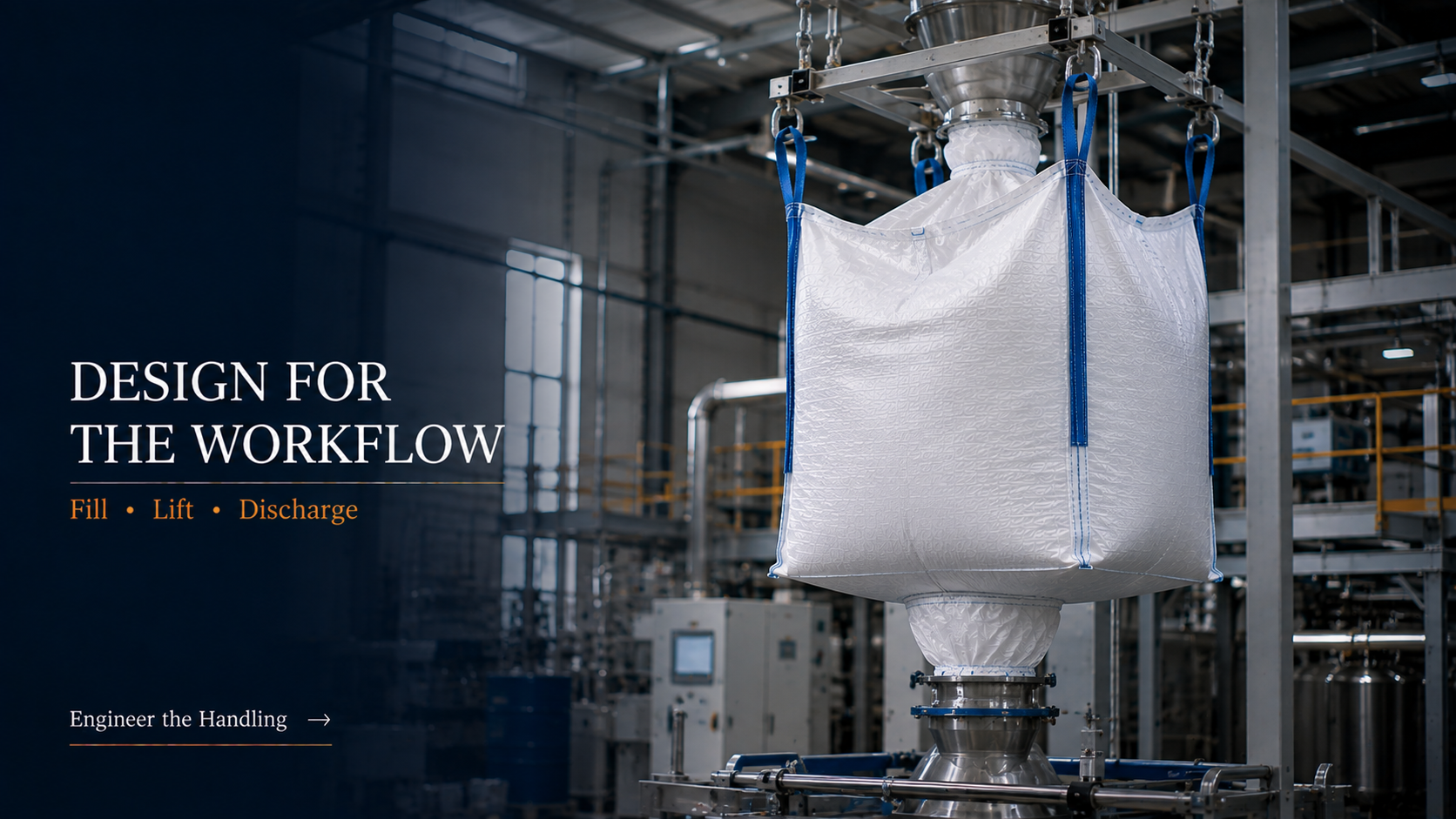
FIBC capacity and Safe Working Load, or SWL, are critical specifications.
SWL defines the load that the FIBC is designed to carry under the specified conditions.
However, the bag’s volume and its rated working load are not the same thing.
A bag may have enough physical volume to hold a certain product but still require a different structural specification because the product has a higher bulk density.
For this reason, buyers should provide:
- Target filling weight
- Product bulk density
- Required bag volume
- Required SWL
- Applicable safety factor
Current FIBC industry information commonly describes Jumbo Bags as carrying substantial bulk loads, while exact capacity depends on the design and specification. :contentReference[oaicite:4]{index=4}
Therefore, specify the required SWL rather than simply asking for a “one-ton bag.”
3. Get the FIBC Dimensions Right
FIBC dimensions affect filling, storage, stacking, transportation and container utilization.
Common dimensions may look simple on a quotation:
Length × Width × Height
However, the filled dimensions can behave differently depending on the construction and material.
Buyers should consider:
- Available warehouse space
- Pallet dimensions
- Stacking height
- Truck dimensions
- Container dimensions
- Filling equipment
- Discharge equipment
- Product density
For example, a Baffle FIBC can maintain a more cubic profile than a conventional bag because internal baffles restrict outward bulging. That characteristic can improve space utilization in some applications.
UWON offers Baffle FIBC Bags specifically as a shape-retaining construction for applications where controlled geometry and space utilization matter. Explore UWON Baffle FIBC Bags.
4. Select the Right FIBC Construction
The construction is one of the most important jumbo bag specifications.
Common constructions include:
- U-Panel FIBC
- 4-Panel FIBC
- Circular FIBC
- Baffle FIBC
Each construction provides a different combination of shape retention, seams, load distribution and stacking characteristics.
U-Panel FIBC
U-Panel construction can provide a balanced solution for many industrial applications, combining practical manufacturing with good load and shape performance.
4-Panel FIBC
4-Panel construction provides defined vertical sides and can be useful when dimensional consistency and stacking matter.
Circular FIBC
Circular construction uses a tubular woven body and can provide an efficient solution for applications where a highly cubic shape is not the primary requirement.
Baffle FIBC
Baffle construction uses internal panels to maintain a more consistent cubic shape and can help improve stacking and space utilization.
Therefore, buyers should select construction according to the application instead of treating one FIBC design as universally superior.
5. Choose the Correct Lifting Loops
FIBC lifting loops connect the bulk bag to the equipment used for handling.
The lifting configuration should match the available forklift, crane or lifting system.
Common configurations include:
- Four corner loops
- Cross-corner loops
- Side-seam lifting loops
- Single-loop configurations
- Two-loop configurations
However, buyers should not choose loops based only on appearance.
Consider:
- Handling equipment
- Forklift access
- Crane requirements
- Operator workflow
- SWL
- Bag construction
- Loop attachment method
The lifting system should form part of the complete structural specification.
6. Decide on the Filling Configuration
The top of the FIBC controls how efficiently the bag connects to the filling system.
Depending on the application, buyers may choose:
- Open top
- Filling spout
- Conical top
- Duffle top
- Customized filling arrangements
An automated filling line may require a different configuration from manual filling.
Therefore, tell your supplier how the FIBC will actually be filled before finalizing the design.
UWON offers FIBCs with filling spouts for applications requiring controlled connection to filling systems.
7. Choose the Right Discharge Configuration
FIBC discharge design can directly influence unloading speed and material control.
Common options include:
- Flat bottom
- Discharge spout
- Extended discharge spout
- Iris or controlled-closure systems
- Application-specific discharge configurations
Fine powders may require more controlled discharge than free-flowing granules.
Similarly, an automated processing line may require a specific outlet diameter or connection arrangement.
Therefore, buyers should provide the supplier with information about the receiving equipment and desired discharge rate.
UWON offers FIBCs with discharge spouts for controlled bulk-material unloading.
8. Decide Whether You Need an FIBC Liner
An FIBC liner can provide additional product protection depending on the material and application.
Buyers may consider liners when handling:
- Fine powders
- Moisture-sensitive materials
- Hygiene-sensitive products
- Food products
- Pharmaceutical materials
- Materials requiring improved containment
However, a liner should not be added automatically.
Instead, consider:
- Product characteristics
- Moisture sensitivity
- Particle size
- Contamination risk
- Filling system
- Discharge requirements
- Applicable food-contact requirements
IFIBCA also notes that polyethylene liners can help contain fine powders when sift-proofing alone is insufficient. :contentReference[oaicite:5]{index=5}
For food-grade applications, you can also explore UWON’s Food & Beverage FIBC solutions.
9. Confirm Safety Factor and Application Requirements
FIBC safety factor is another specification buyers should establish before approving a design.
The appropriate safety factor depends on the intended application, handling conditions, design and applicable requirements.
Buyers should also determine whether the FIBC requires additional application-specific characteristics such as:
- UN certification
- Electrostatic protection
- UV protection
- Food-contact suitability
- Special coating
- Dust-proof seams
- Special liner
Do not add these features simply because they appear on another supplier’s specification sheet.
Instead, determine which requirements actually apply to your product and operating environment.
FIBC Bags for Different Industries
The same basic FIBC concept can serve very different industries.
However, the specification should change according to the application.
Agriculture
Grains, seeds, fertilizers and animal-feed materials can require different combinations of capacity, liner, UV protection and discharge configuration.
Chemicals
Chemical products may require specific liners, coatings, dust containment or electrostatic controls depending on the material and hazard classification.
Construction
Cement, sand, minerals and other construction materials can place significant demands on fabric strength, SWL, lifting configuration and durability.
Food and Beverage
Food applications can require food-contact materials, hygiene controls, suitable liners and appropriate documentation.
Pharmaceuticals
Pharmaceutical and high-purity materials may require tighter contamination control and application-specific liner and manufacturing requirements.
IFIBCA identifies food, pharmaceuticals, chemicals, agriculture, construction, minerals, plastics and other sectors among major FIBC applications. :contentReference[oaicite:6]{index=6}
FIBC Specifications Buyers Should Put on the Purchase Order
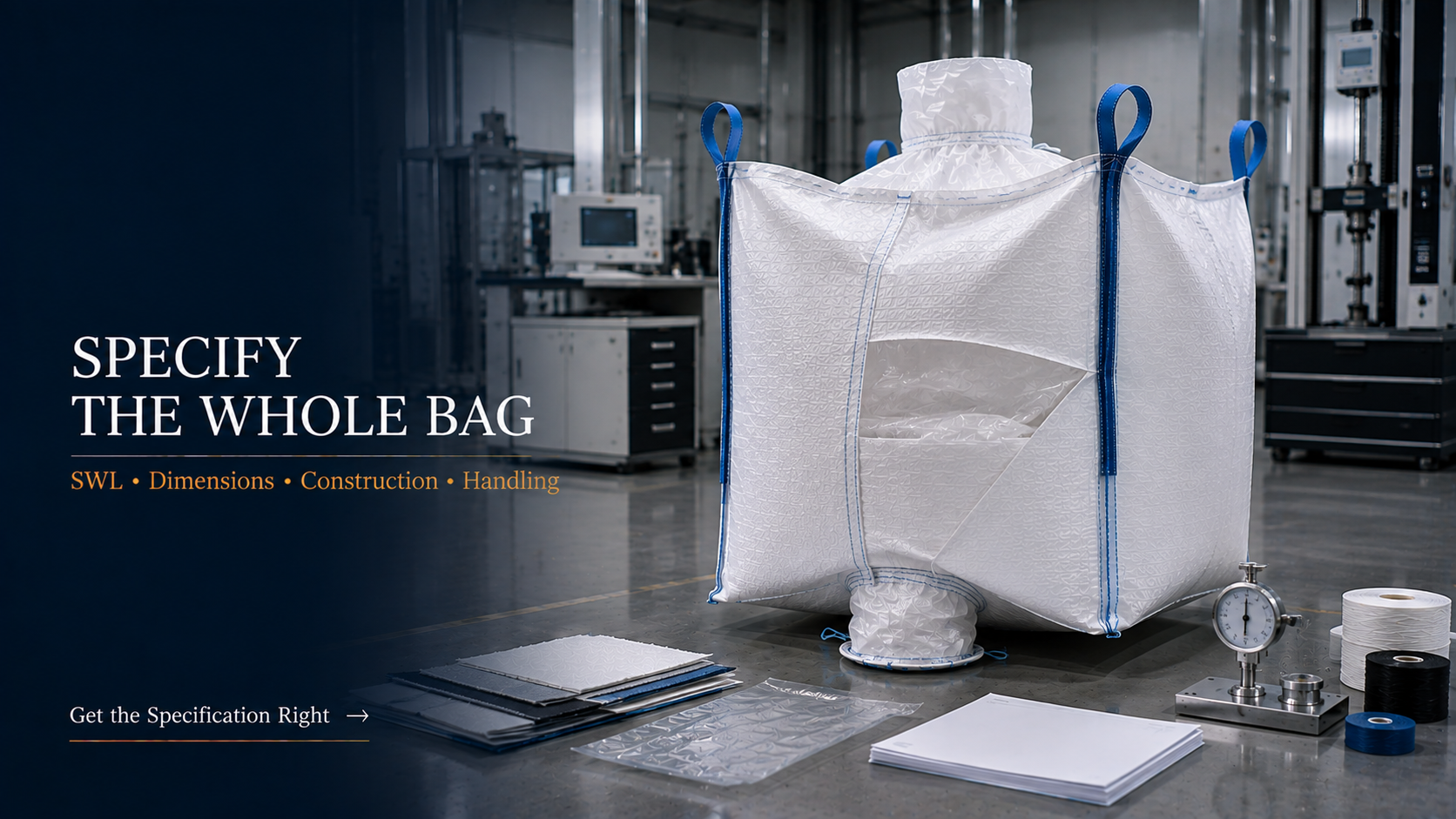
A vague purchase description creates room for specification differences.
Instead of writing:
“1,000 kg Jumbo Bag.”
Define the important characteristics.
| Specification | What to Define |
|---|---|
| Capacity | Required filling weight and SWL |
| Dimensions | Length × width × height |
| Construction | U-Panel, 4-Panel, Circular or Baffle |
| Lifting | Loop configuration and handling method |
| Top | Open, spout, conical or duffle |
| Bottom | Flat, discharge spout or controlled outlet |
| Fabric | Material, GSM and coating requirements |
| Liner | Required or not, plus material and configuration |
| Safety | Safety factor and application requirements |
| Printing | Required markings and identification |
This level of detail helps buyers compare suppliers on the same technical basis.
How to Compare FIBC Manufacturers in India
When evaluating FIBC manufacturers in India, price should not be the only comparison point.
Ask each supplier to quote against the same specification.
Then compare:
- FIBC construction
- Fabric specification
- SWL and safety factor
- Lifting configuration
- Filling configuration
- Discharge configuration
- Liner
- Testing
- Quality controls
- Customization capability
- Documentation
- Production consistency
This prevents a common procurement problem: comparing two different FIBCs simply because both suppliers call them “1-ton jumbo bags.”
Why Custom FIBC Bags Can Be More Efficient
Custom FIBC bags can be useful when a standard specification does not match the actual material-handling process.
For example, a customer may require:
- Specific dimensions
- Specific lifting loops
- Customized filling spout
- Controlled discharge
- Special liner
- Coating
- Printing
- Shape-retaining construction
Instead of forcing the operation to fit a standard bag, the packaging can be designed around the workflow.
UWON positions its FIBC range around engineered solutions for real industrial workflows and offers multiple constructions and customized configurations. Explore UWON’s FIBC and Jumbo Bag solutions.
Common FIBC Buying Mistakes
Several mistakes appear repeatedly during bulk-bag procurement.
Choosing Only by Price
The cheapest empty bag may not provide the lowest total packaging cost.
Specifying Only the Weight
“1-ton bag” does not define dimensions, construction, fabric, lifting system or discharge configuration.
Ignoring the Filling System
A bag that fits the product but does not integrate well with the filling equipment can slow down operations.
Ignoring Discharge Requirements
Different materials and processing systems may require different outlet configurations.
Adding Features Without a Reason
More features do not automatically mean better performance. Select liners, coatings, UV protection and specialized designs according to the actual application.
Comparing Different Specifications
Two supplier quotations are only comparable when both suppliers quote against the same technical specification.
How UWON Helps Buyers Select the Right FIBC
UWON’s current product range includes Standard, U-Panel, Circular, 4-Panel and Baffle FIBC Bags, along with FIBCs with filling and discharge spouts. :contentReference[oaicite:7]{index=7}
This range allows buyers to select the construction according to the material, handling process and logistics requirements rather than relying on a single standard design.
UWON also highlights quality checks across its manufacturing process, with a focus on safety, strength and reliability. :contentReference[oaicite:8]{index=8}
For buyers with specialized requirements, the next step should be a detailed specification discussion rather than a generic quotation request.
Discuss your FIBC specification with UWON Packaging.
Final FIBC Selection Checklist
Before placing your next FIBC order, confirm:
- What material will the bag contain?
- What is the bulk density?
- What filling weight is required?
- What SWL is required?
- What dimensions are required?
- Which construction is appropriate?
- Which lifting configuration is required?
- How will the bag be filled?
- How will the bag be discharged?
- Does the product require a liner?
- Does the application require coating?
- Does the application require UV protection?
- Does the material create an electrostatic hazard?
- Does the application require UN certification?
- Does the application involve food contact?
- What testing and documentation are required?
If you can answer these questions before requesting a quotation, your supplier can provide a much more accurate FIBC specification.
Conclusion
Learning how to choose FIBC bags starts with understanding that a Jumbo Bag is not simply a large woven sack.
Its performance depends on the relationship between the material, capacity, dimensions, construction, lifting system, filling method, discharge system, liner and safety requirements.
Therefore, buyers should define the application first and the bag second.
A well-specified FIBC can support more efficient filling, handling, storage and transportation. It can also make supplier comparisons much more meaningful because every manufacturer is quoting against the same technical requirements.
Instead of asking only for a “1-ton Jumbo Bag,” specify what the bag needs to do.
The right FIBC is not the biggest, cheapest or most feature-rich bag. It is the bag engineered around the job it needs to perform.
Talk to UWON Packaging about your next FIBC or Jumbo Bag requirement.
Frequently Asked Questions
How do I choose the right FIBC bag?
Start with the material, bulk density, required filling weight, dimensions, handling method, storage conditions, filling system and discharge requirements. Then select the appropriate FIBC construction and additional features.
What are the most important FIBC bag specifications?
Important specifications include SWL, dimensions, construction, fabric GSM, safety factor, lifting loops, filling configuration, discharge configuration and liner requirements. Application-specific requirements such as UN certification or electrostatic protection may also apply.
What is the difference between FIBC capacity and SWL?
Capacity describes the amount of product the bag can physically accommodate, while SWL refers to the rated load the FIBC is designed to carry under specified conditions. Buyers should provide both the target filling weight and required SWL.
What FIBC construction should I choose?
The right construction depends on the application. U-Panel, 4-Panel, Circular and Baffle FIBCs each offer different characteristics for shape retention, load distribution, stacking and logistics.
Do all FIBC bags need liners?
No. A liner depends on the material and application. Fine powders, moisture-sensitive products, food products and certain pharmaceutical materials may require additional containment or product protection.
What lifting loops should an FIBC have?
The lifting configuration should match the handling equipment and application. Common options include four-loop, cross-corner, side-seam, single-loop and two-loop configurations.
What is the difference between a Jumbo Bag and an FIBC?
FIBC stands for Flexible Intermediate Bulk Container. Jumbo Bag, Big Bag and Bulk Bag are common commercial terms used for this type of flexible bulk packaging.
How should I compare FIBC manufacturers in India?
Compare suppliers against the same technical specification, including construction, fabric, SWL, safety factor, lifting configuration, filling and discharge systems, liner, testing, quality controls and customization capability.
Can FIBC bags be customized?
Yes. Custom FIBC bags can be designed with specific dimensions, construction, lifting loops, filling and discharge configurations, liners, coatings, printing and other application-specific features.