
FIBC Bags in 2026: 7 Features Buyers Should Know
FIBC Bags in 2026: 7 Features Changing How Buyers Choose Jumbo Bags
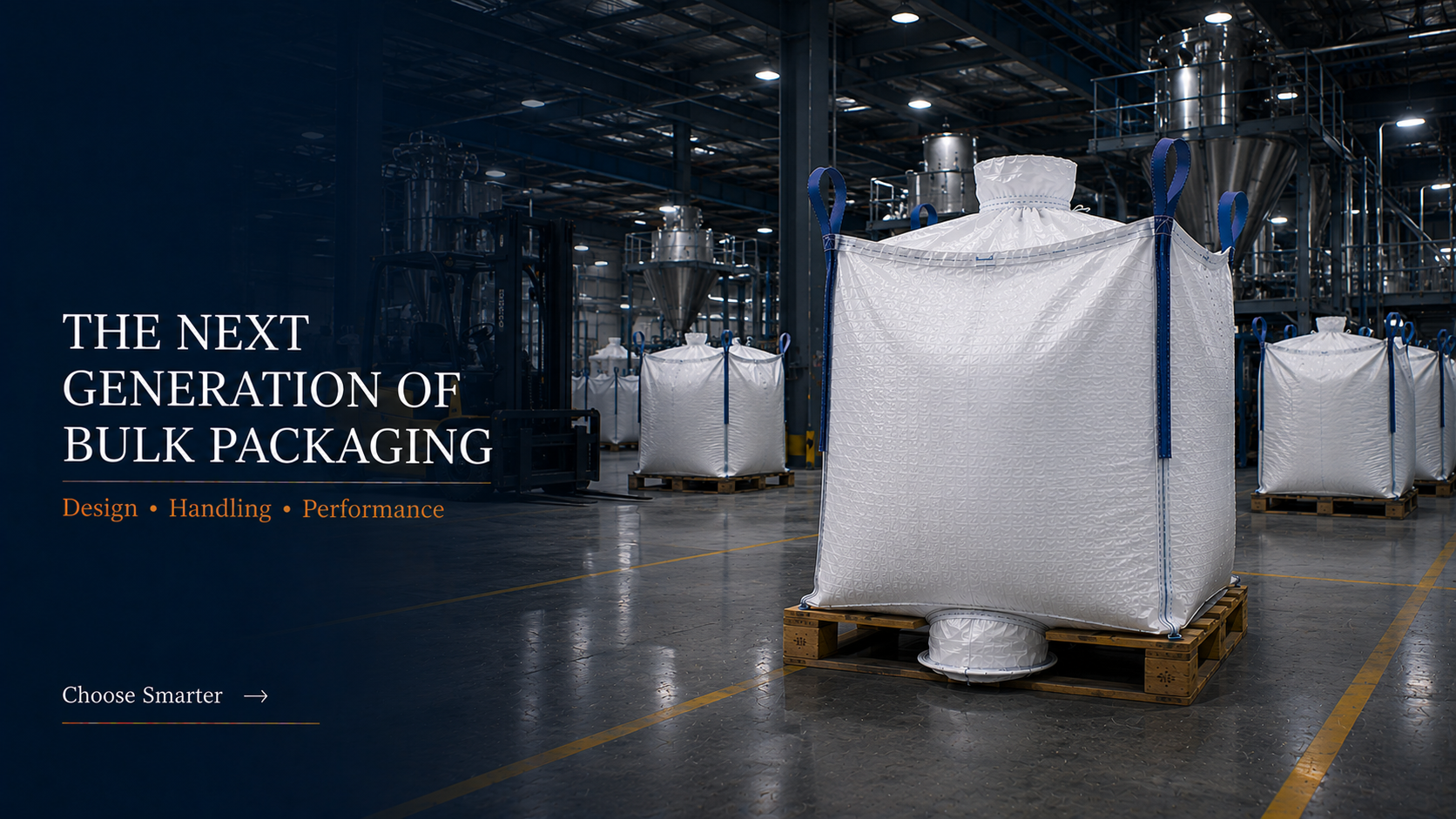
FIBC bags remain one of the most practical ways to handle, store and transport dry bulk materials. However, the way buyers select Jumbo Bags is changing in 2026.
Instead of comparing only price, capacity and dimensions, procurement teams are increasingly looking at the complete packaging system. Construction, material protection, filling and discharge, handling, traceability and application-specific customization are becoming more important parts of the buying decision.
Recent industry coverage points toward a shift from basic bulk transport toward more application-specific FIBC solutions, particularly for chemicals, food ingredients, minerals, agriculture and other high-value materials. :contentReference[oaicite:1]{index=1}
So, what should buyers look for when selecting FIBC Jumbo Bags in 2026?
Why FIBC Bags Are Becoming More Application-Specific
FIBCs, also known as Jumbo Bags, Bulk Bags or Big Bags, can serve many different industries.
IFIBCA lists applications including fertilizers, cement, chemicals, pharmaceuticals, food products, plastic granules, minerals and agricultural products. :contentReference[oaicite:2]{index=2}
However, these materials do not behave in the same way.
A free-flowing granular material may require a simple filling and discharge arrangement. In contrast, a fine powder may require better containment, a liner or sift-resistant construction. Similarly, a moisture-sensitive product can require additional barrier protection.
Therefore, buyers are increasingly moving from the question “Which Jumbo Bag is cheapest?” to “Which FIBC design fits our process?”
1. Application-Specific FIBC Construction
One of the most important developments in FIBC bag design is the move toward application-specific construction.
Common constructions include:
- U-Panel FIBC
- 4-Panel FIBC
- Circular FIBC
- Baffle FIBC
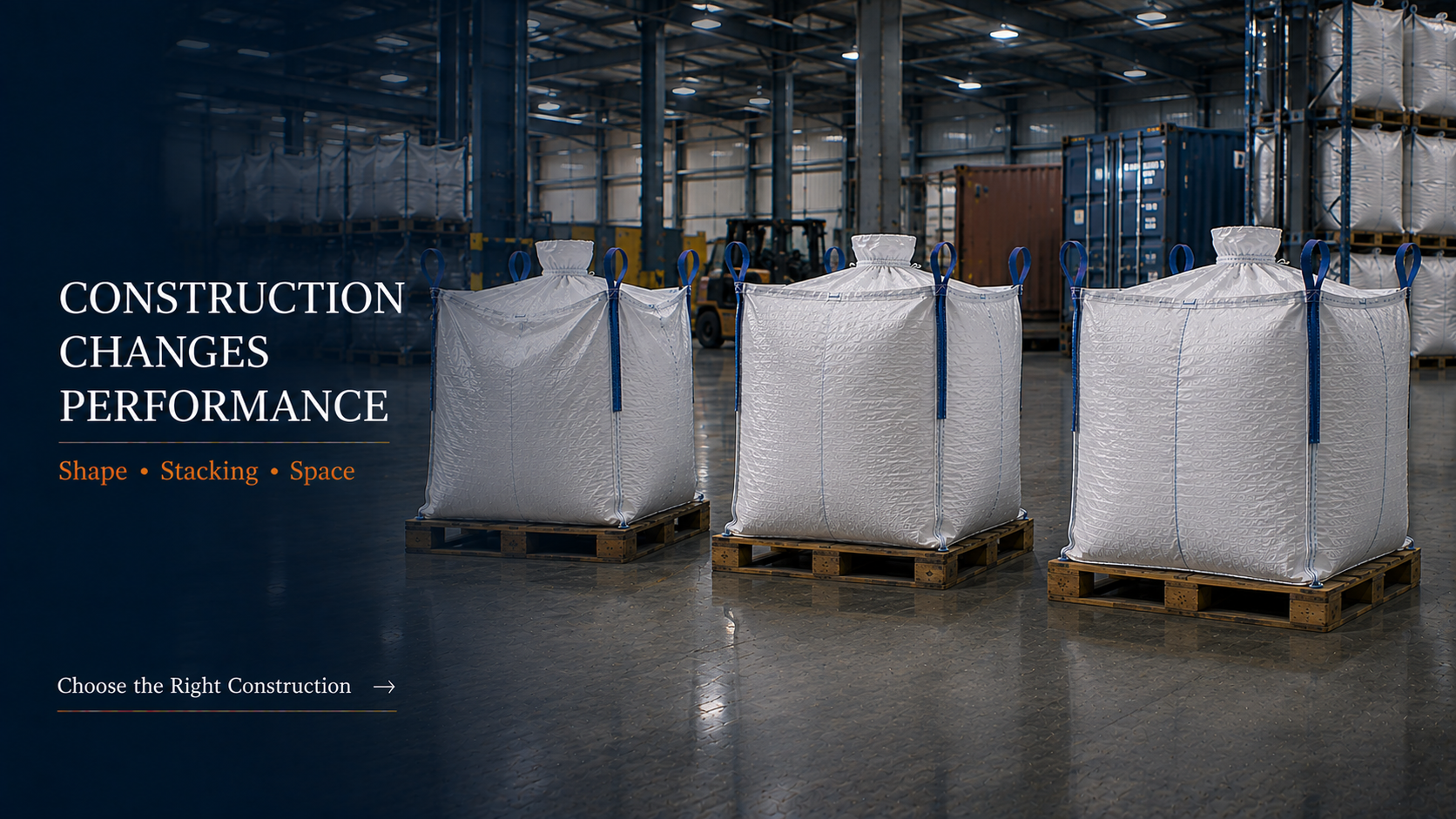
Each construction can provide different characteristics for shape retention, load distribution, stacking and space utilization.
For example, Baffle FIBCs use internal baffles to help maintain a more cubic shape after filling. That can make them useful where warehouse stacking or container utilization matters.
On the other hand, U-Panel and 4-Panel constructions can suit a wide range of conventional industrial applications.
Therefore, construction should follow the application rather than a generic preference for one bag type.
For a detailed comparison, read FIBC Bag Construction: U-Panel vs 4-Panel vs Baffle Bags.
2. Better Shape Retention and Space Utilization
Warehouse and transport efficiency can depend heavily on how an FIBC behaves after filling.
A bag that bulges significantly can occupy more practical space than its nominal dimensions suggest.
That matters when companies:
- Stack bags in warehouses
- Load trucks
- Fill shipping containers
- Move bags with forklifts
- Optimize warehouse floor space
Baffle construction can help control the filled shape because the internal panels restrict outward expansion.
Consequently, buyers should consider the filled geometry of the FIBC rather than looking only at its empty dimensions.
3. Filling and Discharge Are Becoming Part of the Bag Design
An FIBC does not operate independently from the production line.
The way operators fill and empty the bag can significantly influence the required design.
For filling, buyers may choose:
- Open top
- Filling spout
- Duffle top
- Conical top
- Customized filling arrangements
For discharge, options can include:
- Flat bottom
- Discharge spout
- Extended discharge spout
- Controlled discharge arrangements
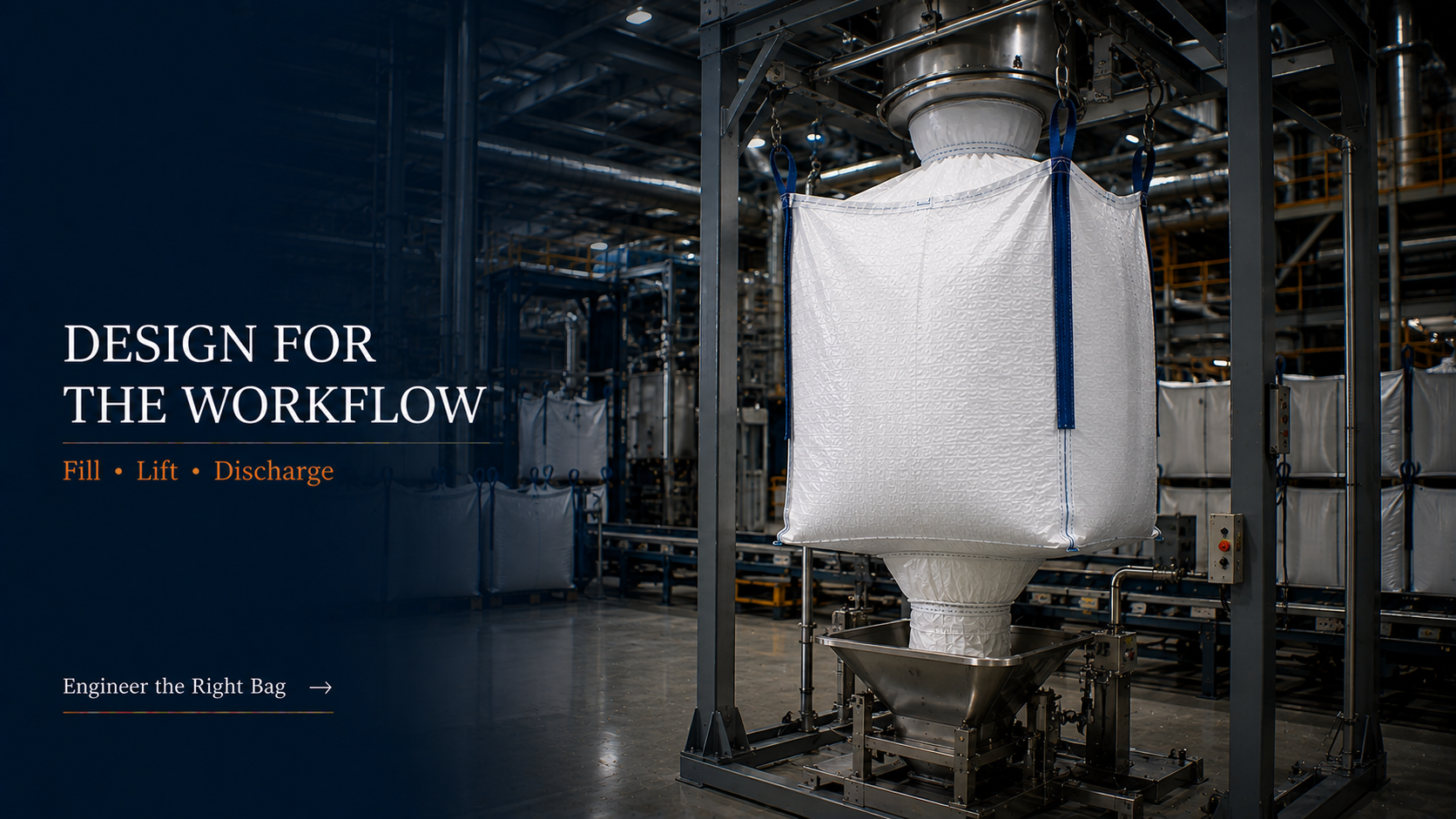
Therefore, the FIBC should connect naturally with the equipment used in the operation.
UWON offers FIBCs with filling spouts and FIBCs with discharge spouts for application-specific handling requirements.
4. Material Protection Is Becoming More Important
Not every bulk material needs the same level of protection.
For example, some products can tolerate normal warehouse conditions, while others require additional protection from:
- Moisture
- Dust
- Contamination
- Product loss
- External exposure
This is where the complete FIBC construction becomes important.
A buyer may need to evaluate the woven fabric, coating, liner and closure system together rather than selecting each feature independently.
For fine powders, IFIBCA notes that sift-proof seams can be useful, while a polyethylene liner can provide additional containment when sift-proofing alone does not provide sufficient control. :contentReference[oaicite:3]{index=3}
Therefore, an FIBC liner should be selected according to the product and operating conditions rather than added automatically to every bag.
5. Custom FIBC Bags Are Moving Beyond Dimensions
Customization used to mean changing the bag size or printing a customer logo.
Today, custom FIBC bags can involve much more.
Buyers may customize:
- Bag dimensions
- Construction
- Fabric specification
- Lifting loops
- Filling spout
- Discharge spout
- Liner
- Coating
- Printing
- Safety factor
- Electrostatic characteristics where applicable
This trend reflects a broader shift toward application-specific bulk packaging. Recent industry reporting also highlights increasing demand for customized FIBC solutions that address material protection, handling and operational requirements. :contentReference[oaicite:4]{index=4}
However, customization should solve a real operational problem.
Adding unnecessary features can increase cost without improving performance.
6. Traceability Is Becoming Part of Bulk Packaging
Another emerging feature in modern bulk packaging is better traceability.
International buyers increasingly want packaging information that connects the supplied bags to a defined specification and production process.
This can include:
- Production batch references
- Material information
- Product specifications
- Inspection records
- Customer order references
- Application instructions
Recent FIBC industry reporting identifies traceability and packaging information management as increasingly important for international procurement, particularly for chemicals, food ingredients, minerals and other high-value materials. :contentReference[oaicite:5]{index=5}
For buyers, this can make supplier communication easier and help identify the affected production range if a quality issue occurs.
7. Automation Compatibility Is Changing FIBC Handling
Modern manufacturing operations increasingly connect packaging with automated filling, weighing, conveying and discharge systems.
That creates a new requirement: the FIBC must work with the equipment around it.
For example, buyers may need to specify:
- Filling-spout dimensions
- Discharge-spout configuration
- Loop arrangement
- Bag dimensions
- Closure method
- Connection requirements
A bag that works well during manual handling may not perform equally well on an automated production line.
Therefore, procurement teams should involve production and engineering teams before finalizing the FIBC specification.
Why FIBC Handling Still Starts With the Lifting System
FIBC lifting loops remain a critical part of the design because they connect the bag to the handling equipment.
Common configurations include:
- Four-loop configurations
- Cross-corner loops
- Side-seam loops
- Single-loop configurations
- Two-loop configurations
The correct configuration depends on the handling equipment and the approved FIBC design.
For example, a warehouse using forklift attachments may require a different lifting arrangement from an operation using crane-based handling.
Therefore, buyers should specify how the bag will be lifted before approving the final design.
FIBC Capacity Is Still Important — But It Is Not Enough
Capacity remains one of the first specifications buyers discuss.
However, “1-ton Jumbo Bag” does not fully define an FIBC.
The same nominal payload can involve different:
- Dimensions
- Fabric specifications
- Construction
- Lifting systems
- Safety factors
- Filling arrangements
- Discharge arrangements
- Liner requirements
Therefore, procurement teams should define the complete FIBC bag specifications before comparing supplier quotations.
For a practical nine-point framework, read How to Choose FIBC Bags: 9 Specifications That Matter.
FIBC Bags Across Major Industries
The flexibility of FIBCs explains why they continue to serve a wide range of industries.
Agriculture and Fertilizers
FIBCs can handle fertilizers, grains, seeds and other agricultural materials where bulk storage and transportation efficiency matter.
Chemicals
Chemical applications can require specialized liners, coatings, electrostatic protection or dangerous-goods certification depending on the product and handling environment.
Construction and Minerals
Cement, minerals, sand and other construction materials can place significant demands on lifting performance, fabric strength and discharge efficiency.
Food and Ingredients
Food applications can require controlled manufacturing environments, suitable materials, liners and food-contact documentation.
Plastics and Polymers
Plastic granules and resins are commonly handled in FIBCs because the format supports efficient bulk movement from manufacturing through storage and distribution.
IFIBCA identifies plastics, food, agriculture, chemicals, pharmaceuticals, construction and other sectors among established FIBC applications. :contentReference[oaicite:6]{index=6}
How Buyers Should Compare Jumbo Bags in 2026
Price remains important, but procurement teams should compare suppliers against the same specification.
A useful comparison can include:
| Specification | What Buyers Should Compare |
|---|---|
| Capacity | Required filling weight and SWL |
| Construction | U-Panel, 4-Panel, Circular or Baffle |
| Dimensions | Filled and empty dimensions |
| Lifting | Loop configuration and handling method |
| Filling | Open top, spout or customized arrangement |
| Discharge | Flat bottom, spout or controlled outlet |
| Liner | Material, fit and application requirement |
| Fabric | GSM, coating and required strength |
| Testing | Applicable tests and supporting documentation |
| Traceability | Batch and specification controls |
This approach helps buyers avoid comparing different bags simply because both suppliers use the term “Jumbo Bag.”
Why the Lowest-Cost FIBC Is Not Always the Lowest-Cost Solution
A low unit price can look attractive during procurement.
However, the total cost can increase if the bag causes:
- Slower filling
- Slower discharge
- Product leakage
- Contamination
- Handling difficulties
- Poor stacking
- Under-utilized container space
- Product damage
For this reason, buyers should evaluate the relationship between FIBC design and operational efficiency.
A slightly more specialized bag can sometimes provide better total value when it reduces problems elsewhere in the supply chain.
What FIBC Manufacturers in India Need to Offer
As international buyers become more specification-driven, FIBC manufacturers in India need to compete on more than production capacity.
Important supplier capabilities can include:
- Consistent manufacturing
- Multiple FIBC constructions
- Customization capability
- Testing and quality control
- Material transparency
- Application understanding
- Export documentation
- Traceability
India remains an important sourcing base for FIBC and woven bulk packaging. Current trade data also shows substantial international activity involving FIBC and Jumbo Bag shipments originating from India. :contentReference[oaicite:7]{index=7}
Therefore, the opportunity for Indian manufacturers is not simply to supply more bags. It is to supply better-specified packaging solutions.
How UWON Approaches FIBC and Jumbo Bag Solutions
UWON offers a range of FIBC constructions and configurations designed around different industrial applications.
The portfolio includes Standard, U-Panel, Circular, 4-Panel and Baffle FIBCs, along with filling and discharge configurations and application-specific options.
This allows buyers to start the conversation with the product and workflow rather than selecting a generic bag first.
For example, a buyer can evaluate whether the application needs a conventional FIBC, shape-retaining Baffle construction, a filling spout, a discharge spout, a liner or another customized configuration.
Explore UWON’s FIBC and Jumbo Bag solutions.
Final Checklist for Choosing FIBC Bags
Before approving a Jumbo Bag supplier, confirm:
- What material will the FIBC contain?
- What is the bulk density?
- What filling weight is required?
- What SWL and safety factor apply?
- Which FIBC construction is appropriate?
- How will the bag be lifted?
- How will it be filled?
- How will it be discharged?
- Does the product require a liner?
- Does the application require coating or lamination?
- Does the application require electrostatic protection?
- Does the product require food-contact suitability?
- Does the application require UN certification?
- What documentation and traceability are required?
If these questions are answered before requesting quotations, buyers can compare suppliers more accurately and reduce specification-related problems later.
Conclusion
FIBC bags in 2026 are becoming more application-specific.
Buyers still need strength, capacity and competitive pricing. However, modern bulk packaging decisions increasingly involve construction, shape retention, material protection, filling, discharge, handling, automation and traceability.
The result is a more mature procurement approach.
Instead of asking for a generic Jumbo Bag, buyers can define the job the packaging needs to perform and then select the construction around that requirement.
The best FIBC is not the bag with the most features. It is the bag with the right features for the application.
Talk to UWON Packaging about your FIBC requirement.
Frequently Asked Questions
What are FIBC bags?
FIBC stands for Flexible Intermediate Bulk Container. FIBCs are flexible bulk-packaging containers commonly used to store and transport dry flowable materials. They are also commonly called Jumbo Bags, Bulk Bags or Big Bags.
What are Jumbo Bags used for?
Jumbo Bags are used across industries including agriculture, chemicals, construction, minerals, food, pharmaceuticals and plastics to handle dry bulk materials efficiently.
What features should I consider when buying FIBC bags?
Important features include capacity, SWL, dimensions, construction, lifting loops, filling configuration, discharge configuration, liner requirements, fabric specification and application-specific compliance.
Are custom FIBC bags better than standard FIBCs?
Not necessarily. Custom FIBC bags can provide advantages when a specific application requires particular dimensions, handling, filling, discharge or material-protection characteristics. Standard FIBCs can remain the most practical option for straightforward applications.
Do FIBC bags need liners?
Not all FIBCs need liners. A liner can provide additional containment or product protection for applications involving fine powders, moisture sensitivity, hygiene requirements or other specific characteristics.
Which FIBC construction is best?
There is no single best construction for every application. U-Panel, 4-Panel, Circular and Baffle FIBCs provide different characteristics, so buyers should select the construction according to the product, handling system, storage and logistics requirements.
Why are FIBC specifications important?
Detailed specifications help buyers ensure that the bag matches the product and operating process. They also allow procurement teams to compare suppliers on the same technical basis instead of comparing different products under the same “Jumbo Bag” label.
How can I choose FIBC manufacturers in India?
Compare manufacturers on product consistency, construction options, customization, testing, quality controls, documentation, traceability, export capability and their understanding of the intended application.