
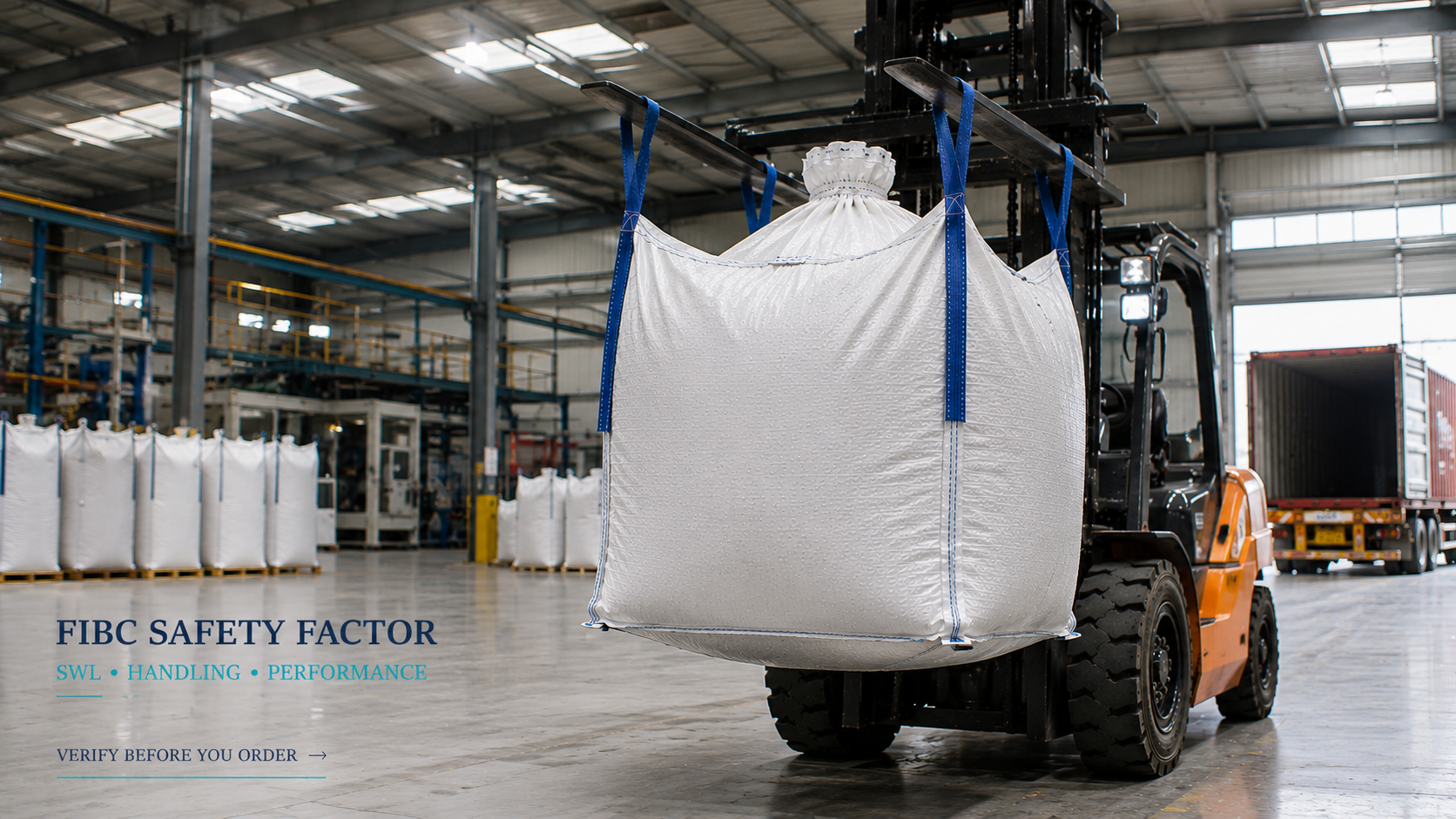
FIBC Safety Factor Explained: A Jumbo Bag Buyer Guide
FIBC Safety Factor Explained: A Jumbo Bag Buyer Guide
FIBC safety factor is one of the most important specifications buyers should understand before ordering Jumbo Bags. A 1,000 kg FIBC is not simply a “1,000 kg bag.” The number on a specification sheet tells only part of the story.
How the bag is lifted, transported, stored and handled can be just as important as how much material it contains. This is where FIBC safety factor becomes an important part of the overall specification.
However, safety factor should not be confused with Safe Working Load, or SWL. It also should not be confused with the electrostatic classification of an FIBC as Type A, B, C or D. These are separate aspects of FIBC selection and should be evaluated according to the application.
ISO 21898:2024 covers materials, construction, design, type testing, marking and safe-use guidance for FIBCs intended for non-dangerous solid materials. :contentReference[oaicite:1]{index=1}
What Is Safety Factor in an FIBC?
The FIBC safety factor represents the relationship between the load or performance level used in the design and the specified Safe Working Load of the bag.
In practical procurement terms, it provides an important part of the basis for assessing whether an FIBC is designed for its intended lifting and handling conditions.
However, buyers should not look at the safety factor in isolation.
The complete specification can also include:
- Safe Working Load (SWL)
- FIBC construction
- Fabric specification
- Seam construction
- Lifting-loop configuration
- Top and bottom construction
- Filling method
- Discharge method
- Handling equipment
- Storage conditions
- Intended number of handling cycles
Therefore, a useful procurement question is not simply “What is the safety factor?” It is “What safety factor and construction are appropriate for the way this FIBC will actually be used?”
Why FIBC Capacity Alone Is Not Enough
A common mistake is to select a Jumbo Bag based only on its target capacity.
For example, a buyer may request a 1,000 kg FIBC and assume that any bag with a 1,000 kg capacity will provide the same performance.
That assumption can create problems.
The bag may experience different conditions during:
- Filling
- Lifting
- Forklift handling
- Crane handling
- Transportation
- Warehouse storage
- Stacking
- Discharge
Consequently, FIBC load capacity should always be considered alongside the construction and intended handling conditions.
A bag that carries the required product weight is not automatically suitable for every lifting or handling method.
SWL vs Capacity vs Safety Factor
These three terms often appear together, but they should not be treated as identical.
FIBC SWL
FIBC SWL, or Safe Working Load, refers to the specified working load for which the FIBC is designed under its defined conditions of use.
FIBC Load Capacity
Load capacity describes how much product the bag is intended to contain. Buyers should specify the required net fill weight based on the actual product and application.
FIBC Safety Factor
The safety factor relates the design or test performance of the FIBC to its specified working load. It forms part of the engineering basis used to assess the bag’s lifting performance.
Therefore:
Capacity tells you what the bag contains.
SWL tells you the specified working load.
Safety factor tells you about the relationship between working load and the relevant design/test performance.
Buyers should ask the supplier to clearly state these values in the FIBC specification rather than assuming that one number represents all three.
How Safety Factor Affects FIBC Selection
The appropriate FIBC bag safety factor depends on the intended application and the applicable specification or standard.
Buyers should therefore begin with the operating conditions.
Ask:
- What material will the FIBC contain?
- What is the required fill weight?
- How will the bag be lifted?
- What lifting equipment will be used?
- Will the FIBC be handled once or repeatedly?
- Will it be stored while filled?
- Will it be stacked?
- Will it experience outdoor exposure?
- What type of discharge system will be used?
Once these conditions are understood, the supplier can recommend the appropriate construction and testing requirements.
This application-first approach is consistent with ISO 21898:2024, which includes guidance on the selection and safe use of FIBCs within its defined scope. :contentReference[oaicite:2]{index=2}
Why Repeated Handling Matters
Not every FIBC follows the same handling cycle.
A single-trip bag may have a different intended use from a reusable FIBC that customers repeatedly lift, move, empty and return.
Repeated handling can introduce additional demands on the bag, particularly around lifting components, seams and other load-bearing areas.
Therefore, buyers should tell the manufacturer whether the FIBC is intended for:
- Single-trip use
- Repeated handling
- Return and reuse
- Temporary storage
- Extended filled storage
Rather than assuming that every FIBC with the same SWL has the same service conditions, buyers should match the specification to the intended handling cycle.
How Lifting, Transport & Storage Conditions Affect the Requirement
FIBC lifting safety depends on more than the weight of the product inside the bag.
The way an FIBC connects to a forklift, crane or other lifting equipment affects how forces reach the lifting loops and bag body.
For example, the manufacturer needs to know whether the bag will be lifted using all specified loops, compatible lifting equipment and the intended handling method.
Storage also matters.
A filled FIBC may experience different forces when it is placed on a pallet, stacked or stored for an extended period. Transportation introduces another set of handling conditions through loading, unloading and movement.
For this reason, buyers should provide the manufacturer with realistic handling and storage information before approving the final FIBC specifications.
Safety Factor and FIBC Construction
The construction of the FIBC influences how loads are distributed through the bag.
Different constructions can be suitable for different applications, dimensions and handling requirements.
U-Panel FIBC
U-Panel FIBC bags use a construction formed around a U-shaped body panel with additional panels forming the complete bag. Buyers should evaluate the construction together with fabric, seams, lifting loops and SWL.
4-Panel FIBC
4-Panel FIBC bags use four individual body panels and can provide a defined rectangular form. As with other constructions, the appropriate specification depends on the intended load and handling conditions.
Circular FIBC
Circular constructions use a tubular body configuration and can provide a different combination of shape, fabric utilisation and manufacturing characteristics.
The construction alone does not determine the safety factor. The complete engineered specification matters.
Baffle FIBC
Baffle FIBC bags incorporate internal baffles to help control outward bulging and maintain a more cubic filled shape.
This can be useful where storage or container utilisation matters. However, shape retention should not be confused with lifting safety factor. Both should be evaluated separately within the complete specification.
Safety Factor and FIBC Types: A, B, C and D
Type A, Type B, Type C and Type D FIBCs are part of the electrostatic classification framework for FIBCs used in potentially hazardous explosive atmospheres.
These types should not be confused with the mechanical safety factor of an FIBC.
IEC 61340-4-4:2018 specifies requirements for electrostatic classification, testing, design, performance and safe use of FIBCs and liners in defined hazardous explosive-atmosphere applications. :contentReference[oaicite:3]{index=3}
Type A FIBC
Type A FIBCs do not provide a specified electrostatic dissipation or grounding function. Their selection depends on the material and surrounding environment.
Type B FIBC
Type B FIBCs provide specific electrostatic properties compared with Type A and are intended for defined applications involving electrostatic hazards.
Type C FIBC
Type C FIBCs use conductive elements that are designed to be connected to ground during use. Proper grounding is an essential part of their safe application.
Type D FIBC
Type D FIBCs use dissipative or other electrostatic-control construction designed for specified hazardous applications without relying on the same grounding connection used by Type C.
These classifications address electrostatic risk, not mechanical safety factor.
That distinction is important because a buyer could specify the correct mechanical load requirements and still select an unsuitable electrostatic classification for a hazardous application.
IEC 61340-4-4:2018 also states that compliance with its requirements does not eliminate the need for a full risk assessment in hazardous environments. :contentReference[oaicite:4]{index=4}
Why Type Classification and Safety Factor Must Stay Separate
The terms can appear together in technical discussions, but they answer different questions.
| Specification | What It Addresses |
|---|---|
| Safety Factor | Relationship between specified working load and relevant design/test performance |
| SWL | Specified safe working load of the FIBC |
| FIBC Construction | Physical design and load distribution |
| Type A/B/C/D | Electrostatic classification for applicable hazardous environments |
Therefore, buyers should never select a Type C or Type D FIBC simply because they believe it provides a higher mechanical safety factor. The two specifications address different risks.
What Buyers Should Ask Their FIBC Manufacturer
Before approving an FIBC supplier, procurement teams should ask specific questions about the complete specification.
- What is the specified SWL?
- What safety factor applies to the FIBC?
- What handling method is the bag designed for?
- Is the FIBC intended for single-trip or repeated handling?
- Which lifting-loop configuration is specified?
- What are the applicable testing requirements?
- What FIBC construction is being supplied?
- What storage and stacking conditions were considered?
- Does the application involve electrostatic hazards?
- If so, which Type A, B, C or D classification is appropriate?
- What grounding requirements apply?
- Does the tested configuration match the production specification?
- How is consistency maintained across repeat orders?
These questions help buyers evaluate the complete packaging system rather than relying on a single number printed on a quotation.
What FIBC Manufacturers in India Should Provide
When evaluating FIBC manufacturers in India, buyers should look for clear technical documentation.
The supplier should be able to communicate the agreed specification, including where applicable:
- FIBC construction
- Dimensions
- SWL
- Safety factor
- Fabric specification
- Lifting-loop configuration
- Top and bottom construction
- Liner requirements
- Applicable testing
- Electrostatic classification where relevant
The goal is not to request every possible test or certification. Instead, the buyer and supplier should identify the requirements that actually apply to the intended use.
UWON develops FIBC solutions across multiple industrial applications and configurations. Explore UWON’s FIBC industry applications to understand how packaging requirements vary across different sectors.
FIBC Safety Factor Checklist Before Placing an Order
Use this checklist before approving your next Jumbo Bag specification:
- Define the required fill weight.
- Confirm the product’s bulk density.
- Specify the required SWL.
- Confirm the applicable safety factor.
- Identify the lifting method.
- Check lifting-loop configuration.
- Confirm whether the FIBC is single-trip or reusable.
- Review filling and discharge conditions.
- Review storage and stacking conditions.
- Review transport and handling conditions.
- Confirm the FIBC construction.
- Identify applicable testing requirements.
- Assess electrostatic risk where relevant.
- Specify Type A, B, C or D only when applicable to the electrostatic requirement.
- Confirm that the tested configuration matches the ordered specification.
Common Buyer Mistakes
Choosing the Bag Only by Its Capacity
A 1,000 kg target fill does not tell you whether the bag is appropriate for the intended handling process.
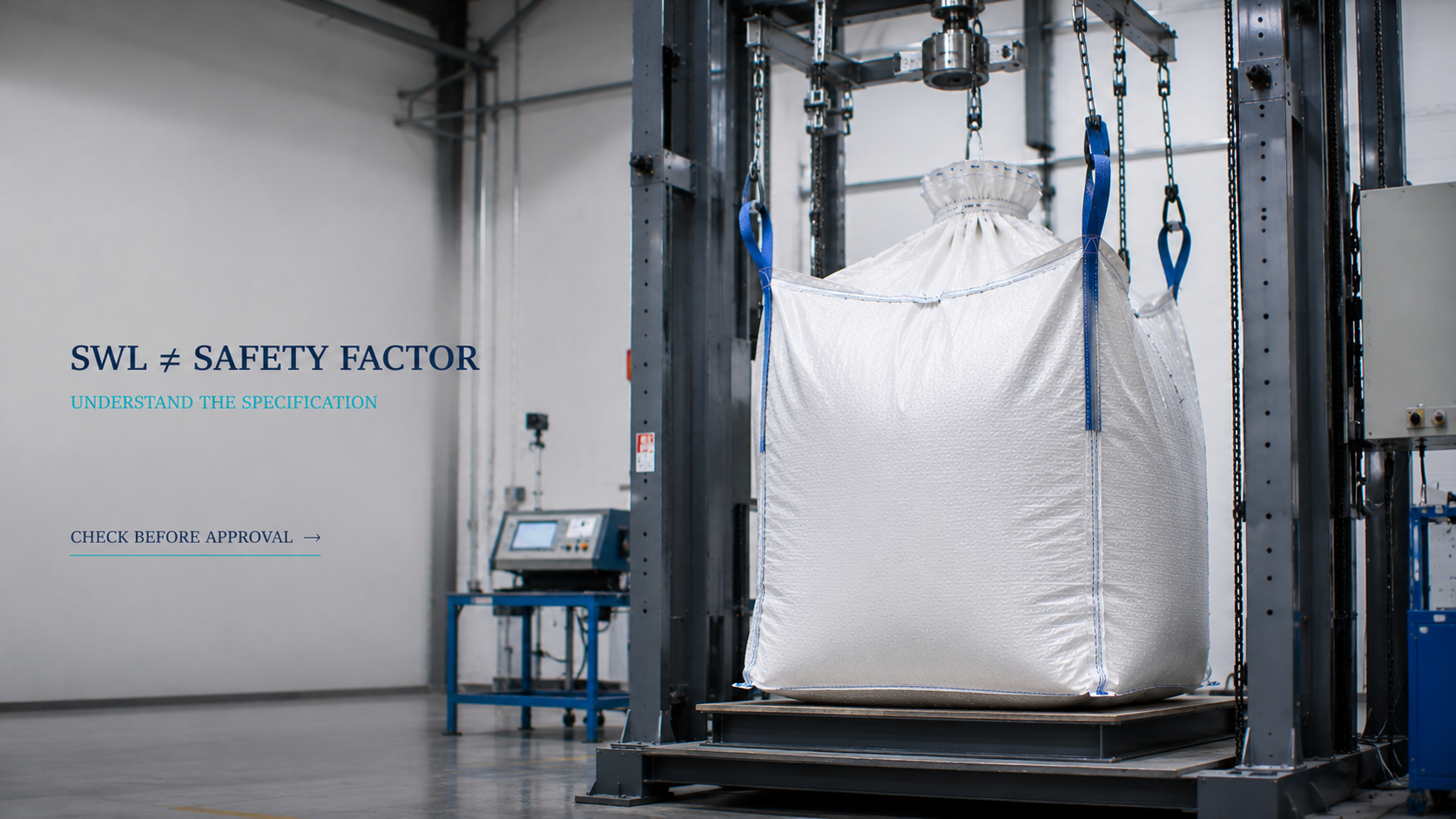
Confusing SWL With Safety Factor
SWL and safety factor describe different aspects of the specification. Buyers should request both where relevant.
Assuming a Higher Safety Factor Solves Every Risk
Mechanical load performance does not address every potential packaging risk. Electrostatic hazards, product compatibility and handling conditions require separate consideration.
Confusing Type C With a Higher Mechanical Safety Factor
Type C relates to electrostatic control and grounding requirements. It is not a mechanical safety-factor category.
Ignoring the Handling Equipment
The FIBC should be compatible with the actual forklift, crane or lifting system used by the customer.
Changing the Bag Specification Without Revalidation
A change in dimensions, construction, fabric, loops or other components can affect the final specification. Buyers should review significant changes rather than assuming the original testing automatically covers the modified design.
How to Choose the Right FIBC Safety Factor
There is no single safety-factor value that should be blindly applied to every FIBC application.
The correct approach is to establish the intended use and applicable specification first.
Start with:
Product → Fill Weight → SWL → Handling → Storage → Transport → Construction → Applicable Testing
Then discuss the required safety factor with the manufacturer.
This approach creates a more reliable specification than simply requesting a higher number without understanding the application.
Why the Complete FIBC Specification Matters
The strongest FIBC procurement decisions consider the complete system.
A bag’s mechanical performance depends on more than one specification. Fabric, seams, lifting loops, construction, dimensions and intended handling conditions all contribute to the final design.
Similarly, electrostatic requirements depend on the material, environment and risk assessment rather than simply the bag’s SWL.
For this reason, buyers should treat FIBC safety factor as one important part of a broader technical specification.
For general-purpose applications, UWON also offers Standard FIBC Bags, while specialised applications can use different constructions and configurations depending on the required performance.
Frequently Asked Questions
What is FIBC safety factor?
FIBC safety factor describes the relationship between the specified working load and the relevant design or test performance of the FIBC. It forms part of the mechanical specification used to evaluate lifting and handling performance.
What is FIBC SWL?
FIBC SWL means Safe Working Load. It identifies the specified working load for which the FIBC is designed under its defined conditions of use.
Is safety factor the same as FIBC capacity?
No. Capacity describes the amount of product the FIBC is intended to contain, while safety factor relates to the mechanical design or testing performance associated with the specified working load.
Does a higher safety factor always mean a safer FIBC?
Not necessarily. The appropriate specification depends on the application, construction, handling conditions and applicable requirements. A higher mechanical safety factor does not address unrelated risks such as electrostatic hazards or incompatible handling equipment.
Are Type A, B, C and D FIBCs related to safety factor?
No. Type A, B, C and D classifications relate primarily to electrostatic properties and safe use in applicable hazardous environments. They should not be interpreted as mechanical safety-factor ratings. IEC 61340-4-4:2018 defines the electrostatic classification framework. :contentReference[oaicite:5]{index=5}
When should buyers consider Type C or Type D FIBCs?
Type selection depends on the electrostatic hazards associated with the product, environment and handling process. A suitable risk assessment should determine the appropriate classification and safe-use requirements.
Does FIBC construction affect safety factor?
Construction forms part of the overall mechanical design. U-Panel, 4-Panel, Circular and Baffle FIBCs can have different physical configurations, but the safety factor must be evaluated for the actual FIBC specification rather than inferred from the construction name alone.
What should I ask FIBC manufacturers in India?
Ask about SWL, safety factor, construction, lifting configuration, testing, handling conditions, storage requirements and any electrostatic requirements relevant to your application.
Conclusion
FIBC safety factor is not just a number on a technical datasheet. It forms part of a larger engineering decision involving SWL, construction, lifting, handling, storage, transportation and applicable testing.
At the same time, buyers must keep mechanical safety separate from electrostatic classification. Type A, B, C and D FIBCs address different electrostatic considerations and should be selected according to the relevant risk assessment and standard requirements. :contentReference[oaicite:6]{index=6}
The better procurement approach is therefore:
Define the application → specify the SWL → select the construction → determine the applicable safety factor → review handling conditions → verify testing → approve the complete specification.
For buyers working with FIBC manufacturers in India, this approach creates a clearer technical conversation and helps ensure that the Jumbo Bag specification matches the way the packaging will actually be used.