
FIBC Type Testing Under ISO 21898:2024: Cyclic Top-Lift, Compression and Buyer Evidence
FIBC Type Testing Under ISO 21898:2024: Cyclic Top-Lift, Compression and Buyer Evidence
When industrial buyers approve a jumbo bag, a visually convincing sample and a headline safe working load are not enough. A sound decision connects the intended contents, bag construction, type-test evidence, marking and actual handling conditions. This guide explains how procurement, quality and plant teams can review those elements without confusing a supplier claim with independent technical proof. It focuses on non-dangerous-goods FIBCs and uses the published scope of ISO 21898:2024, supplemented by documented lifting-safety guidance.
Why type testing matters before an FIBC purchase
A flexible intermediate bulk container is part of a handling system, not merely a woven sack. A bag can appear strong during visual inspection yet behave differently when repeatedly lifted, filled to a different height, or compressed under warehouse loads. Procurement teams therefore need evidence connecting a tested design to the actual bag they will receive. Type testing helps establish that relationship, while incoming inspection checks whether delivered units match the approved specification. Neither activity replaces operator training, safe equipment selection or a site-specific lifting assessment.
The practical question is not simply “Has this jumbo bag been tested?” It is “Which construction was tested, under what conditions, against which requirements, and does our intended application remain inside that scope?” Buyers should retain the specification, test references, approved sample and change-control history together. When the use involves dangerous goods, do not assume a non-dangerous-goods type test satisfies applicable dangerous-goods transport rules.
What ISO 21898:2024 actually covers
The current published ISO 21898:2024 standard addresses flexible intermediate bulk containers for non-dangerous solid materials in powder, granular or paste form, lifted from above using integral or detachable lifting devices. Its public scope includes material, construction, design, type-test and marking requirements, along with selection and safe-use guidance. The 2024 edition supersedes the older 2004 edition; purchasing documents should identify the edition rather than merely writing “ISO compliant.”
A buyer should distinguish a standard’s published scope from a supplier’s claim of conformity. Request the relevant declaration and supporting test evidence for the offered FIBC type. The ISO catalogue describes the standard but does not establish that any individual bag or supplier has passed it. The full copyrighted standard, applicable contract and competent technical assessment govern detailed acceptance criteria.
Map the tested design to your real application
Start with the product: bulk density, particle size, flow characteristics, moisture sensitivity, abrasion potential and any electrostatic or hygiene concerns. Then record target net fill mass, nominal dimensions, filled height, filling and discharge equipment, lifting method, storage duration and expected stacking arrangement. These details determine whether a previously tested design is truly comparable to your order. A nominally identical safe working load does not prove that different loop geometry, seam construction or bag dimensions are interchangeable.
Consider a hypothetical mineral processor filling 950 kilograms into a bag originally qualified for a different fill geometry. Even when 950 kilograms is below the marked safe working load, the altered filled height and material behavior may change load distribution and stability. Treat that as a technical review, not an automatic approval. Share operating conditions with the supplier before selecting the construction.
Understand safe working load and safety factor
Safe working load, commonly abbreviated SWL, identifies the maximum load for which a bag is designed under its specified conditions of use. The safety factor is a separate classification or test-related characteristic; it is not permission to routinely load the bag above its SWL. Buyers should read both fields on the bag marking and reconcile them with the purchase specification and type-test record. An unmarked or illegible bag should be quarantined until its identity and suitability are established.
Do not convert a nominal 5:1 or 6:1 factor into an operating multiplier. A 1,000-kilogram SWL bag is not thereby authorized to carry 5,000 or 6,000 kilograms. Dynamic movements, damaged loops, unsuitable hooks and poor handling can create failure mechanisms outside simplistic arithmetic. Require a written lifting procedure and check that operators understand the difference between rated load, test evidence and operational controls.
Cyclic top-lift testing: the buyer’s interpretation
Cyclic top-lift testing evaluates the loaded FIBC’s behavior under repeated lifting-related loading in the defined test configuration. It is especially relevant to the relationship between the body fabric, loop attachments, seam construction and load path. The standard’s exact procedure and acceptance conditions must be read from the licensed text or competent laboratory documentation; a short marketing summary is not a substitute for the actual report. Ask whether the tested sample represented the shortest and greatest relevant vertical dimensions of the type.
Review the test identification, laboratory, date, bag construction, fill material and recorded outcome. Look for evidence that lifting devices remained functional and that the body did not suffer damage making the bag unsafe. If the buyer’s handling equipment uses a different contact geometry, that difference should be considered during engineering review. A pass on one configuration is not an unrestricted endorsement of every forklift, crane or spreader arrangement.
Compression and stacking tests are different
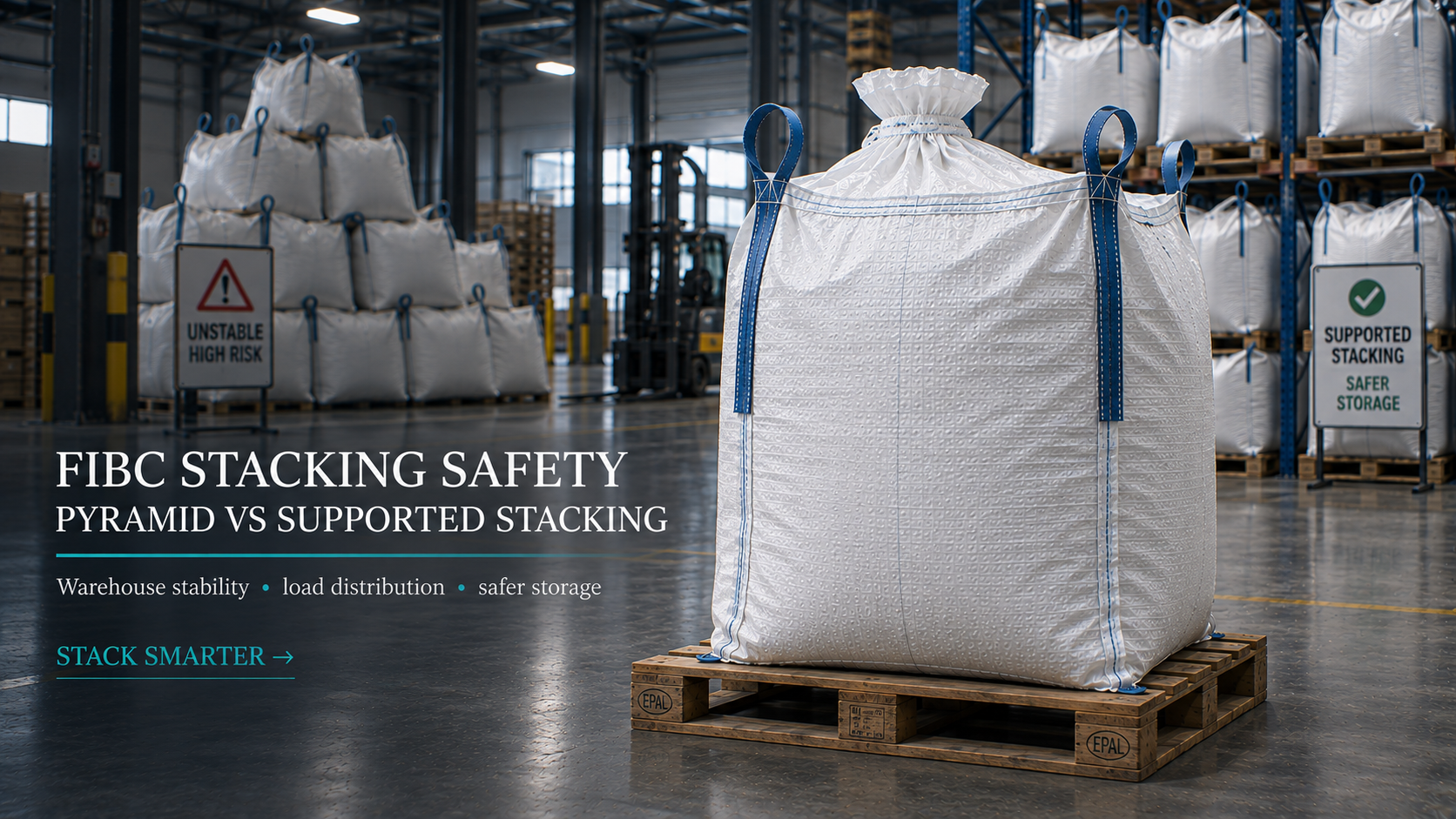
Compression or stacking tests address a distinct loading situation from suspended lifting. A bag that performs satisfactorily while lifted may still present stability, leakage or deformation problems when filled bags are stacked. ISO 21898:2024 identifies compression/stacking testing among its type-test requirements. Buyers should request evidence appropriate to the intended bag dimensions and filled configuration, then separately establish safe warehouse practices for the actual site.
The maximum permitted stacking information on the label must be considered alongside floor condition, pallet compatibility, fill shape, warehouse traffic and environmental exposure. A laboratory result does not guarantee a stable stack on a sloping floor or with inconsistent fill heights. Where stacking is planned, obtain an approved stacking arrangement and prohibit improvisation beyond the marked and documented limits.
Check test specimens and dimensional extremes
A common procurement error is accepting a report for a related bag family without checking which sizes were tested. Different heights can alter the geometry of a suspended load and the way the filled bag behaves in compression. The published ISO 21898:2024 text describes test specimens representing dimensional extremes for the relevant type. Ask the supplier to identify the exact model or type reference covered by the report and the range of dimensions it represents.
Create a comparison sheet with columns for tested length, width, height, lifting-loop arrangement, body fabric, coating, liner and rated load. Add the ordered configuration in a separate column. Every difference should have a disposition: already covered by the approved family, supported by additional evidence, or requiring further qualification. This simple exercise prevents an unrelated test certificate from being attached to a purchase order merely because the product category is similar.
Lifting loops and seam load paths
Lifting loops transfer force from the handling equipment into the bag structure. The strength of the webbing alone is not sufficient evidence of whole-bag performance: attachment geometry, stitch pattern, thread, fabric reinforcement and manufacturing consistency also matter. Request clear drawings or approved photographs showing loop quantity, placement and the intended lifting method. Check whether the loops are designed for four-point, two-point or another specified arrangement rather than assuming all patterns are equivalent.
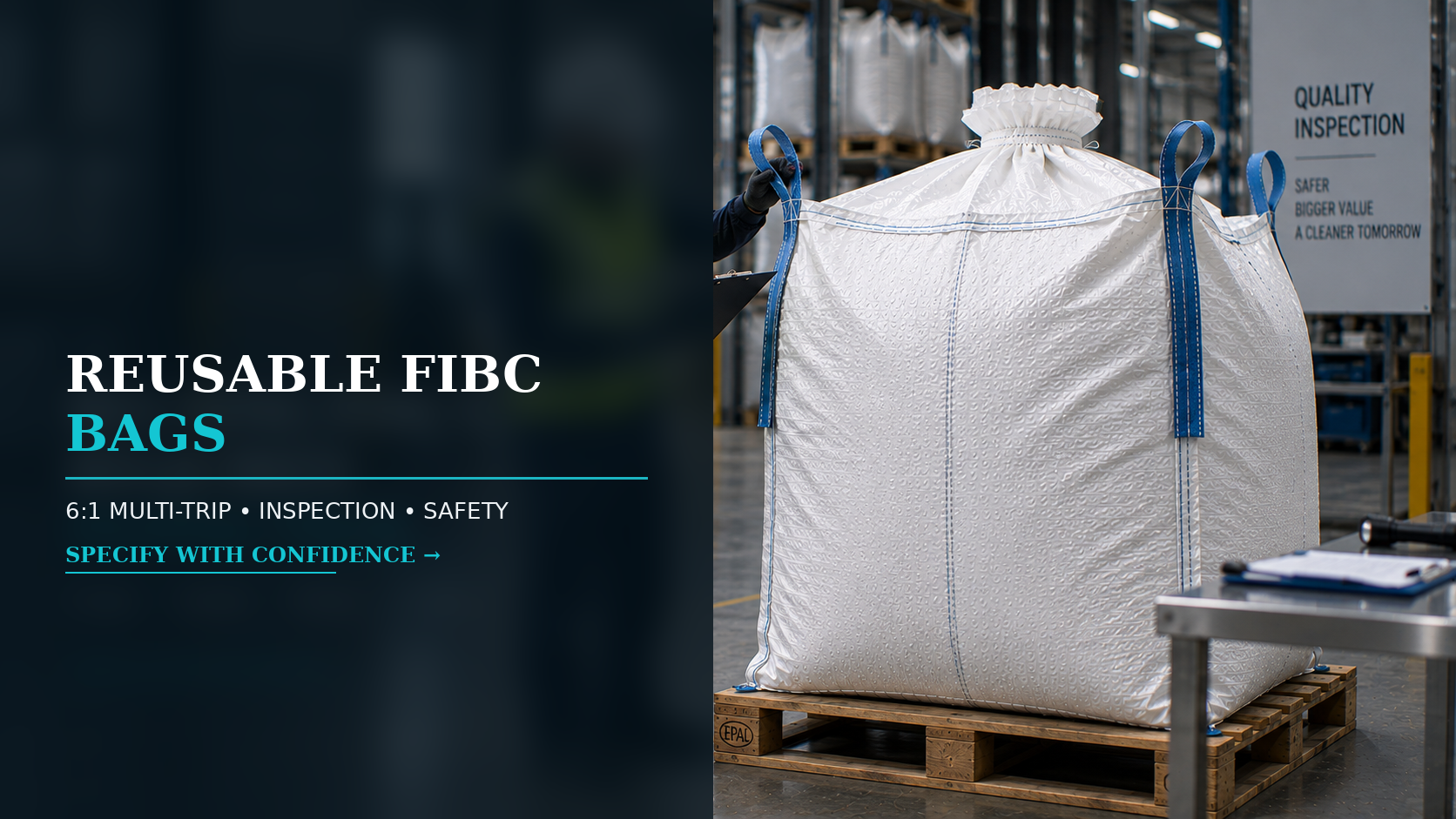
During incoming inspection, look for cut webbing, fraying, missed stitches, uneven loop lengths and visible distortion at attachments. Record defects by lot and identify the relevant acceptance procedure. Never repair a critical load-bearing seam informally or return a suspect bag to service on the basis of a quick visual reassurance. A technically responsible supplier should review structural deviations against the approved design.
Fabric, coating and liner considerations
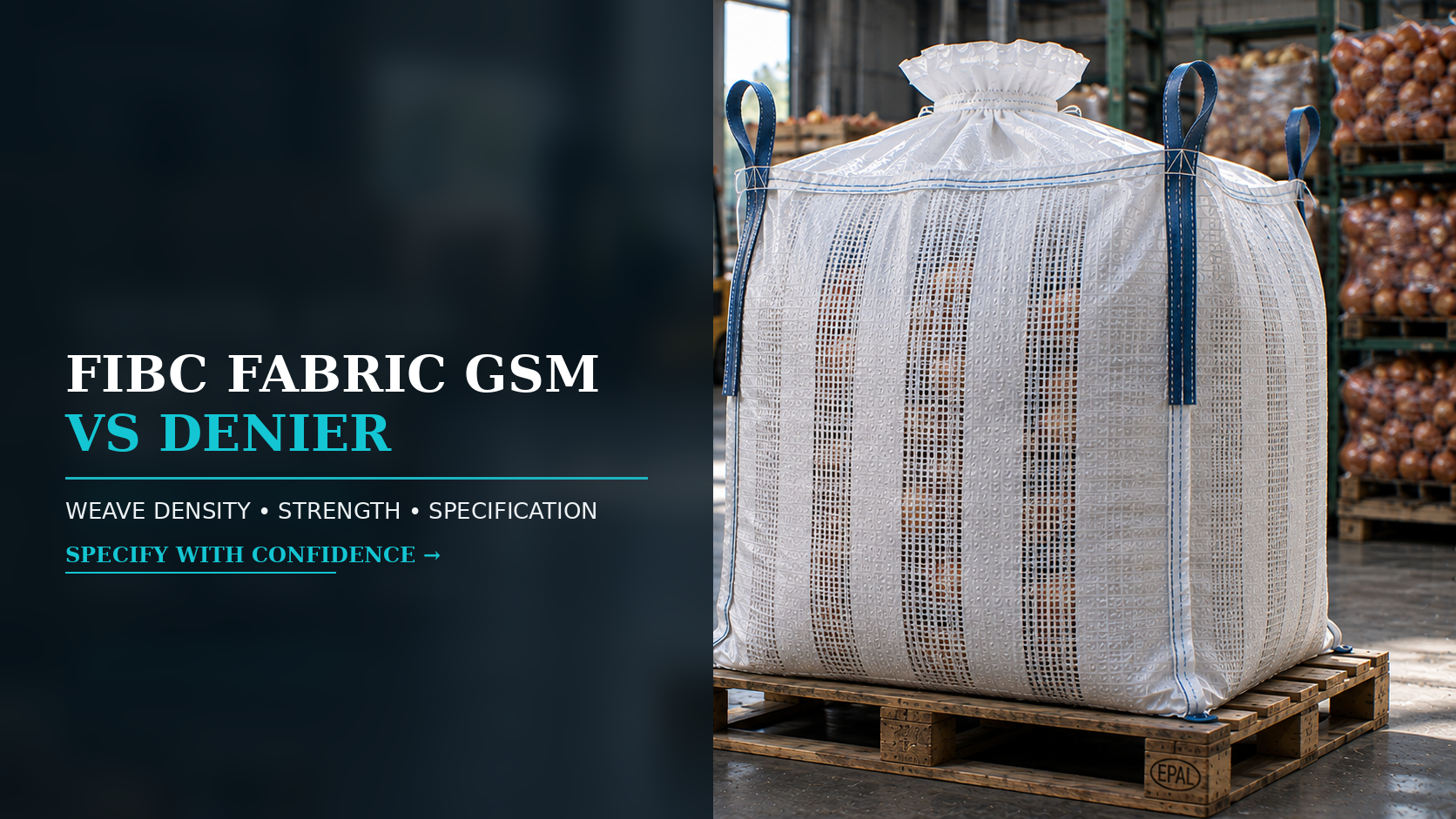
Woven polypropylene construction involves more than nominal fabric weight. Yarn characteristics, weave, coating, seam configuration and exposure history can affect performance. Liners may protect product from moisture or contamination, but their attachment and fit must be compatible with filling, lifting and discharge. A type-test record should be interpreted with the tested construction in mind; a liner or coating change may require review if it alters how the bag behaves.
For powders, ask whether stitch-hole leakage and liner movement have been evaluated under the intended filling and discharge conditions. For sharp or abrasive solids, consider whether the material creates a non-standard use requiring dedicated evaluation. Do not infer suitability for food contact, hazardous atmospheres or dangerous goods from a general FIBC performance test. Those applications can have separate technical and regulatory obligations.
Filling material and test representativeness
Test outcomes depend partly on what fills the bag. Material bulk density, particle size, angle of repose and flow behavior influence how loads distribute during lifting and stacking. The ISO framework addresses test filling conditions and recognizes cases where actual contents are used. Buyers should check whether the report used a standardized surrogate or the intended commercial product, and what limitation follows from that choice.
For example, a free-flowing polymer pellet and a cohesive mineral powder can produce different fill shapes even at the same net mass. The lesson is not that one automatically fails; it is that equivalence needs justification. Capture product data on the RFQ and consider a controlled production-line trial to assess filling stability, discharge, dust leakage and interface compatibility in addition to formal type-test evidence.
Read the label and traceability fields
A durable, readable marking system allows warehouse and procurement personnel to connect the physical bag to its approved identity. ISO 21898:2024 addresses marking information including manufacturer identification, type reference, SWL, safety factor, test identification, test date, bag class and handling recommendations. Buyers should obtain the relevant label artwork and check its consistency with the purchase specification. A certificate without a traceable physical product is weak operational evidence.
Ask for a sample label photograph from the actual production design and define the information that must remain legible after filling. Include manufacturing date and any special treatments where relevant. For received shipments, retain purchase order, supplier lot, label photographs and nonconformance records. This does not imply that every bag carries a unique serial number; the required traceability level should be agreed and verified.
Build an evidence pack procurement can audit
A practical evidence pack includes the approved drawing, specification revision, test report reference, applicable conformity statement, marking artwork, material specifications, inspection plan and change-control approvals. It should also identify the responsible supplier contact and the intended contents. Store records by FIBC type and revision so a new procurement officer can determine which evidence applies without relying on informal email memory.
The pack should answer six questions: What exactly was tested? Which standard and edition were used? Who performed the testing? When was it done? What design was approved? What changed after approval? If any answer is missing, mark it as an open item. Do not fill gaps with assumed certificates, laboratory names or fabricated pass figures. This discipline makes technical supplier discussions faster and more defensible.
Apply change control after type approval
Once a bag type is approved, apparently minor commercial substitutions can alter its technical identity. Examples include a different loop webbing, stitch thread, body fabric construction, seam location, bag height or liner attachment. The supplier should notify the buyer of relevant changes before shipment, with a documented assessment of whether the existing evidence remains applicable. Price or lead-time pressure should not silently override the approved configuration.
A useful change request records the old and proposed specification, reason, affected lots, risk evaluation, required tests or trials and named approvers. Keep first-article samples where appropriate. When a revised design is introduced, update the RFQ, artwork, inspection instructions and receiving checklist together. Otherwise the factory may manufacture to one revision while the buyer inspects against another.
Verify safe lifting and handling at the site
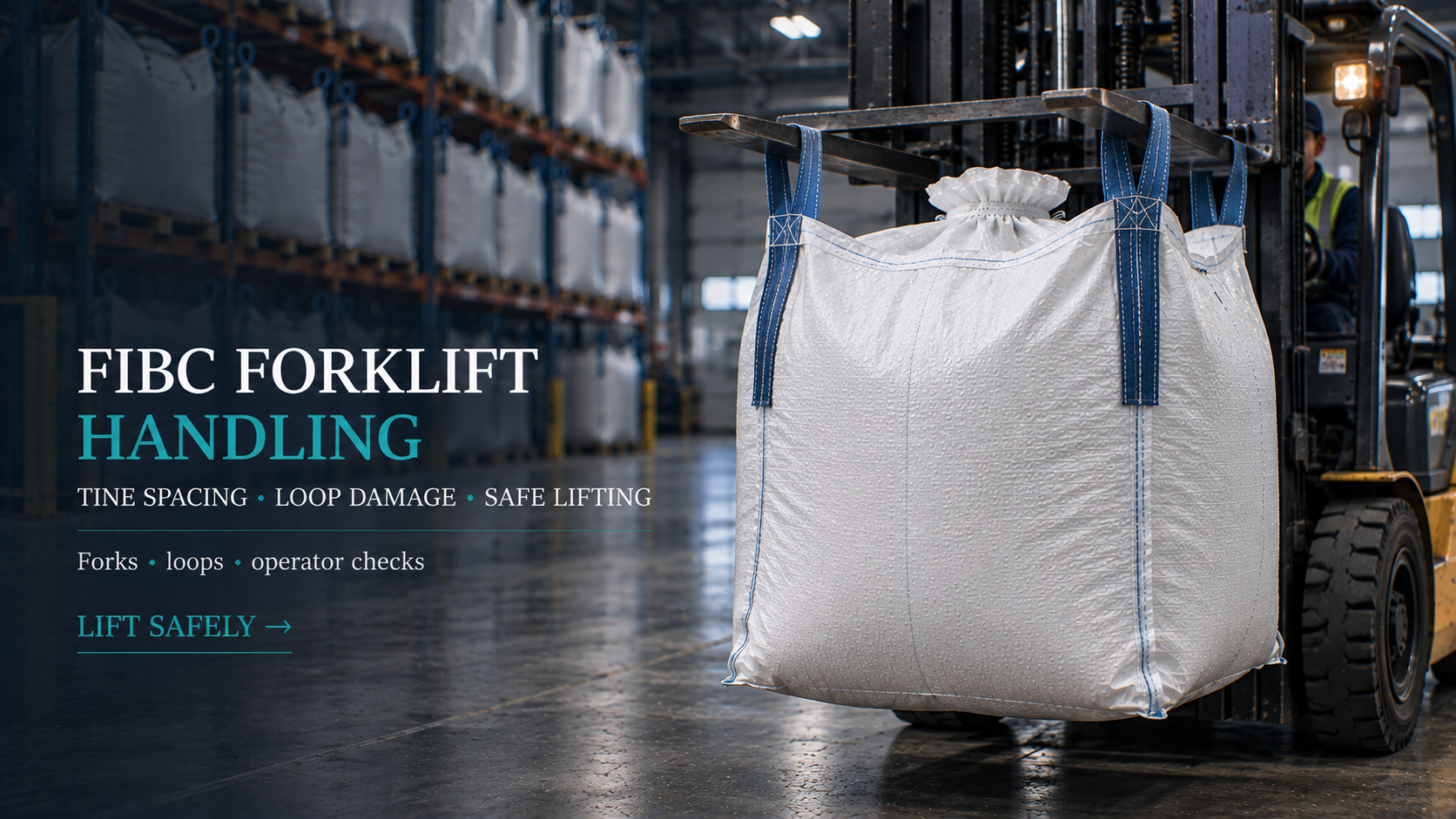
Even a correctly qualified FIBC can be damaged by sharp fork edges, sudden acceleration, uncontrolled swinging or inappropriate loop engagement. The International Marine Contractors Association documented a serious FIBC lifting failure involving torn lifting attachments and emphasized pre-use inspection, following manufacturer instructions, suitable lifting contact surfaces and keeping people clear of suspended loads. The incident illustrates the need to combine product evidence with operational controls.
Write a site procedure covering inspection before each lift, rated equipment, suitable lifting attachments, operator competence, travel path, exclusion zones and safe landing. Never stand or work beneath a suspended bag. Damaged, chemically affected or visibly degraded bags should be isolated for assessment. Do not use a generic age limit as a universal substitute for manufacturer instructions and site-specific evaluation; different environments and duty classifications require appropriate judgement.
Practical buyer acceptance checklist
Before placing an order, confirm product identity, intended fill mass, SWL, safety factor, dimensions, bag class, lifting arrangement, discharge and filling features, storage conditions and applicable standard edition. Request the type-test evidence, marking details and any application-specific assessments. Ask who approves deviations and how traceability is maintained. For first supply, consider a documented sample approval and controlled filling or handling trial using the actual process.
At goods receipt, check quantity, visible damage, labels, construction against the approved sample and the agreed defect acceptance plan. Segregate suspect lots rather than mixing them into production. If a report or certificate references a different design, seek written clarification before release. This checklist is a purchasing control, not a substitute for a qualified safety engineer’s assessment where loads, hazardous materials or complex lifting operations demand it.
FAQ: common questions from FIBC buyers
Does ISO 21898:2024 apply to dangerous goods?
No. Its published scope addresses FIBCs for non-dangerous goods. Dangerous-goods transport requires assessment under the applicable transport rules and approved packaging requirements.
Does a 6:1 safety factor permit six times the SWL in normal use?
No. The marked SWL remains the operating load limit under the specified conditions; the factor is not an authorization to overload the bag.
Can one report cover every bag size from a supplier?
Not automatically. The buyer must check the tested type, dimensional coverage, construction and applicable standard requirements.
Is a visual inspection enough to prove type conformity?
No. Visual checks can detect damage and specification differences but cannot replace the required design and performance evidence.
What should buyers do when a supplier changes lifting loops?
Request a documented change assessment and determine whether additional qualification or testing is needed before approving the revised construction.
Next step: Define your application and compare the available evidence before selecting a bulk bag. UWON’s FIBC RFQ Intelligence tool can help structure the initial technical request. For related buying decisions, read the FIBC AQL incoming inspection guide and supplier change-control checklist.
Primary references: ISO 21898:2024 catalogue and scope; IMCA FIBC lifting safety flash. This article is general technical procurement guidance, not a certificate of conformity or a replacement for the full standard, applicable law or site-specific safety assessment.