
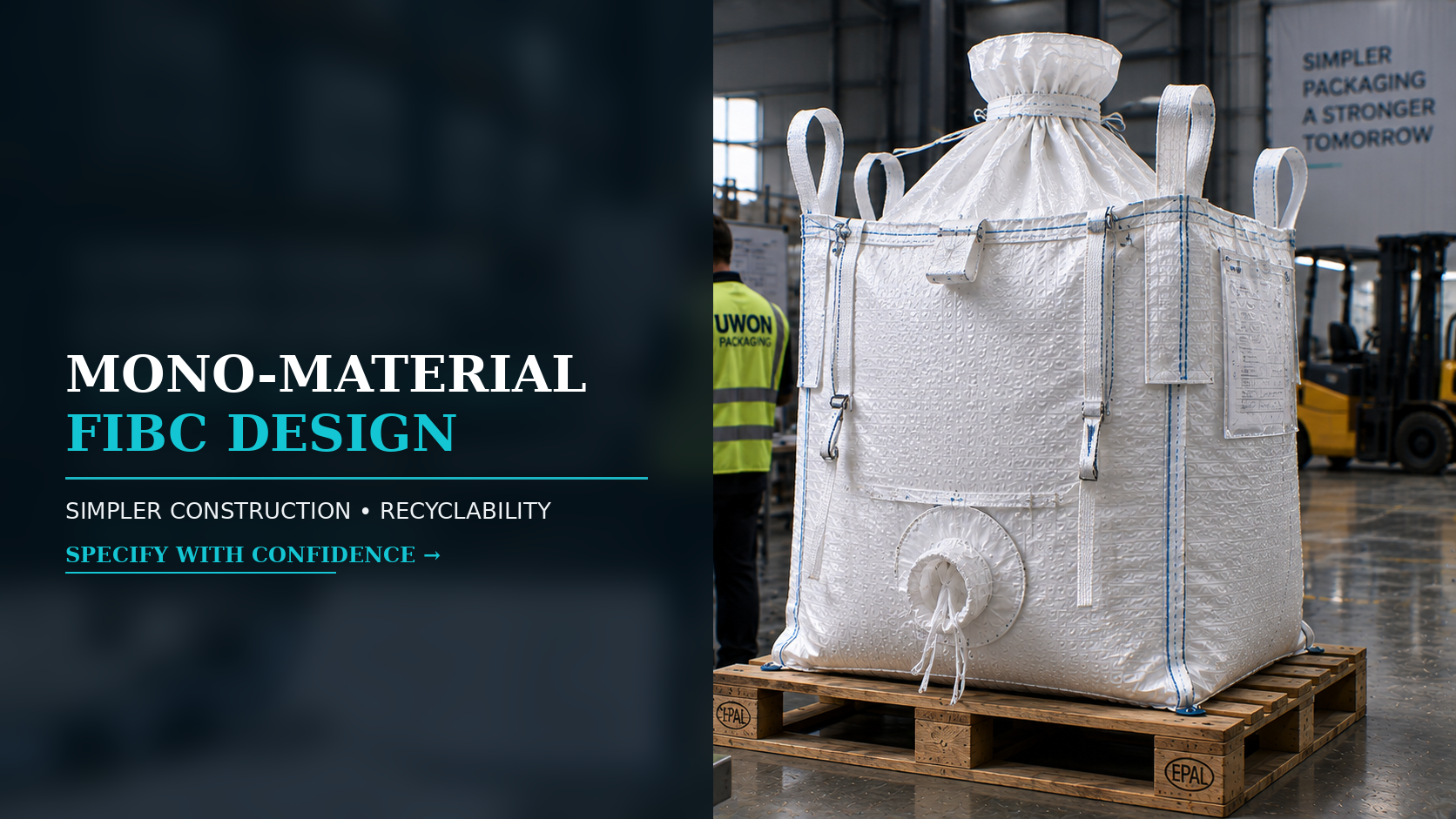
Mono-Material FIBC Design: How Buyers Can Improve Recyclability
Mono-material FIBC design is becoming more relevant as industrial buyers look for packaging that is easier to sort, recover and recycle. The basic FIBC body is usually woven polypropylene, but a complete bag can include liners, coatings, labels, document pockets, sewing threads and accessories made from different materials.
For buyers, the goal should not be to remove every feature. The goal is to identify which features are technically necessary and whether the same function can be achieved with a simpler, more compatible material system.
What Is a Mono-Material FIBC?
A mono-material approach tries to keep the main packaging components within one polymer family where practical. For a woven polypropylene FIBC, that often means maximizing polypropylene-compatible components and avoiding unnecessary incompatible additions.
Why Recyclability Starts at the Drawing Stage
End-of-life recovery is much easier to discuss when the supplier can clearly identify every component. This is also aligned with the broader direction of the EU Packaging and Packaging Waste Regulation. See our PPWR FAQ update for FIBC buyers for current context.
1. Review the Body Fabric and Coating
Woven PP and PP-compatible coating can support a relatively simple material structure. Buyers should still ask how coating changes product protection and whether it is actually required. Our coated vs uncoated FIBC guide helps with that decision.
2. Question Every Liner Requirement
Liners are essential for many products, so removing one simply to improve recyclability can create a worse packaging system. Instead, define the barrier requirement precisely and choose the simplest liner that safely performs the job.
3. Simplify Labels and Document Pockets
Industrial bags often accumulate extra labels, sleeves and document pockets over years of specification changes. Buyers should review whether each component is still needed and whether material compatibility can be improved without reducing traceability.
4. Avoid Unnecessary Decorative Components
Branding should not make the package materially more complex than necessary. Printing directly on the bag may sometimes reduce the need for separate tags, depending on the information and durability required.
5. Design for Separation Where Mixed Materials Are Necessary
If a different material is essential, consider whether it can be easily removed after use. A packaging component that is clearly identified and separable may be easier to manage than a permanently bonded mixed-material structure.
6. Keep Material Documentation With the Specification
Buyers should maintain a component list covering body fabric, loops, coating, liner, thread, label and closure materials. This supports recyclability assessment and future customer requests.
7. Do Not Trade Away Safety
Mono-material design is not a reason to weaken lifting loops, remove required barriers or reduce the tested safety performance. ISO 21898:2024 remains a key reference for FIBC design and testing for non-dangerous goods.
Buyer Checklist for a Simpler FIBC
- List every material in the current bag.
- Identify which components are required for safety or product protection.
- Remove obsolete or duplicated accessories.
- Ask whether labels and pockets can be simplified.
- Define liner barrier needs precisely.
- Confirm material compatibility with the intended recycling route.
- Keep supplier declarations and traceability records.
- Validate the final design for its intended performance.
What This Means for FIBC Manufacturers in India
FIBC manufacturers in India serving sustainability-focused buyers can add value by providing a clear bill of materials and offering design alternatives that reduce unnecessary material complexity. Technical transparency is becoming part of packaging performance.
Frequently Asked Questions
Are all FIBCs mono-material?
No. The main body may be polypropylene, but liners, labels and accessories can introduce other materials.
Does mono-material mean no liner?
No. A liner may be essential for product safety or barrier performance. The correct design balances function and end-of-life goals.
Are polypropylene FIBCs recyclable?
Polypropylene is recyclable where suitable collection, sorting and recycling infrastructure exists, but the complete package design and contamination level affect practical recovery.
Can printing reduce recyclability?
Printing is one component of the overall material system. Buyers should discuss inks and recycling compatibility with the supplier and recycler where relevant.
Final Takeaway
Mono-material FIBC design is best approached as disciplined simplification. Keep what the application truly needs, remove legacy complexity and document every component. That creates a better foundation for both recyclability and procurement clarity.