
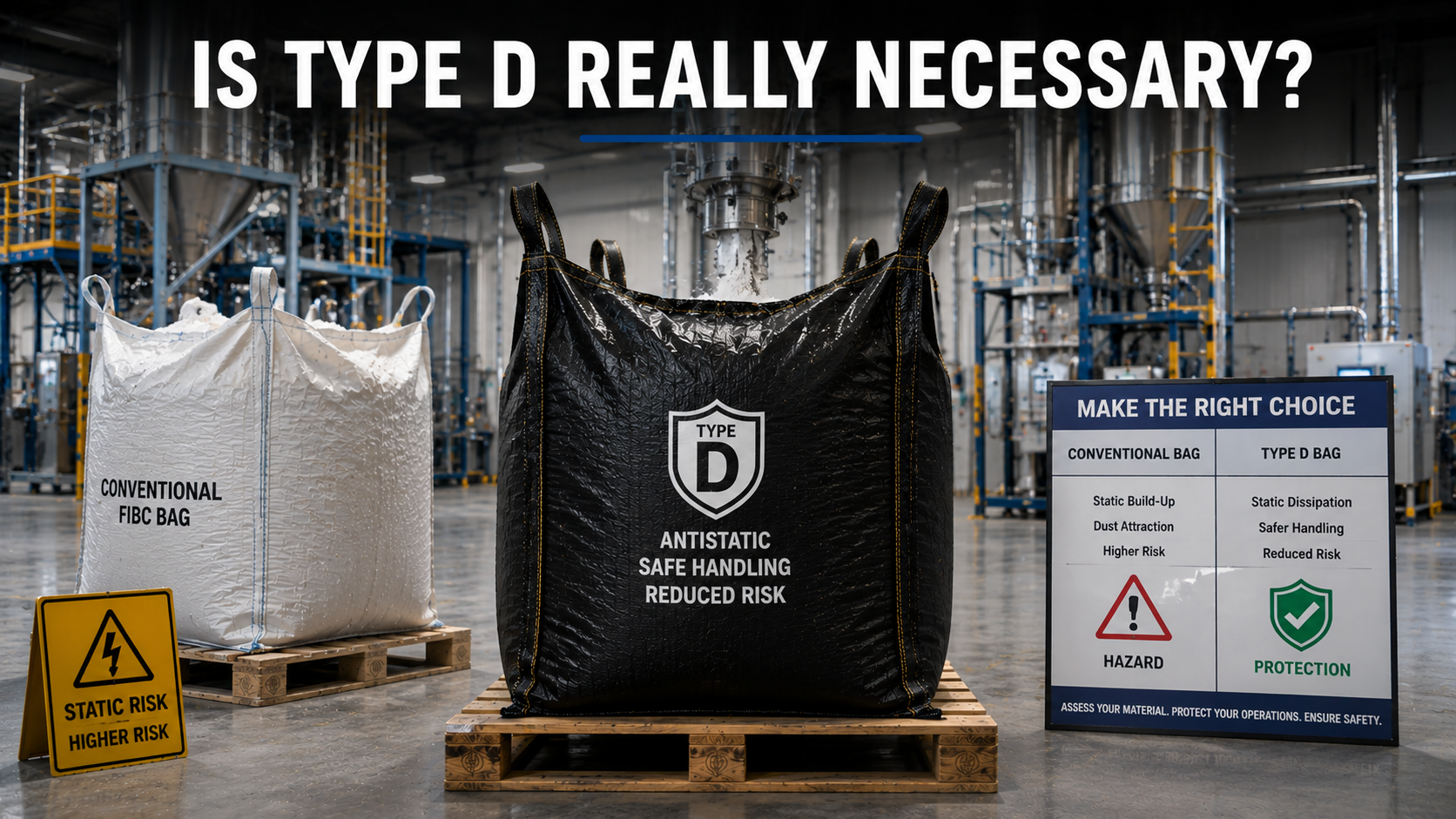
Are Type D FIBC Bags Worth It? Understanding When Your Business Actually Needs Them
When to Use Type D FIBC Bags is a question many businesses ask when evaluating packaging options for hazardous environments. While standard bulk bags may work well for general applications, industries handling combustible powders often require a higher level of protection. However, investing in antistatic packaging only makes sense if the risks justify it. Understanding where Type D FIBC Bags fit into your operations can help businesses improve safety while avoiding unnecessary complexity.
Understanding when to use Type D FIBC Bags is just as important as understanding how they work.
For businesses handling combustible powders and operating in environments where electrostatic hazards exist, Type D bags provide a safer and more practical solution by eliminating grounding dependencies. However, the right choice always depends on your specific process requirements. The smartest packaging decisions are those based on risk assessment, operational efficiency, and long-term reliability.
Do You Really Need Type D FIBC Bags?
Not every industrial operation requires antistatic packaging. In fact, many businesses continue using conventional FIBC bags because their products do not generate hazardous electrostatic conditions.
The challenge lies in identifying when the risk level changes.
Ask These Questions
- Do you handle combustible powders?
- Is dust generated during filling or discharge?
- Are flammable atmospheres present?
- Do operators struggle with grounding procedures?
- Is safety compliance becoming a concern?
If the answer to several of these questions is yes, Type D FIBC Bags may be the right investment. Ignoring electrostatic risks can lead to production interruptions, equipment damage, and serious workplace incidents. Understanding your process is the first step toward making the right packaging decision.
Why Businesses Move Away from Grounding Systems
Many facilities initially use conductive Type C bags. Although effective, they depend heavily on proper grounding procedures.
Unfortunately, human error remains one of the biggest risks in industrial environments.
Common Grounding Challenges
- Missed grounding connections
- Improper attachment methods
- Inconsistent safety practices
- Operator training gaps
- Delays during loading operations
Type D FIBC Bags eliminate these concerns by functioning without earthing requirements.
Because the electrostatic protection is built directly into the fabric, the system becomes simpler to operate. This reduces dependence on manual safety checks while improving consistency. For many facilities, simplicity itself becomes a major safety advantage.
Industries That Benefit Most from Type D FIBC Bags
Some industries gain significantly more value from Type D technology than others.
These businesses often work with products that create static charges during movement.
High-Risk Industries
- Chemical manufacturing
- Petrochemical processing
- Pharmaceutical production
- Food powder handling
- Mining operations
- Industrial powder plants
Fine powders generate friction easily, increasing the possibility of electrostatic buildup. Therefore, facilities handling these materials often view Type D bags as part of their overall risk management strategy. In such environments, prevention is always more cost-effective than responding to incidents after they occur.
The Hidden Cost of Choosing the Wrong Bulk Bag
Price is often the first factor businesses consider.
However, selecting a cheaper packaging option without understanding operational risks can become far more expensive over time.
Potential Consequences
- Production shutdowns
- Product losses
- Workplace incidents
- Compliance challenges
- Equipment damage
A single event involving combustible dust can disrupt operations for days or even weeks. Additionally, investigations and corrective actions can affect customer confidence and business reputation. Choosing the right FIBC bag should therefore be viewed as a long-term operational decision rather than a short-term purchasing decision.
When Type D FIBC Bags May Not Be Necessary
Although Type D bags offer advanced protection, they are not always required.
Businesses handling non-hazardous materials may achieve excellent performance using conventional FIBC designs.
Situations Where Standard Bags May Work
- Non-combustible products
- Low-dust environments
- Minimal electrostatic risk
- Indoor operations without ignition hazards
- Applications with simpler safety requirements
This is why process evaluation is essential. The goal is not to choose the most advanced option available, but rather the most appropriate solution for your specific operation. Packaging should align with risk levels and operational needs.
How to Decide If Type D FIBC Bags Are Right for You
The best decisions are based on understanding your materials, environment, and operational practices.
Decision Checklist
- Assess powder combustibility
- Review workplace conditions
- Evaluate current safety systems
- Identify operator dependencies
- Consult packaging specialists
A structured evaluation helps businesses avoid over-specification while ensuring adequate protection. Working with experienced manufacturers also makes the selection process easier. The result is a packaging solution that balances safety, efficiency, and cost.
Why Businesses Choose UWON Packaging
UWON Packaging helps businesses identify the right packaging solution based on actual operational requirements.
What Makes UWON Packaging Different
- Application-based recommendations
- Specialized FIBC expertise
- Strict quality standards
- Export-ready solutions
- Reliable customer support
Instead of promoting one-size-fits-all products, UWON Packaging focuses on helping clients choose solutions that improve safety and operational performance.
This consultative approach ensures businesses invest in packaging that genuinely supports their objectives.