
EU’s New Packaging Law Is Now Live: What It Means for Bulk Packaging Buyers
The EU packaging law changed on 12 August 2026. From today, the Packaging and Packaging Waste Regulation applies across all 27 member states, and any business placing packaging on the EU market must meet its requirements.
This is the biggest change to European packaging rules in three decades. There is no transposition into national law, and no grace period for packaging placed on the market from today.
What changed in the EU packaging law
Regulation (EU) 2025/40, known as the ppr, becomes applicable on 12 August 2026. On the same date it repeals the previous Packaging and Packaging Waste Directive 94/62/EC, which had governed European packaging for around thirty years.
The structural change matters as much as the content. The old regime was a directive, so each member state wrote its own version, producing 27 different sets of rules, symbols and reporting duties. The new EU packaging law is a regulation, which means one harmonized set of requirements applying directly and identically across the EU. For exporters selling into several European markets, that removes a great deal of fragmentation.
The regulation covers all packaging, regardless of material, including plastic, paper, glass, metal and wood, along with all packaging waste. It was published in the Official Journal in January 2025 and entered into force on 11 February 2025, giving industry an 18 month transition that has now ended. In March 2026, the European Commission also published implementation guidance and FAQs to clarify how the rules work in practice.
Why the EU packaging law matters for bulk packaging
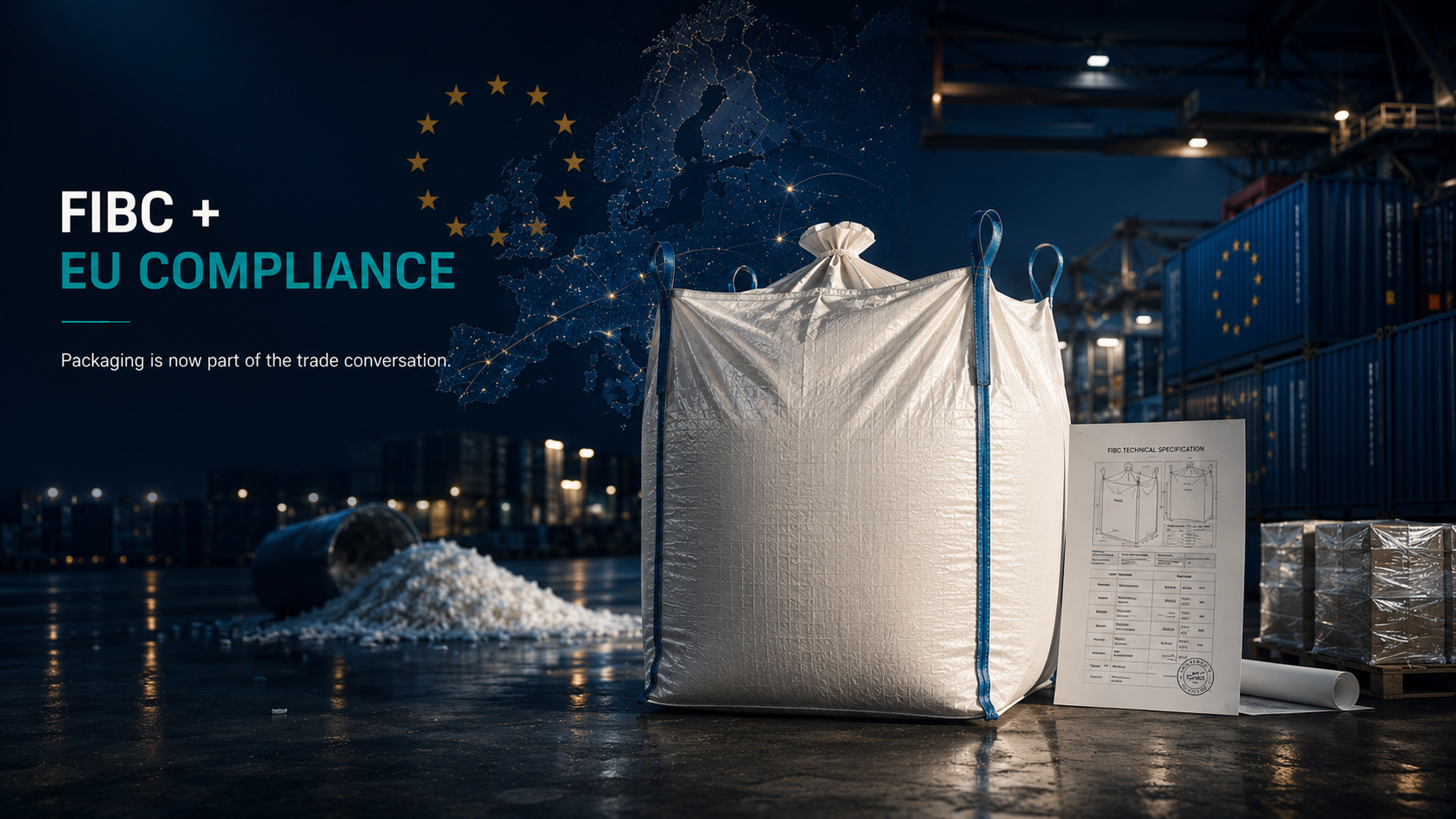
Bulk packaging is not a side note here. FIBC bulk bags, liners, pallets and industrial wrapping are all transport packaging, and transport packaging sits squarely inside the scope of the regulation.
Two areas deserve attention. First, the essential requirements on packaging design, composition and recyclability now apply. Second, and further out, the regulation sets a target for reuse of transport packaging in business to business movements by 2030, which will push buyers to think harder about single trip versus reusable formats.
For exporters outside the EU, the practical risk is simple. Non compliant packaging can be refused at the European border, so this is a trade issue, not only an environmental one.
The headline: from 12 August 2026, packaging that does not meet the regulation cannot be placed on the EU market. The rule applies directly in every member state, with no national version and no transition window.
What applies now, and what comes later
Although most provisions apply from today, the EU packaging law runs on a staggered timeline that extends well beyond 2026. So compliance is a programme, not a single deadline.
From 2026, the essential requirements on packaging design and composition apply, along with restrictions on certain substances and on specific single use formats. Harmonised labeling requirements follow in 2028. Then, in 2030, reuse targets for transport packaging in business to business movements arrive, alongside further single use restrictions. Additional obligations continue to phase in through to 2040.
Who is affected by the EU packaging law
The scope is deliberately wide. It covers manufacturers, importers, distributors, brand owners and e commerce operators who place packaging on the EU market, whether that packaging is empty or already filled with a product.
Crucially, it also reaches suppliers based outside Europe. An Indian, Asian or American exporter shipping goods into the EU is inside this regime through the packaging around those goods, even though the regulation is European law.
What buyers and procurement teams should watch
For anyone buying industrial or bulk packaging, three things are worth checking now.
Start with recyclability and design, because your packaging must meet the essential requirements as of today. Next, ask your suppliers for documentation, since compliance has to be demonstrable rather than assumed. Finally, look ahead to the 2030 reuse target for transport packaging, because decisions taken on formats in the next few years will determine how ready you are.
More broadly, this fits a wider pattern. India tightened its own plastic packaging rules earlier in 2026, and packaging responsibility is being formalized in market after market. The direction of travel is consistent, so buyers who treat compliance as a supplier selection criterion rather than paperwork will adapt faster.
Common questions
When does the EU packaging law apply?
It applies from 12 August 2026. It entered into force on 11 February 2025, and the transition period has now ended. Some requirements, including labeling and reuse targets, phase in later.
Does the ppr apply to exporters outside the EU?
Yes, in practice. Any business placing packaging on the EU market is covered, so non EU exporters shipping packaged goods into Europe must comply. Non compliant goods risk rejection at the border.
Does it cover industrial and transport packaging?
Yes. The regulation covers all packaging regardless of material or format, which includes transport and industrial packaging such as bulk bags, liners and wrapping.
Sources: Regulation (EU) 2025/40, published in the Official Journal of the European Union, January 2025, in force 11 February 2025, applicable 12 August 2026. European Commission implementation guidance and FAQs, March 2026. Summary analysis via Latham and Watkins. This article is general information, not legal advice.
Shipping bulk material into Europe? If you are reviewing your packaging in light of these rules, tell us what you move and where, and we will help you work through the specification. Explore our FIBC range or talk to our team.
Published by UWON Packaging, an FIBC and bulk bag manufacturer and exporter. We track packaging regulation because it shapes what our customers can ship, and where. About UWON · Our FIBC range · Talk to our team