
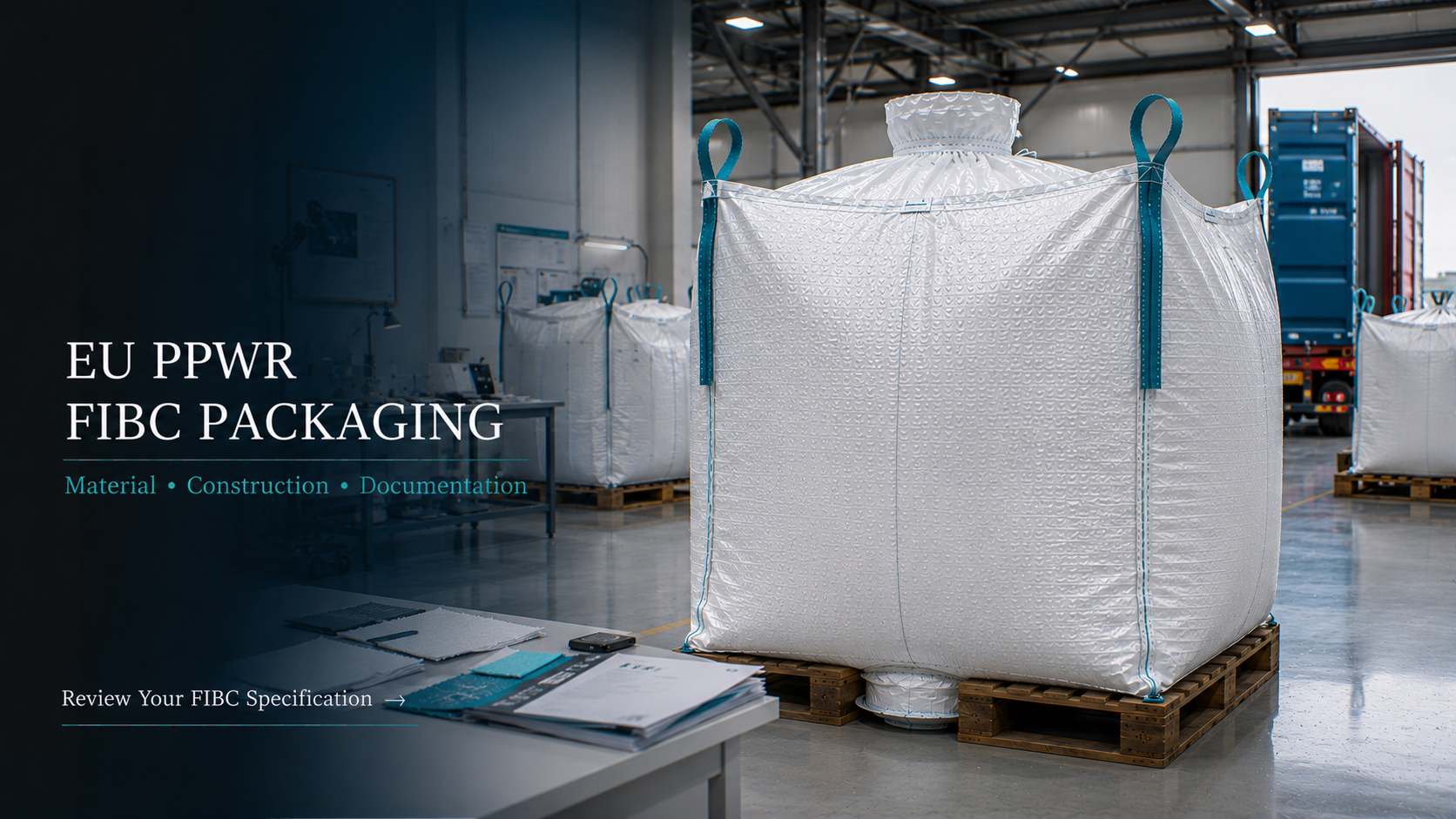
EU PPWR Is Now in Force: What FIBC Buyers Need to Check
EU PPWR FIBC: What European Buyers Need to Check
EU PPWR FIBC requirements are now an important consideration for companies sourcing bulk packaging for the European market. Regulation (EU) 2025/40, commonly known as the Packaging and Packaging Waste Regulation (PPWR), applies from 12 August 2026. However, its requirements do not all take effect at once, so FIBC buyers need to understand which provisions apply to their packaging and when. Read the official PPWR regulation on EUR-Lex.
For procurement teams, this means looking beyond a simple “recyclable” or “PPWR compliant” claim. The complete FIBC construction, material composition, documentation, traceability and intended application all deserve closer attention.
The European Commission has also published guidance to help economic operators interpret selected PPWR provisions and prepare for implementation. :contentReference[oaicite:1]{index=1}
Why EU PPWR FIBC Requirements Matter in 2026
The PPWR establishes a common European framework for packaging and packaging waste. It entered into force in February 2025 and applies from 12 August 2026, while several additional requirements are introduced through later milestones. :contentReference[oaicite:2]{index=2}
For buyers sourcing FIBC packaging in Europe, this makes packaging specifications more important. Instead of treating an FIBC as a simple woven bag, procurement teams should understand the complete packaging construction and the requirements associated with its intended use.
This is particularly relevant when purchasing from international FIBC manufacturers, because the buyer may need clear information about materials, construction and supporting documentation before placing an order.
What Should Buyers Review Under EU PPWR FIBC Considerations?
There is no single specification that applies identically to every FIBC. The relevant PPWR provisions depend on the packaging, application and applicable implementation dates.
Nevertheless, buyers can create a stronger procurement process by reviewing:
- FIBC construction
- Woven polypropylene fabric
- Inner liners
- Coatings and laminations
- Printing and other components
- Material specifications
- Traceability information
- Technical documentation
- Application-specific requirements
This approach helps buyers distinguish actual regulatory requirements from general sustainability claims.
Why “Recyclable” Alone Does Not Explain an FIBC
One of the biggest mistakes in EU PPWR FIBC procurement is treating recyclability as a simple yes-or-no label.
An FIBC is a constructed packaging system. The woven polypropylene body may represent the primary component, but the finished configuration can also include liners, coatings, laminations, printing systems, sewing threads and other components.
Therefore, buyers should understand the complete construction before making conclusions about recyclability or material compatibility.
The PPWR itself also addresses material composition and packaging components, including provisions concerning the identification of material composition. :contentReference[oaicite:3]{index=3}
EU PPWR FIBC Construction: What Materials Should Buyers Check?

The first step is to identify what actually makes up the finished FIBC.
Woven Polypropylene Fabric
The main body of many FIBCs uses woven polypropylene fabric. Buyers should confirm the material specification and ensure that the supplier can provide accurate information about the construction.
Inner Liners
Some applications require an inner liner for product protection, moisture management or contamination control. However, the liner becomes part of the overall packaging construction and should therefore be considered during the material review.
Coatings and Laminations
Coatings or laminations can provide application-specific functional benefits. Buyers should specify whether these features are required and identify the material used rather than assuming that all coated FIBCs have identical characteristics.
Printing, Inks and Other Components
Printing systems, sewing threads and other components can also form part of the finished FIBC specification. For this reason, buyers should ask suppliers for sufficient construction information to understand the complete packaging.
Why EU PPWR FIBC Documentation Matters

Documentation should become part of the procurement conversation rather than an afterthought.
Depending on the applicable PPWR provisions, economic operators may need appropriate conformity information and technical documentation. The European Commission’s 2026 guidance was specifically issued to help businesses and Member States interpret selected provisions of the regulation. :contentReference[oaicite:4]{index=4}
For FIBC buyers, useful supplier information can include:
- Material specifications
- Construction details
- Liner specifications
- Coating or lamination information
- Relevant technical documentation
- Traceability information
- Application-specific compliance information
EU PPWR FIBC Traceability: Questions Buyers Should Ask
Traceability becomes particularly valuable when companies purchase large volumes of bulk packaging across international supply chains.
Before approving an FIBC supplier, ask:
- What materials are used throughout the FIBC construction?
- What fabric specification is being supplied?
- Does the application require an inner liner?
- What material is used for the liner?
- Are coatings or laminations included?
- What printing or ink system is specified?
- How is the packaging identified and traced?
- What technical documentation is available?
- Which PPWR provisions apply to the intended application?
- Can the supplier maintain consistent specifications across production batches?
These questions help procurement teams move from a generic compliance statement toward a documented packaging specification.
How FIBC Construction Connects With European Packaging Requirements
FIBC construction affects much more than appearance. The selected configuration can influence handling, filling, discharge, storage, stacking and transportation.
UWON offers multiple FIBC constructions and configurations, including standard FIBC bags, U-Panel FIBC bags, 4-Panel FIBC, Circular FIBC and Baffle FIBC solutions.
Therefore, European procurement teams should evaluate the required construction alongside their packaging and market requirements rather than selecting a bag solely on price or a broad sustainability claim.
Do FIBC Liners Change the EU PPWR FIBC Assessment?
An FIBC liner can be important for applications where the product requires additional protection or contamination control.
However, adding a liner changes the overall packaging construction. Buyers should therefore identify the liner material and configuration when reviewing the packaging specification.
The same principle applies to coatings, laminations and other additional components. The objective is not to assume that a particular feature automatically makes an FIBC compliant or non-compliant. Instead, buyers should understand the actual construction and assess it against the applicable requirements.
What Should European Buyers Ask FIBC Manufacturers?
When discussing EU PPWR FIBC requirements with suppliers, procurement teams should focus on specific, documentable information.
Ask the supplier:
- What is the complete material composition?
- Which FIBC construction is being proposed?
- Is a liner necessary for the application?
- Are coatings or laminations included?
- What documentation supports the specification?
- How is production traceability maintained?
- Which requirements apply to the intended European market?
- Can the supplier support changes to the specification if requirements evolve?
This creates a much stronger procurement discussion than simply asking whether the supplier provides “PPWR compliant FIBCs”.
Why EU PPWR FIBC Matters for FIBC Manufacturers in India
India is a major sourcing market for global FIBC buyers. As European packaging requirements evolve, FIBC manufacturers in India need to communicate material specifications, construction details and supporting documentation clearly to international customers.
For buyers, supplier transparency can make it easier to evaluate packaging requirements and maintain consistency across repeat orders.
UWON develops FIBC solutions for multiple industrial applications and offers customized bulk packaging configurations. Its applications include agriculture, cement and construction, chemicals, food and beverages, mining and minerals, plastics and polymers, metals and alloys, petrochemicals, paints and coatings, and energy and power.
Explore UWON’s FIBC industry solutions.
How FIBC Buyers Can Prepare for EU PPWR
A practical procurement framework can make the transition easier.
Specify → Verify Materials → Review Construction → Document → Confirm Application Requirements
First, define the FIBC construction and performance requirements. Next, verify the materials used throughout the packaging. Then review the complete construction, collect relevant documentation and confirm which regulatory requirements apply to the intended European-market application.
This approach reduces ambiguity and gives buyers a stronger basis for supplier discussions.
EU PPWR FIBC: What Buyers Should Do Before Their Next Order
European buyers do not need to treat every FIBC as identical. Instead, they should review their existing specifications according to application and market requirements.
Start with high-volume FIBC configurations. Review the fabric, construction, liner, coating, printing and documentation. Then discuss any gaps with the supplier before the next production cycle.
Where the application requires controlled filling or discharge, buyers should also specify the appropriate configuration. UWON offers FIBCs with filling spouts and FIBCs with discharge spouts for application-specific bulk handling requirements.
Frequently Asked Questions About EU PPWR FIBC
What is EU PPWR?
The Packaging and Packaging Waste Regulation, Regulation (EU) 2025/40, establishes a European framework for packaging and packaging waste. It entered into force on 11 February 2025 and applies from 12 August 2026, with additional requirements introduced at later dates. :contentReference[oaicite:5]{index=5}
Does PPWR apply to FIBC bags?
FIBCs can fall within the scope of the PPWR when they meet the regulation’s definition of packaging and are placed on the EU market. The exact obligations depend on the packaging, economic operator, application and applicable provisions.
Are all FIBCs required to be recyclable immediately?
No. Buyers should not assume that every FIBC has one identical immediate recyclability requirement. The PPWR introduces requirements on different timelines, including later provisions related to recyclability and design for recycling. :contentReference[oaicite:6]{index=6}
Does an FIBC liner affect PPWR considerations?
A liner forms part of the overall packaging construction and should therefore be considered when reviewing the materials and specification of the finished FIBC.
What should European buyers ask FIBC manufacturers?
Buyers should ask about complete material composition, construction, liners, coatings, printing, traceability, technical documentation and the requirements applicable to the intended European-market application.
Why is supplier transparency important for EU PPWR FIBC procurement?
Clear specifications and supporting documentation help buyers evaluate packaging requirements, communicate with compliance teams and maintain consistency across international supply chains.
Conclusion
The EU PPWR FIBC conversation is moving beyond simple sustainability claims. With the PPWR applying from 12 August 2026 and additional provisions coming into effect progressively, European buyers should take a more structured approach to bulk packaging procurement. :contentReference[oaicite:7]{index=7}
Review the complete FIBC construction, verify materials, understand liners and coatings, maintain appropriate documentation and confirm the requirements that apply to the intended application.
For international buyers and FIBC manufacturers in India, transparent specifications can provide a stronger foundation for reliable European-market supply.