
EU PPWR & FIBC Packaging: 7 Key Checks for European Buyers
EU PPWR and FIBC Packaging: Why Buyers Need to Look Beyond “Recyclable”
The EU PPWR FIBC discussion is becoming increasingly important for companies that manufacture, source or place bulk packaging on the European market. Regulation (EU) 2025/40 on packaging and packaging waste, commonly known as the Packaging and Packaging Waste Regulation (PPWR), entered into force on 11 February 2025 and applies from 12 August 2026.
For FIBC procurement teams, however, the important question is not simply whether a jumbo bag is described as “recyclable.” The more useful question is how the complete FIBC packaging construction supports the applicable European requirements and the relevant end-of-life pathway.
That distinction matters because an FIBC can contain more than its main woven polypropylene fabric. Depending on the design, the construction may include an inner liner, coating or lamination, printing, inks, sewing threads, additives, lifting components and other materials.
Therefore, European buyers should increasingly look beyond a single sustainability claim and examine the materials, construction, documentation and intended application of the complete bag.
This article focuses specifically on what the PPWR means for FIBC packaging in Europe and how procurement teams can prepare their specifications without making unsupported assumptions about every FIBC design.
What Is the EU PPWR and Why Does It Matter for FIBC Buyers?
The PPWR establishes a harmonised European framework for packaging and packaging waste. It addresses areas including packaging design, recyclability, recycled content, packaging waste prevention, reuse and information requirements.
For FIBC buyers, the regulation matters because packaging placed on the EU market increasingly needs to be considered through its complete lifecycle rather than only its initial function.
The PPWR states that packaging placed on the market must be recyclable and establishes requirements around design for material recycling and, at later stages, collection, sorting and recycling at scale. It also introduces recyclability performance grades, with requirements becoming progressively stricter from 2030 and 2038. :contentReference[oaicite:1]{index=1}
However, buyers should not translate this into a simplistic statement such as “every FIBC must use one specific material configuration.” The exact regulatory treatment depends on the packaging classification, applicable provisions, exemptions and the relevant implementation framework.
For this reason, procurement teams should connect PPWR discussions with the actual FIBC specification they intend to purchase.
Read Regulation (EU) 2025/40 on EUR-Lex.
Why “Recyclable” Is Not the Only Question
“Recyclable” sounds simple. In practice, recyclability involves several questions.
The PPWR connects recyclability with packaging being designed for material recycling and, according to the applicable timeline, being capable of collection, sorting and recycling at scale. :contentReference[oaicite:2]{index=2}
Therefore, an FIBC procurement team should not stop at the question:
“Is this bag recyclable?”
Instead, ask:
- What materials make up the complete FIBC?
- Which material forms the main packaging structure?
- Does the bag contain an inner liner?
- Does it use coating or lamination?
- What printing and ink system does it use?
- Are additives or conductive components present?
- What other components form part of the final construction?
- What material documentation can the supplier provide?
- What recycling route is relevant to the intended application and market?
This approach does not mean that a liner, coating or printed area automatically makes an FIBC non-recyclable. Instead, it recognises that the overall packaging construction matters when evaluating material recycling and end-of-life considerations.
Consequently, European buyers should request enough technical information to understand what they are actually purchasing.
Which Parts of an FIBC Construction Should Buyers Consider?
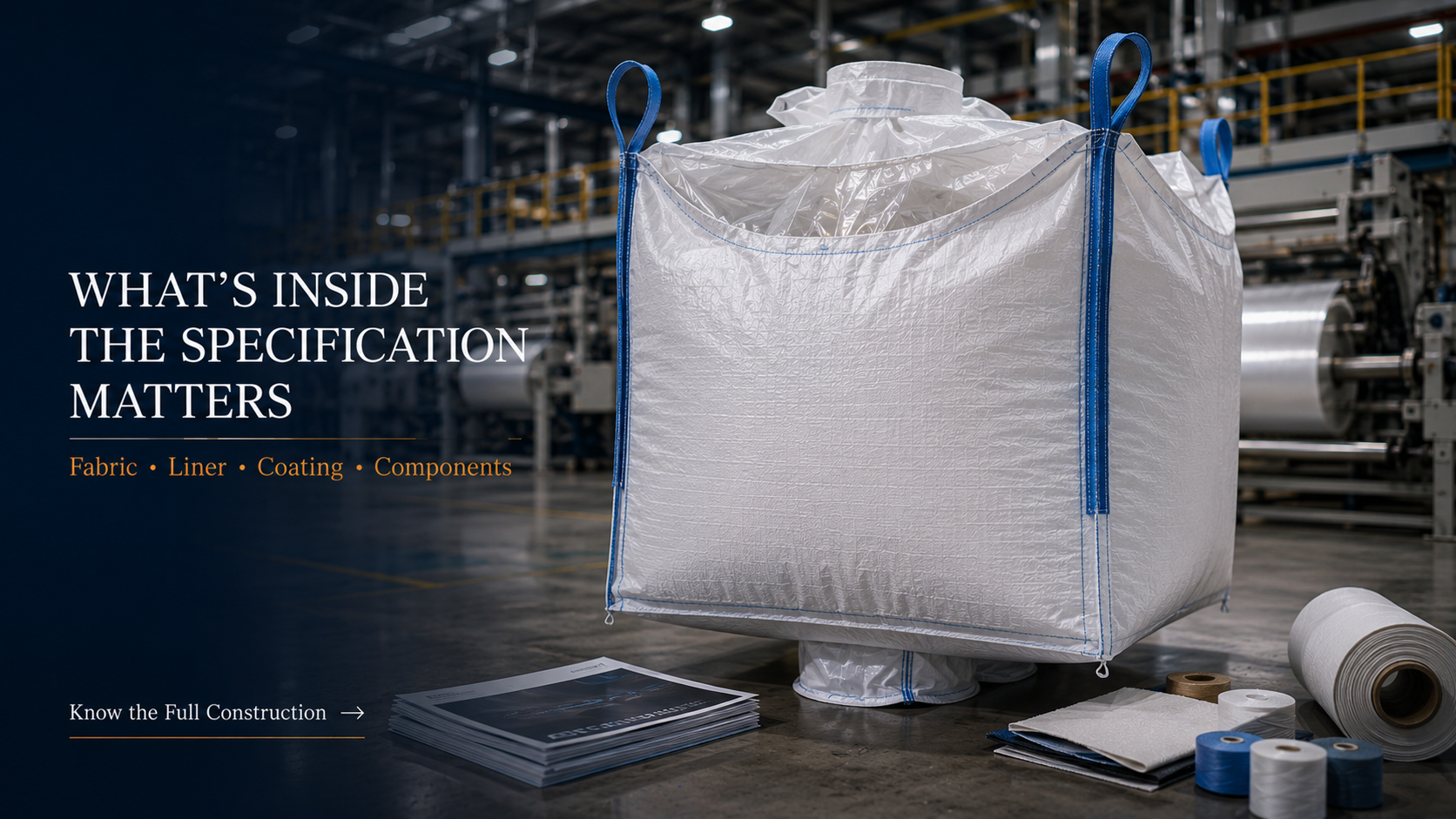
An FIBC is a functional packaging system. Its sustainability and regulatory considerations therefore extend beyond the visible outer fabric.
Woven Polypropylene Fabric
Woven polypropylene forms the main body of many FIBCs and provides the structural strength required for filling, lifting, storage and transportation.
However, buyers should document the actual material specification instead of relying only on a product description such as “PP woven bag.”
Useful information can include:
- Polymer type
- Fabric construction
- Fabric GSM
- Coating status
- Relevant additives
- Intended application
UWON currently offers multiple FIBC constructions, including Standard, U-Panel, Circular, 4-Panel and Baffle designs, with options for different materials, liners, coatings and other specifications. Explore UWON’s FIBC packaging range.
Therefore, buyers should record the actual material and construction rather than treating every polypropylene FIBC as identical.
Inner Liners
An inner liner can provide additional product protection and may be important for applications involving powders, moisture-sensitive products or food-related materials.
However, the presence of a liner introduces another material into the overall packaging construction.
That does not automatically mean the complete FIBC loses recyclability. Instead, buyers should identify the liner material and understand how the complete construction relates to the intended recycling route and applicable requirements.
For example, UWON lists LDPE, HMHDPE and form-fit liner options across relevant FIBC constructions. Its U-Panel FIBC specifications also identify LDPE, HMHDPE and form-fit liner options. Review UWON U-Panel FIBC specifications.
Consequently, buyers should ask the supplier whether the liner is necessary for the application and document its material when it forms part of the final packaging.
Coatings and Laminations
Coatings and laminations can provide functional benefits such as improved moisture protection, dust control or surface performance.
At the same time, they add another consideration to the packaging construction.
Therefore, European buyers should ask:
- Is the fabric coated?
- What material is used for the coating?
- Is the fabric laminated?
- Does the treatment remain compatible with the intended recycling route?
- What documentation identifies the construction?
UWON’s current product specifications distinguish between uncoated and laminated FIBC configurations. For example, its Circular FIBC range lists both uncoated and laminated options. View UWON Circular FIBC specifications.
However, buyers should not assume that every coated or laminated structure has the same regulatory outcome. The relevant assessment depends on the complete construction and applicable requirements.
Printing, Inks and Additives
Printing can be essential for product identification, handling instructions, traceability and branding. However, printing also introduces inks and potentially other substances into the packaging construction.
For that reason, buyers preparing European-market specifications should ask suppliers to identify the printing system used where the information is relevant to the packaging assessment.
Similarly, additives can support specific technical requirements. UV stabilisation, for example, can help protect polypropylene fabric during relevant exposure conditions. Other specialised FIBC designs may use conductive or antistatic components for handling applications where static control matters.
These features do not automatically determine whether an FIBC can be recycled. Instead, they are part of the material and construction information buyers should understand before making a sustainability claim.
UWON lists printing and branding, fabric type, liner options and lifting-loop configuration among its FIBC customization considerations. :contentReference[oaicite:3]{index=3}
Sewing Threads and Other Components
The main fabric is not the only physical component in an FIBC.
Depending on the design, the final bag can include:
- Sewing thread
- Lifting loops
- Webbing or reinforcement
- Filling spouts
- Discharge spouts
- Closures
- Labels
- Liners
- Coatings
- Printing
Not every component requires the same level of regulatory attention in every application. However, documenting the construction gives buyers a much clearer basis for evaluating the final packaging.
Therefore, a good FIBC specification should identify the components that materially affect the intended application and relevant end-of-life considerations.
PPWR FIBC Requirements vs Procurement Best Practice
This distinction is extremely important.
Regulatory requirements come from the PPWR and other applicable European legislation. Buyers and suppliers must determine which provisions apply to the specific packaging and market situation.
Procurement best practices help buyers collect the technical information they need to evaluate those requirements and make informed packaging decisions.
For example, asking a supplier for the material composition of an FIBC is a sensible procurement practice. It does not mean that the PPWR necessarily requires every FIBC supplier to provide one identical document in every commercial situation.
Similarly, asking whether a liner can be removed or separated before recycling can be useful during specification discussions. It does not mean that the PPWR automatically prohibits liners.
Consequently, procurement teams should avoid turning recommendations into legal statements.
Questions FIBC Buyers Should Ask Their Supplier
European buyers can use the following questions when reviewing an FIBC supplier.
- What materials are used throughout the FIBC construction?
- What polymer is used for the main woven fabric?
- Is an inner liner required for the application?
- What material is the liner made from?
- Are coatings or laminations used?
- What material is used for the coating or laminate?
- What printing and ink system is used?
- Are additives included in the fabric or other components?
- Does the bag include conductive or antistatic components?
- What technical and material documentation is available?
- Can the supplier identify the complete construction of the quoted FIBC?
- Is the proposed construction suitable for the intended European-market application?
- Can the supplier provide updated specifications if the construction changes?
- Can the supplier support traceability for the supplied configuration?
These questions create a stronger procurement conversation because they move the discussion from a broad sustainability claim toward measurable technical information.
How FIBC Specifications May Need to Evolve
European buyers may increasingly need to make packaging specifications more detailed.
Instead of specifying only:
“1,000 kg white FIBC, 90 × 90 × 90 cm.”
A more comprehensive specification can describe the packaging construction and application in greater detail.
For example:
- FIBC construction
- Main fabric material
- Fabric GSM
- Coating or lamination
- Liner material
- Liner configuration
- Printing requirements
- Relevant additives
- Lifting configuration
- Filling configuration
- Discharge configuration
- SWL and safety factor
- Application requirements
- Material documentation
This approach does not guarantee regulatory compliance by itself. However, it gives procurement teams and suppliers a much clearer technical basis for evaluating the packaging against applicable European requirements.
For customized FIBC applications, this level of detail can become particularly valuable because changing one component can change the overall construction.
UWON states that its design and development team works on customized FIBC designs according to customer requirements. Learn more about UWON’s custom FIBC approach.
What FIBC Buyers Should Do Before Their Next European Order
European procurement teams can use a simple five-step framework.
1. Specify
Define the material, filling weight, dimensions, construction, handling system and application before requesting quotations.
2. Verify Materials
Ask the supplier to identify the materials used in the main fabric, liner, coating, laminate and other relevant components.
3. Review Construction
Look at the complete FIBC rather than evaluating only the woven outer fabric.
Consider whether the selected liner, coating, printing and other features are necessary for the application.
4. Document
Keep the material specifications, product specifications and relevant supplier documentation connected to the approved FIBC design.
5. Confirm Application Requirements
Finally, confirm that the selected construction matches the intended European-market application and the applicable PPWR provisions.
This sequence creates a practical procurement workflow:
Specify → Verify Materials → Review Construction → Document → Confirm Application Requirements
Why Supplier Transparency Matters
PPWR-related procurement becomes difficult when suppliers describe an FIBC only with broad terms such as “eco-friendly,” “green” or “recyclable.”
Those claims may not provide enough technical information for a European buyer to evaluate the actual packaging construction.
A transparent supplier should be able to explain what the bag contains and which specifications define the final product.
That includes information about:
- Fabric
- Construction
- Liner
- Coating
- Lamination
- Printing
- Additives
- Lifting configuration
- Filling and discharge components
UWON currently manufactures and exports a range of FIBC, Big Bags and Bulk Bags, including U-Panel, 4-Panel, Baffle, Circular and other customized configurations. Its industry page also lists Food Grade FIBC, UN Certified Bags, PP woven sacks and PP woven fabrics among its product offerings. :contentReference[oaicite:4]{index=4}
This broad construction capability is relevant because European buyers increasingly need packaging specifications that reflect the actual material and application rather than a generic bulk-bag description.
Why “One Material” Is Not the Same as “One FIBC Construction”
It is tempting to reduce the European packaging discussion to polymer selection.
However, two FIBCs can both use polypropylene as their primary material while having different liners, coatings, laminations, printing systems or functional components.
For example, UWON’s product specifications show that FIBCs can be supplied with different liner and coating configurations depending on the design. :contentReference[oaicite:5]{index=5}
Therefore, buyers should distinguish between:
- The primary material
- The complete packaging construction
- The intended application
- The applicable recycling pathway
- The documentation supporting the specification
This distinction is particularly useful when discussing FIBC recyclability with European customers.
How the PPWR Changes the Procurement Conversation
Historically, buyers often focused on capacity, dimensions, SWL, lifting loops, filling and discharge configuration and price.
Those specifications remain important.
However, European packaging procurement can increasingly require another layer of discussion: what exactly is the packaging made of, and how does the complete construction fit the applicable packaging requirements?
The PPWR establishes recyclability requirements and also introduces minimum recycled-content requirements for plastic packaging, subject to the specific categories, formats, dates and exceptions defined in the regulation. :contentReference[oaicite:6]{index=6}
Therefore, buyers should avoid adding unsupported blanket requirements such as “100% PP” unless their specific application and regulatory assessment actually call for that specification.
Instead, they should discuss the complete construction with the supplier and, where necessary, their European compliance or regulatory team.
What This Means for FIBC Packaging in Europe
The European market is moving toward more detailed packaging information and stronger lifecycle considerations.
For FIBC buyers, this creates an opportunity to improve procurement specifications before regulatory pressure turns into urgent redesign work.
Rather than waiting for a customer or compliance team to ask for material details, buyers can build those details into the sourcing process now.
That means documenting:
- What the FIBC is made from
- Why each component is included
- Which components are optional
- Which components affect the final construction
- What documentation supports the specification
- Which application the packaging serves
As a result, buyers can make better-informed decisions when comparing FIBC manufacturers and preparing future European orders.
How UWON Can Support European FIBC Specification Discussions
UWON provides engineered FIBC solutions across multiple industrial applications and offers customized designs based on material type, handling requirements and customer specifications. Its product range includes different FIBC constructions, liner options and filling and discharge configurations. :contentReference[oaicite:7]{index=7}
For food and beverage applications, UWON also offers food-grade FIBC solutions for products including grains, sugar, flour and dry goods. Explore UWON’s Food & Beverage FIBC solutions.
For applications involving dangerous goods, UWON also offers UN Certified FIBC solutions. Learn about UWON’s UN Certified FIBC solutions.
For European buyers, the useful starting point is not simply asking for a “PPWR-compliant FIBC.” Instead, discuss the actual application, construction, materials, components and documentation required for the intended market.
Final Checklist for European FIBC Buyers
Before approving your next European-market FIBC specification, ask:
- Have we identified the main fabric material?
- Have we documented the complete FIBC construction?
- Does the application actually require an inner liner?
- Have we identified the liner material?
- Are coatings or laminations necessary?
- Have we documented those coatings or laminations?
- What printing and ink system does the bag use?
- Are relevant additives included?
- Does the design include conductive or antistatic components?
- Do we have adequate material and product documentation?
- Have we discussed the intended European-market application with the supplier?
- Have we distinguished regulatory requirements from internal sustainability preferences?
- Have we avoided unsupported “recyclable” or “sustainable” claims?
- Can the supplier maintain the same approved construction consistently?
If several of these questions remain unanswered, the FIBC specification may not yet be detailed enough for a robust European procurement decision.
Conclusion
The EU PPWR FIBC conversation is not simply about putting the word “recyclable” on a product specification.
The PPWR introduces a broader framework around packaging sustainability, including recyclability and, for relevant plastic packaging categories, recycled-content requirements. The exact obligations depend on the applicable provisions, packaging category, timing and circumstances. :contentReference[oaicite:8]{index=8}
For FIBC buyers, the practical lesson is straightforward: understand the complete construction.
Look beyond the woven polypropylene fabric and identify the liner, coating, lamination, printing, additives and other relevant components. Then document those specifications and discuss them with the supplier before finalizing the European-market design.
Most importantly, separate what the regulation requires from what good procurement practice recommends.
That approach gives European buyers a stronger foundation for evaluating FIBC packaging Europe, comparing suppliers and preparing specifications that can adapt as the PPWR framework develops.
Don’t just ask whether an FIBC is recyclable. Ask what it is made of, why it is built that way, and whether the complete construction supports the intended European-market application.
Talk to UWON Packaging about your European FIBC specification.
Frequently Asked Questions
What is PPWR?
PPWR stands for the European Union’s Packaging and Packaging Waste Regulation, Regulation (EU) 2025/40. It establishes a harmonised framework covering areas such as packaging sustainability, recyclability, recycled content, packaging waste prevention and other packaging requirements. The regulation entered into force on 11 February 2025 and applies from 12 August 2026. :contentReference[oaicite:9]{index=9}
Does PPWR apply to FIBC bags?
FIBCs can fall within the scope of the EU packaging framework when they meet the applicable definition and are placed on the EU market. However, buyers should determine the precise classification and provisions that apply to their specific packaging, application and market situation rather than assuming that every FIBC receives identical treatment.
Are FIBCs recyclable under PPWR?
The PPWR establishes recyclability requirements for packaging, including design-for-recycling and, according to the applicable timeline, collection, sorting and recycling-at-scale considerations. However, buyers should evaluate the complete FIBC construction and applicable requirements rather than relying on a generic “recyclable” claim. :contentReference[oaicite:10]{index=10}
Does an FIBC liner affect recyclability?
An inner liner adds another material or component to the packaging construction, so buyers should document its material and consider the complete construction when evaluating recyclability. A liner does not automatically mean that an FIBC is non-recyclable.
What should European buyers ask FIBC manufacturers?
Buyers should ask about the main fabric, liner, coatings, laminations, printing, inks, additives, lifting components, filling and discharge components, material documentation and the intended European-market application.
What materials are commonly used in FIBC construction?
Woven polypropylene is widely used for FIBC bodies. Depending on the design, an FIBC can also include liners, coatings, laminations, sewing threads, lifting components, filling or discharge spouts, printing and other functional components.
How can FIBC suppliers support European packaging requirements?
Suppliers can support buyers by providing clear product specifications, identifying the materials and components used in the FIBC, maintaining consistency with the approved construction and providing relevant technical documentation. Buyers should then assess that information against the applicable European requirements for their specific packaging and market situation.
Does PPWR mean every FIBC must use 100% polypropylene?
No blanket conclusion like this should be applied to every FIBC. The PPWR contains specific requirements and conditions, while the appropriate FIBC construction depends on the application and applicable provisions. Buyers should evaluate the complete packaging specification rather than imposing an unsupported universal material rule.
Does PPWR require every FIBC to contain recycled material?
The PPWR establishes minimum recycled-content requirements for relevant plastic packaging categories and formats, with specific dates, percentages and exceptions defined in the regulation. Buyers should determine which category and provisions apply to their particular FIBC rather than assuming one recycled-content percentage applies to every bulk bag. :contentReference[oaicite:11]{index=11}