
What EU PPWR Means for FIBC and Bulk Packaging Buyers
EU PPWR for FIBC is now an important consideration for bulk packaging buyers selling or shipping into Europe. From 12 August 2026, the EU Packaging and Packaging Waste Regulation applies, bringing packaging design, recyclability, documentation and future reuse requirements into a single European framework.
For FIBC buyers, the important question is no longer only whether a bulk bag meets its technical specification. It is whether the packaging is also appropriate for the market where it will be placed.
What Is the EU PPWR?
The Packaging and Packaging Waste Regulation, formally Regulation (EU) 2025/40, is the European Union’s new framework for packaging and packaging waste. It replaces the previous Packaging and Packaging Waste Directive 94/62/EC and applies directly across all 27 EU member states.
The regulation entered into force on 11 February 2025 and becomes applicable from 12 August 2026. Unlike the previous directive, which required individual member states to transpose its requirements into national legislation, the PPWR is a regulation that applies directly across the European Union.
The regulation covers packaging regardless of material, including plastic, paper, glass, metal and wood. That broad scope means industrial and transport packaging also needs to be considered when businesses review their European packaging requirements.
For the official regulatory text, buyers can refer to Regulation (EU) 2025/40 published in the Official Journal of the European Union.
Why Does EU PPWR Matter for FIBC Buyers?
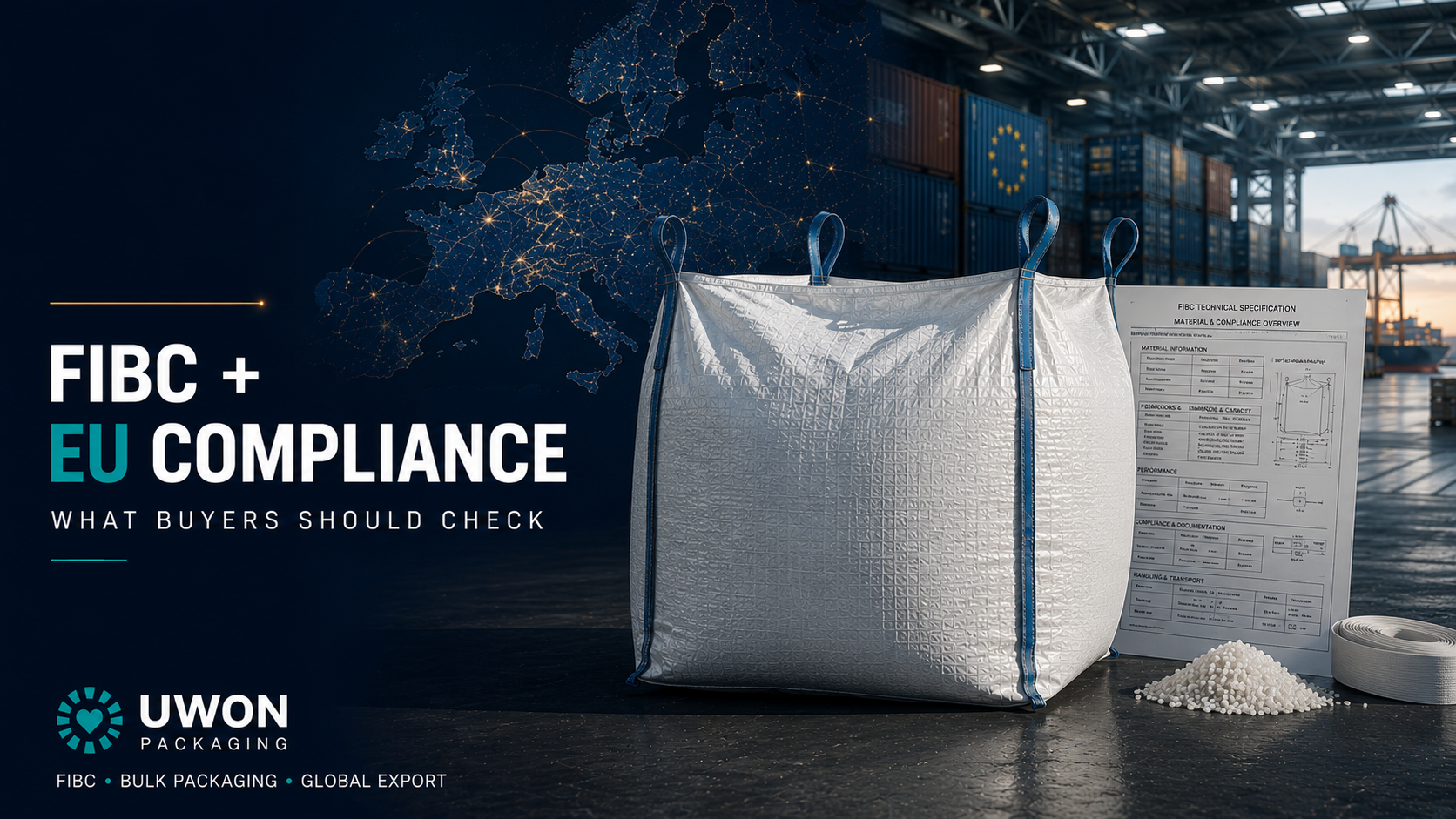
FIBCs are used to transport and handle products across industries ranging from chemicals and minerals to agriculture, food and pharmaceuticals. For companies supplying or importing bulk materials into Europe, the packaging itself is therefore part of the supply chain that needs to be considered.
The PPWR introduces requirements around packaging design, composition and recyclability, while additional requirements will phase in over the coming years.
For an FIBC buyer, this means packaging selection should increasingly consider more than capacity, dimensions, fabric construction and price.
The buyer’s question is changing: not only “Can this FIBC carry my product?” but also “Can this packaging meet the requirements of the market I am selling into?”
7 Things FIBC Buyers Should Check Under EU PPWR
1. Check the complete packaging composition
Packaging compliance starts with understanding what the packaging actually contains. An FIBC is not simply a piece of woven polypropylene fabric. Its construction can include the main fabric, lifting loops, seams, liners, coatings, labels, printing and other components.
When reviewing EU PPWR for FIBC requirements, buyers should look at the complete packaging specification rather than focusing on one parameter such as GSM, capacity or price.
2. Review recyclability
Recyclability is becoming an increasingly important part of packaging discussions in Europe. Buyers should understand how their selected FIBC construction fits the applicable recyclability requirements and what information their supplier can provide about the materials used.
For procurement teams, this means recyclability should become part of supplier evaluation rather than an issue considered only after the packaging has already been selected.
3. Ask for supporting documentation
Compliance should not simply be assumed because a supplier describes a bag as recyclable or compliant.
Buyers should ask what technical and material information is available to support relevant claims. Depending on the packaging and applicable requirements, documentation can become an increasingly important part of the supplier relationship.
A supplier that can clearly explain the material construction, specifications and available supporting documentation gives buyers a stronger basis for evaluating their packaging options.
4. Evaluate the complete FIBC specification
An FIBC can contain several components that work together as one packaging system. The body fabric, lifting loops, seams, liner, coating, discharge system, filling system and labels can all form part of the final specification.
When regulatory requirements become more important, buyers should evaluate the complete packaging construction instead of focusing only on the lowest quoted price or a single technical specification.
5. Consider the destination market
The same FIBC specification is not automatically appropriate for every application or destination market.
Before confirming a specification, procurement teams should consider where the packaging will be placed on the market, what product it will carry and which requirements apply to the intended packaging format.
This makes destination-market requirements an important part of the initial specification discussion rather than a last-minute compliance check.
6. Understand future reuse requirements
The PPWR is not a single-day compliance event. Different requirements are phased in over time.
One important future development for industrial and bulk packaging is the regulation’s direction on reuse of transport packaging in business-to-business movements. Reuse targets are scheduled for 2030, giving buyers time to evaluate how their packaging formats may fit into longer-term European requirements.
For FIBC buyers, this creates an important strategic question: when is a single-trip bag the right solution, and when could a reusable format make more sense?
7. Discuss compliance with your supplier early
One of the simplest steps buyers can take is to bring regulatory requirements into the supplier conversation early.
Instead of selecting an FIBC purely on price and then checking compliance afterwards, buyers can discuss material construction, recyclability, documentation and future requirements while the specification is being developed.
This can help prevent regulatory questions from becoming a last-minute procurement problem.
Does EU PPWR Apply to FIBC Suppliers Outside Europe?
Yes, businesses outside the European Union can be affected when packaging is placed on the EU market.
For an Indian FIBC manufacturer or exporter, the practical implication is that European market requirements need to be considered during specification, manufacturing and documentation rather than only after a shipment has been prepared.
This makes regulatory awareness part of international supplier management.
For buyers, it also means that the ability of an overseas supplier to understand the destination market can become an important part of supplier evaluation.
What Does EU PPWR Mean for FIBC Procurement?
Historically, FIBC procurement has often centred around factors such as price, dimensions, SWL, safety factor, fabric construction, delivery time and supplier reliability.
Those factors remain important. But packaging regulations add another layer: the ability to demonstrate that the packaging is appropriate for the market where it will be placed.
For European buyers, packaging compliance can therefore become part of supplier selection and specification development rather than simply a documentation exercise.
The practical takeaway: FIBC procurement is moving beyond “price + specification”. Buyers should increasingly consider material transparency, recyclability, documentation and future regulatory requirements when selecting a bulk packaging supplier.

What About the 2030 Reuse Requirements?
The PPWR runs on a staggered implementation timeline, so buyers should distinguish between requirements that apply from 2026 and those that come later.
Harmonised labelling requirements follow in 2028, while reuse targets for certain transport packaging in business-to-business movements are scheduled for 2030. Additional requirements continue to phase in beyond that.
For companies that regularly purchase bulk packaging, this makes long-term planning important. Packaging formats selected today may continue to be used for years, so future regulatory requirements can be relevant when evaluating new specifications.

What Should FIBC Buyers Ask Their Suppliers?
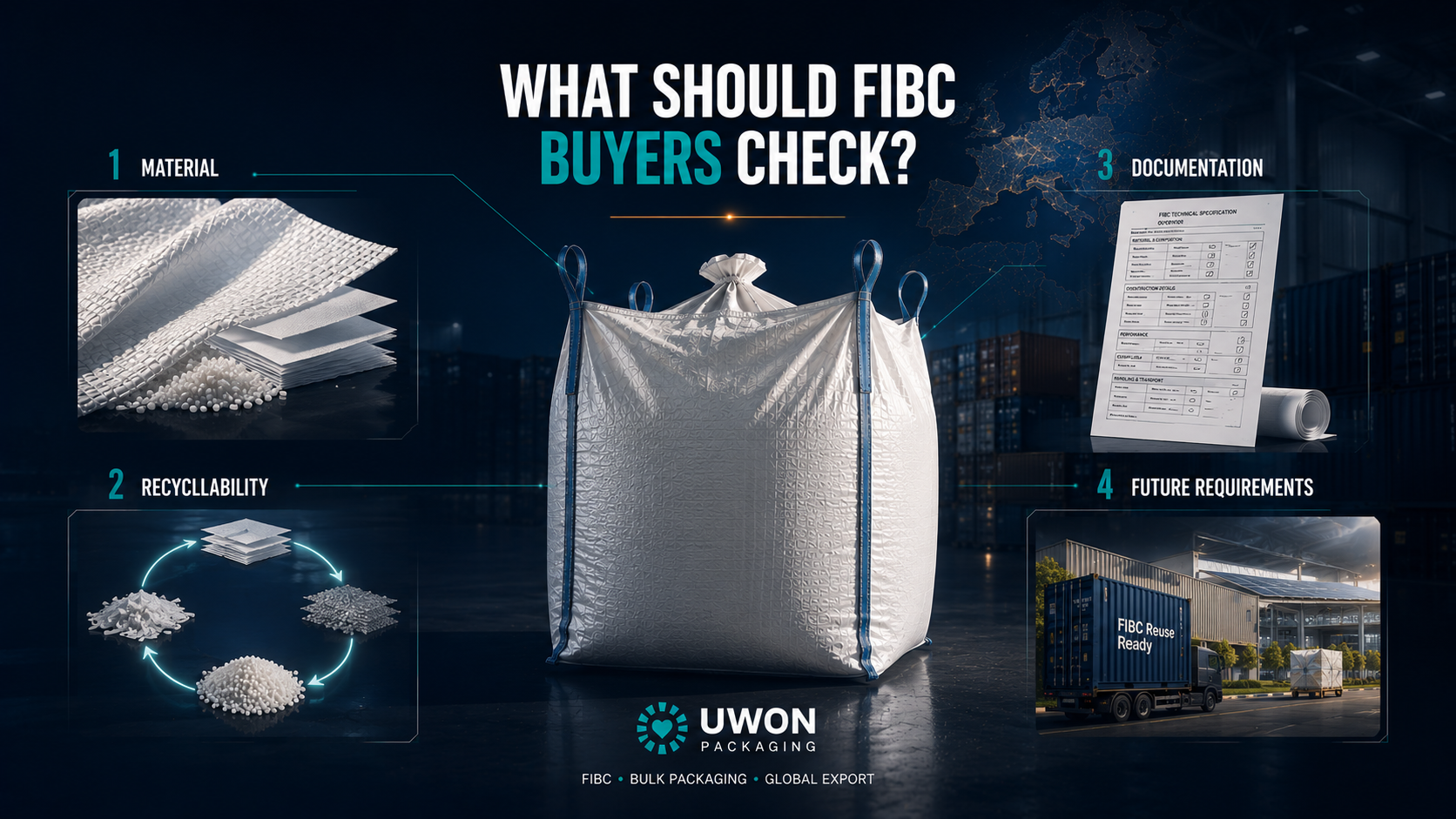
A practical way to approach EU PPWR for FIBC is to turn the regulation into a supplier-evaluation discussion.
What materials are used in the complete FIBC construction?
This should include the main fabric as well as relevant components such as liners, coatings and other materials.
What documentation can you provide?
Ask suppliers what technical information and supporting documentation are available for the selected packaging specification.
How does the proposed construction address recyclability?
Do not rely only on a general “recyclable” statement. Ask the supplier to explain the actual construction and available supporting information.
Is the specification designed for the intended market?
The destination market and intended application should be part of the specification discussion from the beginning.
What future changes should we plan for?
With additional PPWR requirements scheduled to phase in through 2030 and beyond, buyers should understand whether today’s packaging decisions could create challenges later.
EU PPWR and the Future of Bulk Packaging
The most important change may not be a single technical requirement. It is the way packaging is evaluated.
For FIBC buyers, the conversation is gradually moving from simply asking whether a bag is strong enough, correctly specified and competitively priced to asking whether the packaging is also suitable for the regulatory environment in which it will be used.
That does not mean every FIBC specification needs to change immediately. It means buyers should understand the requirements that apply to their packaging and destination market before making long-term procurement decisions.
For international suppliers, this also creates an opportunity to provide greater value by helping buyers understand how technical packaging decisions connect with market requirements.
Common Questions About EU PPWR for FIBC
When does the EU PPWR apply?
The regulation becomes applicable from 12 August 2026. It entered into force on 11 February 2025, while different requirements phase in over subsequent years.
Does EU PPWR apply to FIBC bags?
FIBCs used as industrial or transport packaging fall within the broad scope of the PPWR. The specific obligations depend on the packaging format, intended use and applicable provisions.
Does EU PPWR apply to Indian FIBC manufacturers?
Indian manufacturers supplying packaging into the EU can be affected because the regulation applies to packaging placed on the EU market. Exporters should review the requirements applicable to their specific products, packaging formats and customers.
Does PPWR mean every FIBC must be reusable?
No. The regulation contains different requirements and a staggered implementation timeline. Reuse targets for certain transport packaging are scheduled for 2030, so buyers should distinguish between requirements that apply now and those that come later.
Is recyclability the only thing FIBC buyers need to consider?
No. Recyclability is one part of the wider packaging framework. Buyers should also consider packaging design, composition, documentation and the requirements applicable to their specific market and packaging format.
What Should Buyers Do Next?
The PPWR should not be treated as a reason to change every packaging specification overnight. It is a reason to review the specifications and supplier documentation that support your European business.
Start by identifying which packaging formats you place on the EU market. Review their material composition, recyclability information and available documentation. Then discuss future requirements with your FIBC supplier so that upcoming changes do not become a last-minute procurement problem.
For buyers sourcing from outside Europe, this conversation is particularly important. A supplier who understands both the technical requirements of FIBC manufacturing and the evolving requirements of the destination market can make compliance planning easier.
Looking for FIBC packaging for the European market? Share your product, filling and discharge requirements, capacity and destination market with the UWON Packaging team. We can help you review the appropriate FIBC specification for your application.
Published by UWON Packaging, an FIBC and bulk bag manufacturer and exporter. We track packaging regulations because they increasingly influence how bulk packaging is specified, manufactured and supplied across international markets. About UWON · Our FIBC range · Talk to our team
Sources: Regulation (EU) 2025/40, Official Journal of the European Union; European Commission packaging and packaging waste resources. The regulation entered into force on 11 February 2025 and applies from 12 August 2026. This article provides general information and is not legal advice.