
FIBC Bag Cost: Why the Cheapest Jumbo Bag Can Cost More
FIBC Bag Cost: Why the Cheapest Jumbo Bag Can Cost More
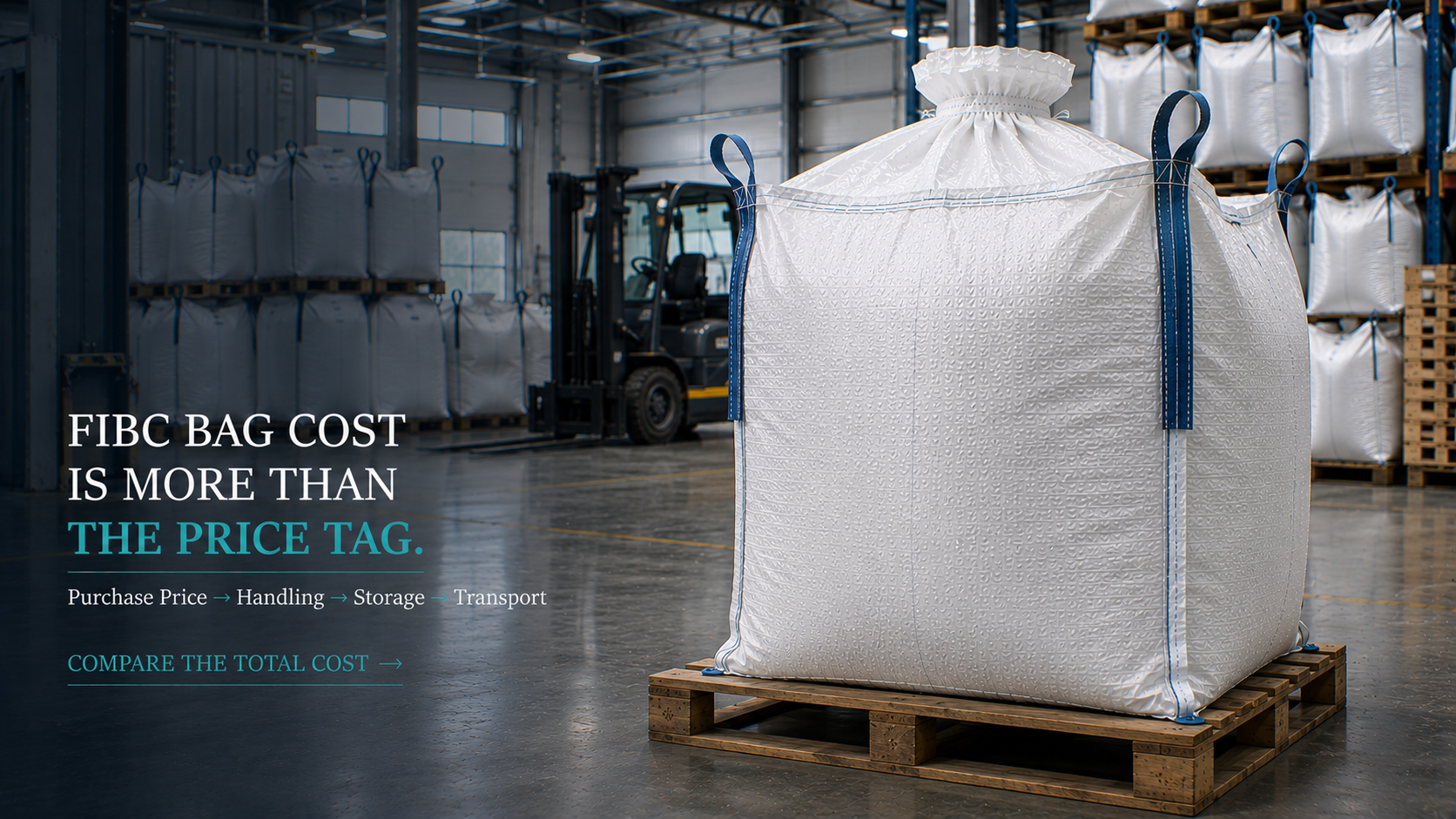
FIBC bag cost is often treated as a simple price-per-bag calculation. However, that approach can hide the real cost of bulk packaging. A lower-priced FIBC may appear attractive during procurement, yet the wrong specification can increase filling time, handling effort, storage requirements, transportation costs, product loss and operational disruption.
For this reason, experienced procurement teams should compare the total cost of using an FIBC rather than looking only at the initial purchase price. The better question is not simply, “Which supplier offers the cheapest bag?” Instead, ask, “Which FIBC specification delivers the most efficient result across the complete handling cycle?”
Recent FIBC procurement guidance increasingly evaluates total cost of ownership through specification optimisation, logistics efficiency, handling performance and cost per ton rather than price per bag alone. NNZ’s FIBC total-cost-of-ownership guidance provides a useful industry perspective on this approach.
Why FIBC Bag Cost Is More Than the Purchase Price
The quoted FIBC bag price represents only one part of the overall packaging cost.
A buyer may receive two quotations for apparently similar 1,000 kg FIBCs and find a significant price difference. However, the specifications behind those quotations may not be identical.
Fabric weight, safety factor, construction, lifting configuration, liner, coating, printing, certification, order volume and delivery terms can all influence the final quotation.
Therefore, comparing two bags only by their unit prices can produce the wrong conclusion.
A better comparison considers:
- Purchase price
- Filling efficiency
- Discharge efficiency
- Handling time
- Storage requirements
- Transportation utilisation
- Product protection
- Quality consistency
- Replacement and disruption costs
What Actually Makes Up FIBC Bag Cost?
The final bulk bag cost depends on the specification selected for the application.
Some of the main cost drivers include:
Fabric and Construction
Fabric specification and construction influence how the FIBC is designed for its intended load and handling conditions. A heavier or more complex construction can increase material and manufacturing requirements.
Safety Factor and Load Requirements
The required safety factor and safe working load influence the design of the FIBC. Buyers should specify these requirements based on the intended application rather than automatically selecting the lowest-cost option.
Liners, Coatings and Laminations
Some products require additional protection against moisture, contamination, leakage or other application-specific conditions. These features add to the specification and therefore can affect the FIBC bag price.
Printing and Customisation
Printing, labels and customised construction can add production steps and setup costs. However, customisation can also provide operational or identification benefits when the specification genuinely requires it.
Order Volume and Logistics
Order quantity can influence unit economics. At the same time, freight, packaging density, shipping terms and delivery location can affect the landed cost.
That is why buyers should compare quotations on the same technical and commercial basis.
How FIBC Design Can Affect Handling Cost
An FIBC is not simply a container that holds material. Its construction interacts with the way the material is filled, lifted, stored and discharged.
For example, the body construction can affect filled shape and stability. Lifting loops influence how the bag connects with handling equipment. Top and bottom configurations influence filling and discharge operations.
Consequently, a slightly higher purchase price can make commercial sense when the specification improves the efficiency of the surrounding operation.
This is why FIBC procurement can benefit from looking at the complete process rather than the bag in isolation. Industry guidance also recommends reviewing filling, handling, storage, transport and specification together when assessing FIBC performance and cost. See how FIBC specifications interact with filling processes.
FIBC Filling and Discharge: Where Hidden Costs Appear
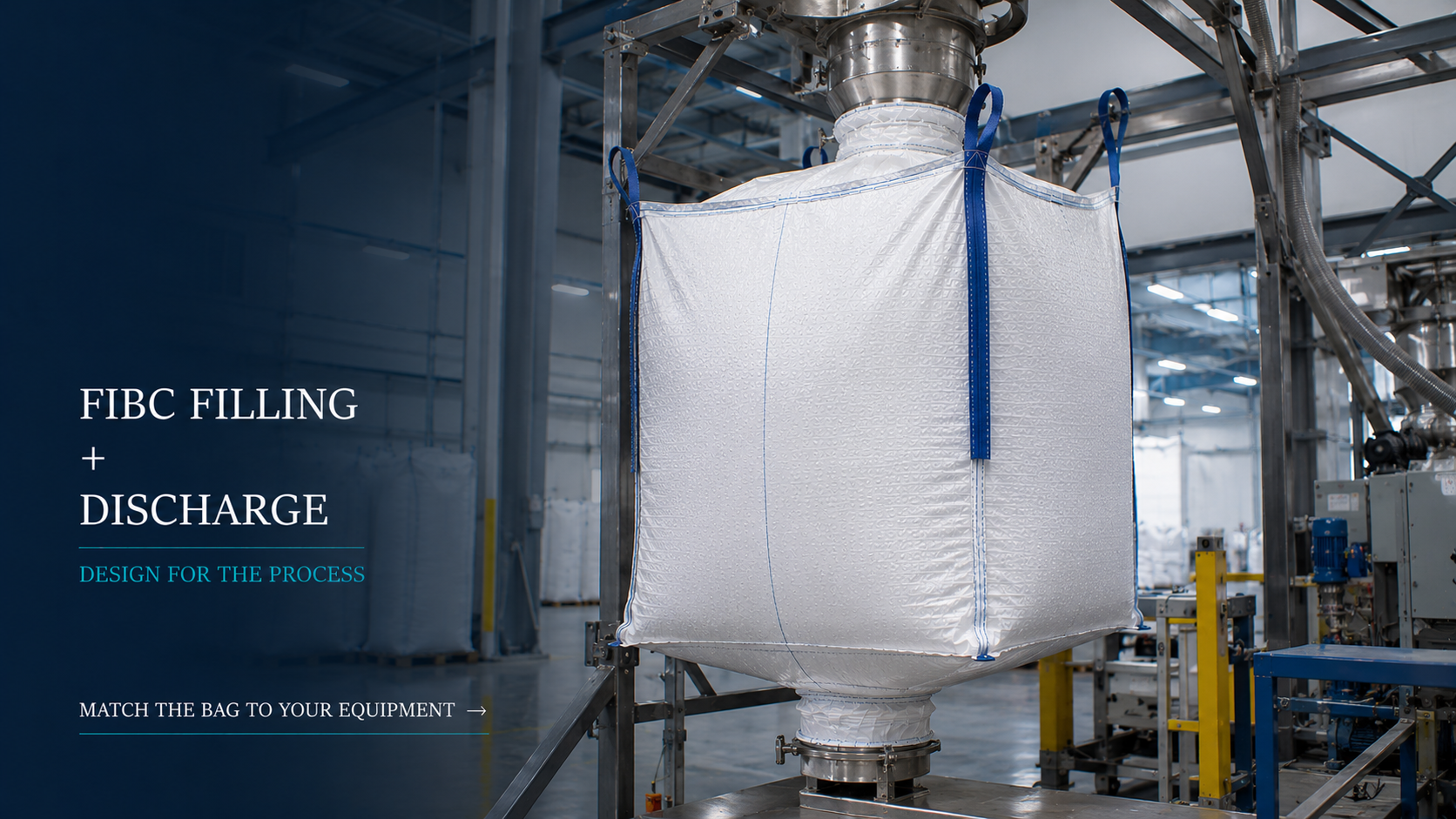
FIBC filling and discharge can have a direct effect on operational efficiency.
Consider two bags with similar capacity. One may integrate more effectively with the customer’s filling equipment, while another may require additional manual intervention.
The same principle applies during discharge. A suitable discharge configuration can help operators control how material leaves the FIBC. An unsuitable configuration may create additional handling steps, slower unloading or material-management challenges.
Therefore, buyers should specify the filling and discharge process before selecting the bag.
UWON provides configurations including FIBCs with filling spouts and FIBCs with discharge spouts, allowing the packaging specification to align with the intended handling process.
Transportation and Container Utilization
FIBC transportation cost is another area where the purchase price can become misleading.
FIBCs are lightweight relative to their payload, but they still occupy physical space. Therefore, dimensions, filled shape, palletisation and loading patterns can influence how efficiently trucks and containers are utilised.
For this reason, buyers should evaluate the complete logistics configuration rather than asking only for the lowest ex-factory or FOB price.
FIBC procurement guidance also recommends matching bag dimensions with pallets, truck beds and container dimensions to improve loading efficiency and reduce unnecessary logistics costs. Read the FIBC supply-chain and TCO analysis.
Product Protection and Material Loss
The cost of an FIBC also needs to be considered alongside the value of the material inside it.
A low-cost bag may not deliver the right protection for a particular product or environment. Depending on the application, moisture, contamination, leakage, dusting or handling damage can create additional costs.
For example, some fine powders may require sift-proof construction or a suitable liner. IFIBCA notes that liners can provide additional protection for certain fine-powder applications. Review common FIBC applications and liner considerations.
The objective should not be to add protection unnecessarily. Instead, buyers should specify the protection required by the product and supply chain.
Consistency Across Repeat Orders
A supplier’s ability to reproduce the agreed FIBC specifications consistently can matter as much as the initial quotation.
Imagine receiving a lower-priced FIBC that performs differently from one production batch to another. Even small changes in dimensions, fabric, construction or functional components can create operational variation.
That variation can lead to additional inspection, adjustment, rehandling or production disruption.
Therefore, buyers should evaluate supplier consistency alongside unit pricing.
A useful procurement comparison should ask:
- Are the specifications clearly documented?
- Can the supplier reproduce the approved construction?
- Are samples and production specifications aligned?
- Does the supplier maintain appropriate quality-control processes?
- Can repeat orders maintain the same agreed configuration?
Storage Efficiency and FIBC Shape

FIBC storage efficiency can influence the total cost of a bulk packaging system, particularly for warehouses handling large volumes.
Filled FIBCs need to occupy space safely and predictably. Their dimensions, shape retention and stacking characteristics can affect how efficiently warehouse space is used.
For example, a construction that maintains a more controlled filled shape may be advantageous when warehouse layout and stacking are important considerations.
However, buyers should not assume that one FIBC construction is automatically better for every application. Material behaviour, bag dimensions, load requirements and storage conditions should guide the specification.
FIBCs are used across industries ranging from food and agriculture to chemicals, minerals and construction materials, with the appropriate construction depending on the application. IFIBCA’s FIBC application overview provides further industry context.
When Custom FIBC Bags Make Financial Sense
Custom FIBC bags can initially appear more expensive than standard configurations. However, customisation can make commercial sense when it solves a specific operational requirement.
For example, a buyer may need:
- A particular bag dimension
- A specific lifting configuration
- A controlled filling method
- A specific discharge configuration
- A liner
- A particular body construction
- Specific handling or storage requirements
In these situations, paying for the correct specification can be more sensible than buying a cheaper standard bag and adapting the process around it.
The key is to customise for a measurable requirement rather than adding features without a clear purpose.
How Buyers Should Compare FIBC Bag Cost
A proper FIBC cost comparison should compare like-for-like specifications.
Start with the technical specification. Then compare the commercial terms. Finally, consider the operational cost.
| Cost Area | What to Compare |
|---|---|
| Bag Price | Unit price for the same specification |
| Construction | Body design, fabric and dimensions |
| Handling | Lifting configuration and equipment compatibility |
| Filling | Top configuration and filling equipment compatibility |
| Discharge | Bottom configuration and unloading method |
| Storage | Filled dimensions and stacking requirements |
| Transport | Container, truck and pallet utilisation |
| Protection | Liner, coating or sift-proof requirements |
| Quality | Consistency and inspection requirements |
| Delivery | Freight, Incoterms and lead time |
This gives procurement teams a more realistic view of the total cost instead of focusing on a single number.
What to Ask FIBC Manufacturers in India
When evaluating FIBC manufacturers in India, buyers should ask questions that connect the bag specification with the actual operation.
Useful questions include:
- What FIBC construction do you recommend for this material?
- What information do you need about bulk density and material flow?
- How should the bag dimensions be selected?
- Which lifting configuration fits the handling equipment?
- What filling and discharge options are available?
- Would a liner or coating serve a specific application requirement?
- How will the filled bag behave during storage?
- Can the dimensions support our truck or container loading pattern?
- How do you maintain consistency between repeat production batches?
- Can you provide samples before large-scale production?
These questions help shift the supplier conversation from “What is your price?” to “What is the right specification for our operation?”
A Practical FIBC Cost Comparison Checklist
Before approving a supplier, use this checklist:
- Compare identical FIBC specifications.
- Confirm the safe working load and required safety factor.
- Review body construction and dimensions.
- Check lifting-loop configuration.
- Confirm filling and discharge requirements.
- Review liner, coating and protection requirements.
- Evaluate storage and stacking conditions.
- Review container and truck loading efficiency.
- Compare freight and Incoterms on the same basis.
- Evaluate quality consistency.
- Consider product-loss and handling risks.
- Compare total operational cost rather than unit price alone.
This approach makes the jumbo bag cost comparison much more meaningful.
How UWON Approaches Bulk Packaging Solutions
For industrial buyers, the right bulk packaging solutions should begin with the application rather than a generic bag size.
Material characteristics, handling equipment, filling and discharge processes, storage conditions and transportation requirements can all influence the final FIBC specification.
UWON provides FIBC solutions across multiple industrial applications and configurations, allowing buyers to discuss packaging requirements around the intended use.
Explore UWON’s FIBC industry applications or review its standard FIBC bags and U-Panel FIBC bags.
Frequently Asked Questions
What determines FIBC bag cost?
FIBC bag cost depends on factors such as fabric specification, construction, safety factor, dimensions, lifting configuration, liners, coatings, printing, certification, order quantity and logistics.
Why can a cheaper FIBC cost more overall?
A lower purchase price can become more expensive if the bag creates additional handling time, filling or discharge problems, storage inefficiency, product loss, transport inefficiency or quality-related disruption.
What is the difference between FIBC bag price and total FIBC cost?
FIBC bag price refers primarily to the purchase price of the packaging. Total FIBC cost considers the wider expenses associated with filling, handling, storage, transportation, product protection, quality and delivery.
Can custom FIBC bags reduce operating costs?
They can, when the custom specification solves a measurable operational requirement. Examples include improved equipment compatibility, more efficient filling or discharge, better storage fit or a more suitable handling configuration.
How should I compare jumbo bag cost between suppliers?
Compare suppliers using identical technical specifications and the same commercial terms. Then consider filling, handling, storage, transport, protection and quality-related costs.
What should I ask FIBC manufacturers in India?
Ask about construction, material characteristics, dimensions, safe working load, lifting configuration, filling and discharge, liners, storage, transportation, quality consistency and repeat-order control.
Does FIBC design affect transportation cost?
It can. Bag dimensions, filled shape, palletisation and loading patterns can influence how efficiently trucks and containers are used. The actual impact should be evaluated against the specific route and loading configuration.
Conclusion
The cheapest FIBC is not always the lowest-cost packaging solution.
A meaningful FIBC cost comparison should look beyond the purchase price and evaluate the complete operating cycle: specification, filling, handling, storage, transportation, product protection, quality consistency and delivery.
For high-volume buyers, even a small improvement in handling efficiency or logistics utilisation can matter more than a small reduction in the initial bag price.
The better procurement strategy is therefore simple:
Specify the right bag → compare like-for-like → calculate the wider operational cost → then select the supplier.
That approach helps buyers move from buying the cheapest bag to selecting the most commercially suitable bulk packaging solution.