
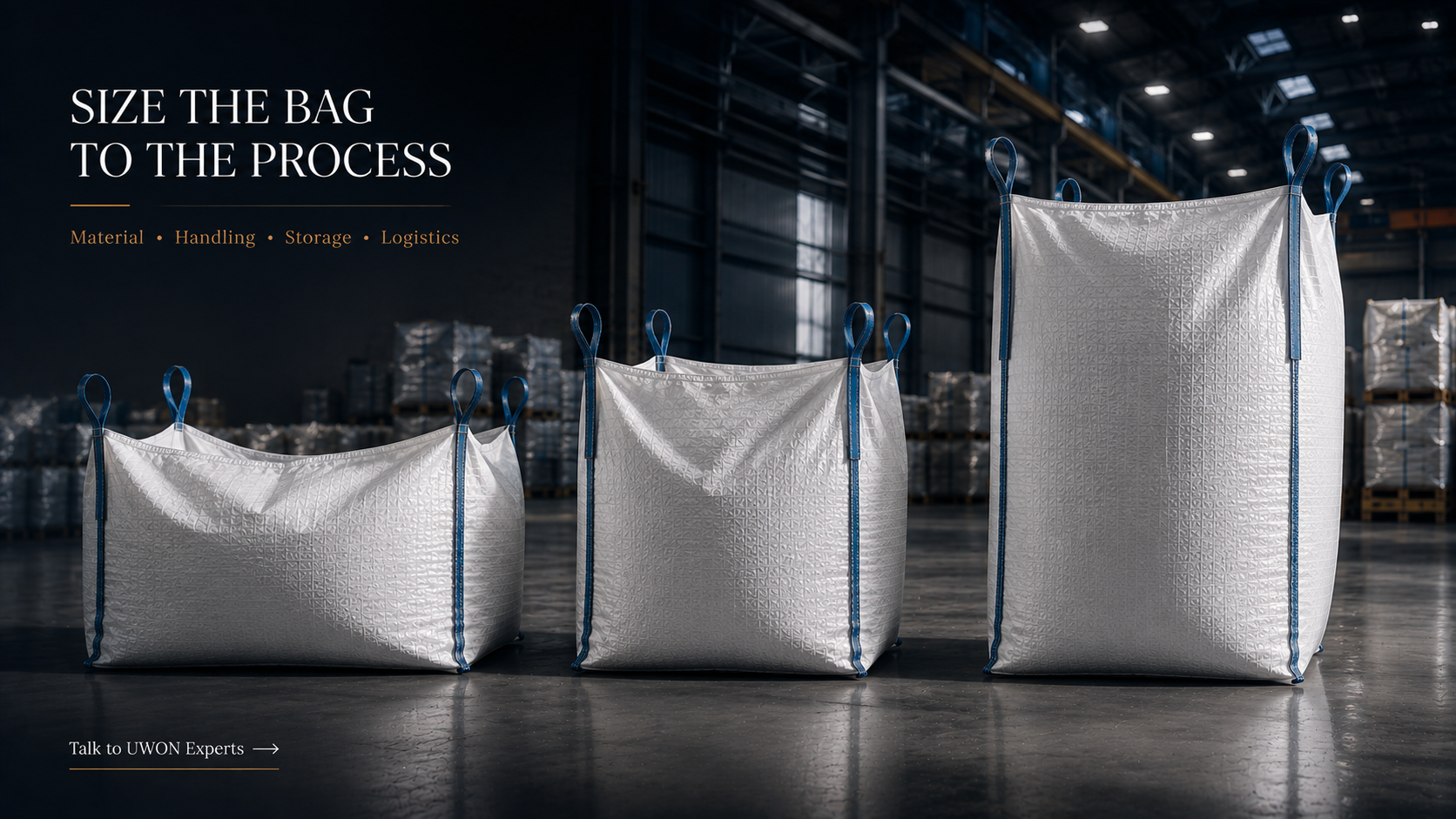
FIBC Bag Dimensions: 7 Tips to Choose the Right Size
FIBC Bag Dimensions: How to Choose the Right Size for Your Bulk Material
Choosing the right FIBC bag dimensions is not simply a matter of selecting a bag that can hold the required weight. The correct size must match the material’s bulk density, filling equipment, storage conditions, stacking requirements, discharge system and transportation environment.
A bag that is too small may require excessive filling height or fail to provide the required capacity. A bag that is unnecessarily large can waste warehouse and container space, create handling problems and increase packaging costs.
For industrial buyers, the best FIBC specification is therefore the one that fits the entire bulk-handling workflow — from filling to storage, transportation and final discharge.
What Are FIBC Bag Dimensions?
FIBC dimensions are generally specified using the bag’s length, width and height, usually written as L × W × H.
However, the stated dimensions should not be treated as a simple rigid-box measurement.
FIBCs are flexible woven containers. Their filled shape can change depending on the construction, fabric, material characteristics, filling level and internal design. Square or panel-based constructions can retain their shape differently from circular or tubular designs.
That is why selecting an FIBC requires more than multiplying three dimensions and choosing the largest available bag.
Why Do FIBC Bag Dimensions Matter?
The dimensions of an FIBC influence much more than its physical capacity.
The right dimensions can affect:
- How much material fits into each bag
- Whether the bag works with the filling equipment
- How stable the filled bag becomes
- How efficiently bags can be stacked
- How much warehouse floor space is required
- How efficiently filled bags fit into trucks and containers
- Whether the discharge spout aligns with downstream equipment
- How easily operators can handle the filled bag
This makes dimensions an operational specification rather than simply a packaging measurement.
Start With Material Density, Not Bag Size
One of the first pieces of information an FIBC supplier needs is the bulk density of the material.
Bulk density describes the mass of material contained within a given volume. Two materials can have the same target weight but require very different bag volumes because their bulk densities differ.
The basic relationship is:
Required volume = Target material weight ÷ Bulk density
For example, if a buyer needs to pack 1,000 kg of a material with a bulk density of 1,000 kg/m³, the theoretical material volume is approximately 1 m³.
If the material has a bulk density of only 500 kg/m³, the same 1,000 kg requires approximately 2 m³ of material volume.
That difference can completely change the required FIBC dimensions.
For FIBC design guidance, the Flexible Intermediate Bulk Container Association’s FIBC Design Guide also identifies product bulk density and required net fill weight among the key information buyers should provide when determining the appropriate FIBC design.
How Bulk Density Changes the Required Bag Size
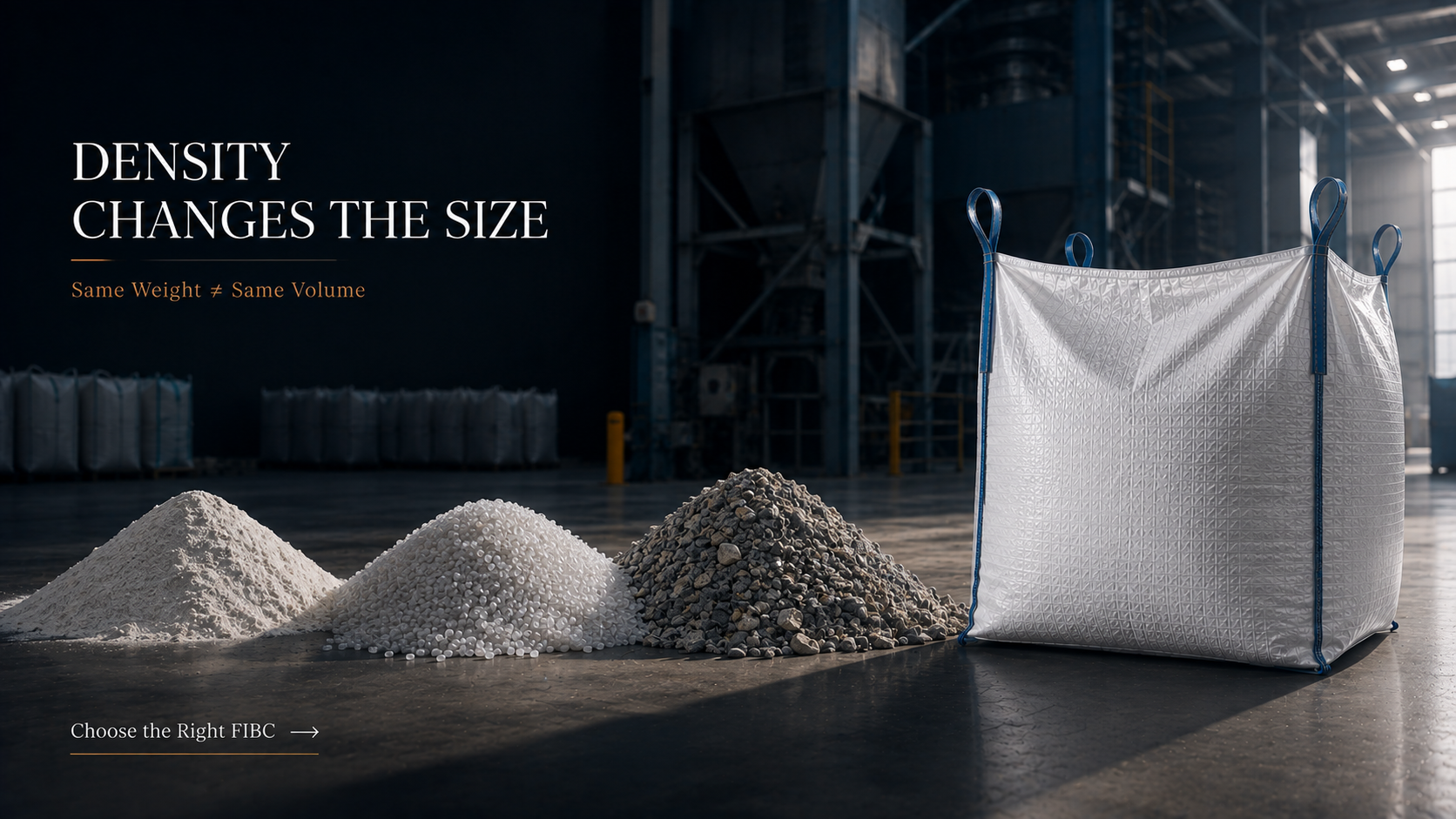
| Target Weight | Bulk Density | Approx. Material Volume |
|---|---|---|
| 1,000 kg | 500 kg/m³ | 2.00 m³ |
| 1,000 kg | 750 kg/m³ | 1.33 m³ |
| 1,000 kg | 1,000 kg/m³ | 1.00 m³ |
| 1,000 kg | 1,250 kg/m³ | 0.80 m³ |
| 1,000 kg | 1,500 kg/m³ | 0.67 m³ |
These are theoretical volume calculations. The final FIBC specification should also account for the actual product behaviour, filling conditions, bag construction and required operating capacity.
Do Not Choose Dimensions From Weight Alone
A common purchasing mistake is to tell the supplier:
“We need a 1,000 kg FIBC.”
That information is useful, but it is not enough.
The supplier should also understand:
- Product bulk density
- Target fill weight
- Product flow characteristics
- Required filling method
- Required discharge method
- Storage height
- Pallet dimensions
- Container or truck dimensions
- Stacking requirements
- Handling equipment
This is why two customers requiring the same 1,000 kg capacity may legitimately need different FIBC dimensions.
How Filling Equipment Affects FIBC Dimensions
The filling system should be considered before finalising the bag dimensions.
Automated filling equipment may require specific positioning, filling-spout dimensions, inlet height or bag suspension arrangements.
If the bag is too tall, too short or incorrectly positioned relative to the filling machine, operators may need to modify the process or use additional equipment.
For example, the filling specification may need to consider:
- Filling spout diameter
- Filling spout length
- Bag inlet position
- Filling-head clearance
- Suspension height
- Bag positioning on the filling station
- Required fill rate
UWON’s product range includes FIBCs with filling spouts designed for controlled filling and equipment integration, making the relationship between bag construction and filling equipment an important part of specification development. Buyers looking for standard FIBC bags can review available configurations before finalising their required dimensions.
How Discharge Requirements Affect Bag Dimensions
The bottom of the FIBC is just as important as its top.
If the bag will discharge directly into a hopper, conveyor, mixer or processing line, the bottom configuration needs to match the receiving equipment.
Common considerations include:
- Flat bottom
- Discharge spout
- Spout diameter
- Spout length
- Closure arrangement
- Required discharge rate
- Available clearance below the bag
A bag can have the correct volume and still be operationally unsuitable if the discharge configuration does not work with the receiving system.
UWON offers both flat-bottom and discharge-spout configurations across its FIBC range, allowing the packaging specification to be aligned with different handling requirements.
Storage and Stacking Should Influence the Dimensions
Warehouse space is another important part of FIBC sizing.
A tall, narrow bag may provide the required volume, but it may not offer the best stability or stacking performance for a particular warehouse.
Conversely, a wider bag may occupy more floor space but provide a more stable footprint.
Before selecting dimensions, buyers should consider:
- Available warehouse height
- Available floor area
- Pallet dimensions
- Stacking method
- Number of bags stored together
- Forklift clearance
- Rack dimensions where applicable
- Filled-bag stability
For applications where shape retention and stacking are important, structured constructions can be advantageous. UWON’s U-Panel FIBC bags and 4-Panel FIBC bags are designed for applications where defined shape, load distribution and handling performance are important.
Why Baffle FIBCs Can Improve Space Utilization
When filled, conventional flexible bags can bulge outward. This can create unused space between adjacent bags.
Baffle FIBCs use internal fabric panels to restrict this outward movement and help maintain a more cubic shape.
This can be valuable when:
- Warehouse space is limited
- Container utilisation is important
- Bags must be stacked closely
- Consistent bag geometry is required
- Large export volumes are involved
However, a baffle bag is not automatically the right choice for every application. The material, filling process, storage arrangement and handling requirements should determine the final construction.
FIBC Dimensions and Container Utilization
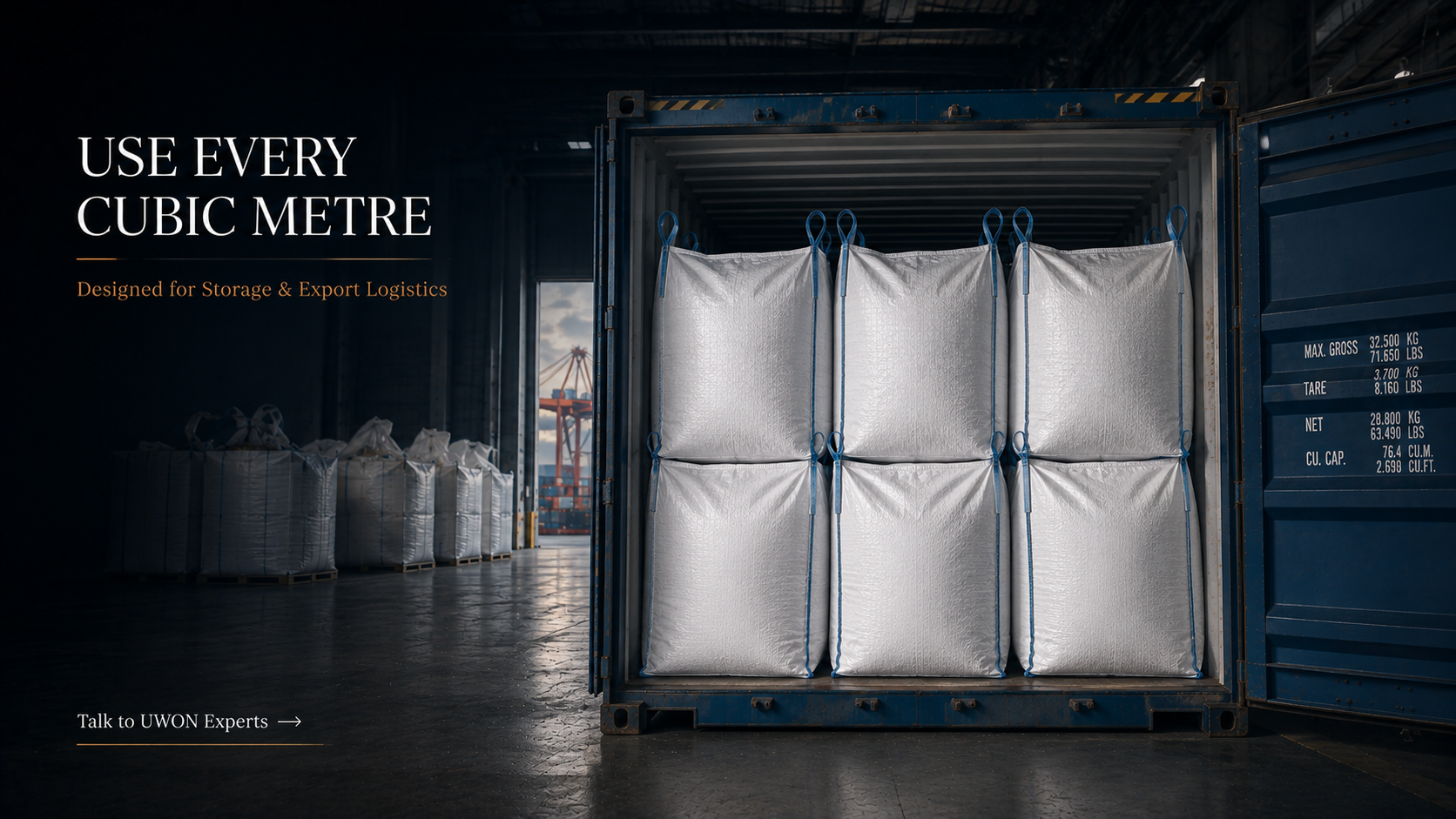
For exporters, the dimensions of a filled FIBC can directly influence how efficiently cargo space is used.
A bag that leaves large gaps between adjacent bags can reduce the amount of product transported per container or vehicle.
Before finalising dimensions, buyers should evaluate:
- Internal container width
- Internal container height
- Container door opening
- Bag footprint
- Filled bag height
- Number of bags per loading pattern
- Pallet requirements
- Stacking configuration
For containerised shipments, the goal is not simply to make the bag as large as possible.
The goal is to create a loading pattern that uses available space efficiently without compromising safe handling or the packaging’s functional requirements.
Why “Standard FIBC Size” Is Not Always the Right Size
Standard dimensions are useful because they can simplify purchasing, manufacturing and equipment compatibility.
However, standard does not necessarily mean optimal.
A standard FIBC may not be ideal when:
- The product has unusual bulk density
- The filling machine has specific clearance requirements
- The warehouse has limited height
- The pallet footprint is different
- The shipping container requires a specific loading pattern
- The discharge system requires a specific bottom position
- The product needs a liner or specialised construction
- The bag needs to integrate with automated handling equipment
UWON’s standard FIBC range supports general industrial and export applications, while its custom FIBC solutions allow dimensions and configurations to be adapted to application-specific requirements.
Standard vs Custom FIBC Dimensions
| Factor | Standard Dimensions | Custom Dimensions |
|---|---|---|
| Availability | Generally easier to source | Requires specification and production planning |
| Equipment compatibility | Useful where existing equipment uses common dimensions | Can be designed around specific equipment |
| Warehouse fit | Works well for common layouts | Can optimise unusual storage constraints |
| Container loading | Suitable for common loading patterns | Can be optimised for a specific logistics configuration |
| Material requirements | Best for predictable applications | Useful for unusual density or handling conditions |
Customisation does not automatically mean “better.” It means the dimensions can be engineered around the actual operating environment.
How FIBC Construction Changes Dimensional Performance
The same nominal dimensions can behave differently depending on the construction.
For example:
U-Panel FIBC
U-Panel construction uses a continuous U-shaped panel with additional side panels. It can provide good load distribution and shape stability for applications where stacking and handling matter.
4-Panel FIBC
Four-panel construction creates a defined square structure and can support dimensional consistency during storage and transport.
Baffle FIBC
Internal baffles help restrict outward bulging and maintain a more cubic shape, making this construction useful when space utilisation is a major consideration.
Circular FIBC
Circular construction uses tubular woven fabric and can provide an efficient solution for applications where the specific shape-retention characteristics of panel-based designs are not required.
Therefore, selecting dimensions and selecting construction should be treated as connected decisions.
A Practical Method for Choosing FIBC Bag Dimensions
Step 1: Define the Required Fill Weight
Determine how much material should go into each bag.
Step 2: Determine Bulk Density
Obtain a reliable bulk-density value for the actual material and operating condition.
Step 3: Estimate Required Volume
Use the target weight and bulk density to determine the approximate material volume required.
Step 4: Check the Filling System
Confirm that the proposed bag dimensions and top configuration work with the filling equipment.
Step 5: Check the Discharge System
Confirm that the bottom configuration and discharge position work with the receiving equipment.
Step 6: Check Warehouse Constraints
Review pallet footprint, storage height, stacking method and available floor space.
Step 7: Check Transport Constraints
Review container or vehicle dimensions and determine the most efficient loading arrangement.
Step 8: Select the Construction
Choose between circular, U-Panel, 4-Panel, Baffle or another configuration according to the material and operating environment.
Step 9: Validate the Complete Specification
Before production, confirm dimensions, SWL, safety factor, top, bottom, liner, fabric and handling requirements with the FIBC manufacturer.
For applicable FIBCs, buyers can also review the ISO 21898:2024 standard for FIBCs, which covers materials, construction, design, type testing and marking requirements for relevant FIBCs intended for non-dangerous solid materials.
7 Questions to Ask Before Ordering an FIBC
- What is the exact bulk density of the material?
- What is the required net fill weight per bag?
- What filling equipment will be used?
- How will the bag be discharged?
- How will filled bags be stored and stacked?
- What container, truck or pallet configuration will be used?
- Would a custom dimension or baffle/panel construction improve the overall operation?
Common FIBC Dimension Mistakes
Choosing the Bag by Weight Only
A 1,000 kg requirement does not tell the supplier how much volume the material occupies. Bulk density is essential.
Ignoring Filled-Bag Shape
The nominal dimensions of an empty FIBC do not tell the entire story. The filled shape can change according to construction and material.
Designing the Bag Without the Filling Equipment
A dimension that looks ideal on paper may not work with the existing filling station.
Ignoring Discharge Clearance
The bottom of the FIBC needs sufficient clearance and the correct discharge configuration for the receiving system.
Optimising for Container Volume Alone
Maximum theoretical volume is not the same as efficient logistics. Stability, handling and safe loading still matter.
Assuming Standard Means Optimal
Standard dimensions can be efficient for common applications, but process-specific requirements may justify a custom specification.
How UWON Can Help With FIBC Dimension Selection
FIBC dimensions should be developed around the material and the process in which the bag will operate.
UWON offers standard, U-Panel, 4-Panel, Baffle and custom FIBC configurations, with options for different top, bottom, loop, liner and fabric requirements.
Its custom FIBC solutions are designed around application-specific requirements, including adjustable dimensions, specialised construction and integration with filling, storage, transportation and discharge workflows.
For buyers who are unsure whether a standard bag is suitable, discussing the complete operating environment with the manufacturer before finalising dimensions can prevent expensive packaging and handling problems later.
Practical Takeaway
The right FIBC bag dimensions are determined by more than the amount of material you want to pack.
A reliable sizing process considers:
- Material bulk density
- Required fill weight
- Filling equipment
- Discharge requirements
- Warehouse space
- Stacking conditions
- Pallet configuration
- Container utilisation
- FIBC construction
- Handling requirements
Instead of asking for a “standard 1-ton bag,” give your supplier the complete application information. The result is more likely to be a bag that fits not only the product, but the entire supply chain around it.
If you need help selecting the appropriate FIBC dimensions, explore UWON Packaging’s FIBC solutions or discuss your material, filling, storage and transport requirements with the team.
Frequently Asked Questions
What are standard FIBC bag dimensions?
There is no single universal FIBC dimension that is correct for every application. Common dimensions vary by market, construction, capacity and intended use. The appropriate size should be selected according to material density, required weight, equipment and logistics conditions.
How do I calculate the required FIBC volume?
A basic estimate can be obtained by dividing the target material weight by its bulk density. The final FIBC design should then be validated against the material behaviour, filling conditions, bag construction and required operating capacity.
Does bulk density affect FIBC dimensions?
Yes. Bulk density determines how much volume a given weight of material occupies. Lower-density materials require more volume than higher-density materials for the same target weight.
Can FIBC dimensions be customised?
Yes. FIBCs can be manufactured with application-specific dimensions and configurations. Custom dimensions can be useful when filling equipment, storage areas, pallets or transport systems require a particular footprint or height.
Do baffle bags use space more efficiently?
Baffle FIBCs are designed to restrict outward bulging and maintain a more cubic shape. This can improve stacking and reduce unused space in certain warehouse and container-loading applications.
Should FIBC dimensions be designed around the pallet?
Often, yes. The pallet footprint can influence storage stability, stacking and loading efficiency. Pallet dimensions should be considered together with the filled FIBC’s actual footprint and height.
Can the same FIBC dimensions be used for different materials?
Not always. Materials with different bulk densities and flow characteristics can require different volumes, filling configurations and sometimes different bag constructions even when the target weight is the same.