
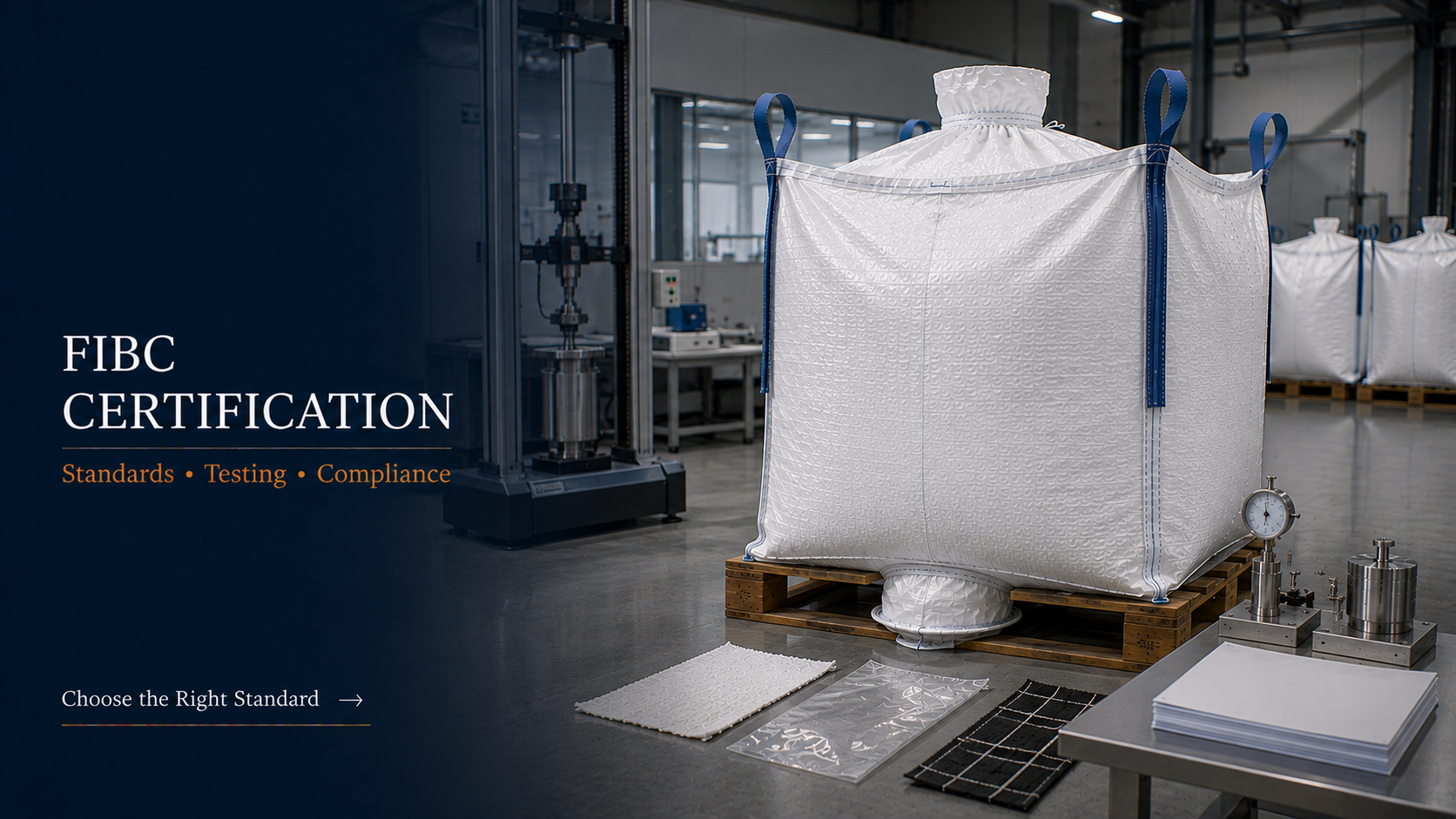
FIBC Certification Guide: 7 Standards Buyers Should Check
FIBC Certification Guide: Which Standard Does Your Jumbo Bag Need?
FIBC certification can become confusing when buyers encounter terms such as ISO 21898, UN certification, Type C, Type D, food-contact compliance and ISO 9001. These requirements do not all serve the same purpose, and not every Jumbo Bag needs every certification.
The right approach starts with the application. A standard FIBC for a non-dangerous material follows a different compliance path from a UN-certified FIBC used for applicable dangerous goods. Similarly, an FIBC used in a hazardous explosive atmosphere may require electrostatic classification.
Therefore, buyers should not simply ask a supplier, “Is this FIBC certified?” Instead, ask:
“Which standard applies to this specific FIBC, and what evidence supports the specification?”
This guide explains the major FIBC standards buyers should understand before approving a bulk-bag supplier.
FIBC Testing Is Not the Same as Certification

One of the most important distinctions for procurement teams is the difference between FIBC testing and certification.
A test provides evidence about a particular characteristic or performance requirement.
A certification or approval can involve a broader conformity or approval process depending on the applicable standard or regulation.
Depending on the FIBC application, buyers may encounter tests relating to:
- Top-lift performance
- Drop performance
- Stacking
- Seam strength
- Fabric strength
- Lifting-loop performance
- Electrostatic properties
- Food-contact migration where applicable
ISO 21898:2024 includes type-test requirements for applicable FIBCs for non-dangerous goods. :contentReference[oaicite:6]{index=6}
The UN dangerous-goods framework separately establishes testing and approval requirements for applicable packagings and IBCs. :contentReference[oaicite:7]{index=7}
Therefore, buyers should ask what was tested, against which requirement, and whether the evidence relates to the actual FIBC design being purchased.
Why FIBC Certification Depends on the Application
An FIBC is a flexible bulk container designed to handle substantial quantities of dry materials. However, the risks associated with the material and operating environment can vary significantly.
For example, a bag carrying a non-dangerous mineral product has different compliance considerations from a bag used to transport an applicable dangerous good.
Likewise, a food-contact application can require different material and documentation controls from an industrial packaging application.
Consequently, FIBC compliance should follow a simple sequence:
- Identify the material.
- Understand the handling environment.
- Determine the applicable regulatory or technical requirements.
- Select the appropriate FIBC construction.
- Verify the supporting tests and documentation.
This application-first approach helps buyers avoid paying for certifications that do not address their actual risk while also reducing the chance of missing an important requirement.
1. ISO 21898:2024 for Non-Dangerous FIBCs
ISO 21898:2024 is an important reference for buyers purchasing FIBCs for non-dangerous solid materials.
The current standard specifies materials, construction and design requirements, type-test requirements and marking requirements for FIBCs intended for non-dangerous solid materials in powder, granular or paste form. It also provides guidance on selection and safe use. View ISO 21898:2024 on ISO.
The 2024 edition replaced ISO 21898:2004 and was published in August 2024. :contentReference[oaicite:2]{index=2}
For buyers, this makes the edition referenced in a supplier specification important.
Instead of simply writing “ISO certified” on a purchase specification, buyers should identify the applicable standard and confirm how the supplier’s FIBC design relates to it.
Importantly, ISO 21898:2024 is specifically for non-dangerous goods. Buyers should not treat it as a universal certification for every type of FIBC.
2. UN Certified FIBC for Applicable Dangerous Goods
UN certified FIBC serves a different purpose.
When an FIBC is used for applicable dangerous-goods transport, the relevant UN dangerous-goods framework establishes requirements for packaging construction, testing, approval and related transport procedures.
The current UN Model Regulations include requirements covering the construction and testing of intermediate bulk containers, including marking, testing, certification and inspection. :contentReference[oaicite:3]{index=3}
Therefore, a normal industrial FIBC should not automatically be treated as suitable for dangerous goods.
Before requesting a UN-certified design, buyers should provide the supplier with information such as:
- UN number
- Proper shipping name
- Dangerous-goods classification
- Packing group where applicable
- Required packaging type
- Transport method
- Relevant regulatory requirements
This information helps the manufacturer determine the appropriate packaging route.
For dangerous-goods applications, explore UWON’s UN Certified FIBC solutions.
3. Electrostatic Protection and FIBC Classification
Electrostatic protection becomes an important consideration when FIBCs operate in environments where combustible dusts or other explosive-atmosphere hazards may exist.
IEC 61340-4-4:2018 covers electrostatic classification of FIBCs intended for hazardous explosive atmospheres. The standard includes classification and labelling, inner-liner classification, test methods, design and performance requirements, and safe-use considerations. :contentReference[oaicite:4]{index=4}
Depending on the application, buyers may encounter Type A, Type B, Type C and Type D FIBC classifications.
However, the classification should follow a proper risk assessment rather than a simple preference for one “premium” bag type.
Type A FIBC
Type A FIBCs do not provide specific electrostatic control characteristics for hazardous explosive atmospheres. Therefore, they should not be selected for an application simply because the bag is physically strong.
Type B FIBC
Type B designs address specific electrostatic discharge risks under defined conditions. The actual application and material characteristics still determine whether the design is appropriate.
Type C FIBC
Type C FIBCs use conductive elements and require appropriate grounding during operation. Consequently, the bag design and the grounding procedure both matter.
Type D FIBC
Type D FIBCs use dissipative or specified electrostatic-control characteristics without relying on the same grounding approach as Type C. However, buyers still need to evaluate the actual operating environment and applicable safety requirements.
IEC 61340-4-4:2018 also addresses relevant inner liners, so buyers should evaluate the liner together with the FIBC rather than treating it as an unrelated accessory. :contentReference[oaicite:5]{index=5}
4. Food-Grade FIBC Compliance
Food grade FIBC certification requires a different approach because the relevant requirements depend on the intended food-contact application and market.
For example, EU food-contact materials are subject to the general framework of Regulation (EC) No 1935/2004 and Good Manufacturing Practice requirements under Regulation (EC) No 2023/2006.
Plastic materials intended for food contact can also fall under Regulation (EU) No 10/2011, which establishes specific requirements for applicable plastic materials and articles.
Therefore, buyers should not treat the phrase “food grade” as a complete technical specification.
Instead, ask the supplier about:
- Food-contact suitability
- Material composition
- Applicable legislation
- Migration testing where applicable
- Declarations or supporting documents
- Manufacturing controls
- Liner specifications
For food and beverage applications, explore UWON’s Food & Beverage FIBC solutions.
5. ISO 9001 Does Not Replace Product-Specific FIBC Requirements
Buyers may also encounter ISO 9001 when evaluating FIBC manufacturers.
However, ISO 9001 and an FIBC product standard address different things.
ISO 9001 concerns a quality-management system. It does not automatically demonstrate that a particular Jumbo Bag meets every applicable FIBC, dangerous-goods, electrostatic or food-contact requirement.
Therefore, a strong supplier evaluation should consider both:
- The manufacturer’s quality-management system
- The product-specific technical and compliance evidence
This distinction prevents buyers from treating a company-level management-system certification as a substitute for product testing or regulatory approval.
6. Product Certification vs Supplier Certification
This distinction can save procurement teams from a common mistake.
A supplier may hold a valid management-system certification while the specific FIBC still requires separate testing or approval.
Similarly, a product may meet a particular technical requirement without that requirement representing a universal legal certification for every FIBC application.
Therefore, buyers should ask:
- What exactly does this certificate cover?
- Who issued it?
- Which manufacturing site does it cover?
- Which product or FIBC design does it cover?
- What standard or regulation does it reference?
- Is it still valid?
- Does the actual supplied bag match the certified design?
These questions make certification documents much more useful during supplier qualification.
How to Choose the Right FIBC Certification
The easiest way to identify the appropriate requirement is to start with the application.
For Non-Dangerous Industrial Materials
Begin with the FIBC design, SWL, construction, handling conditions and applicable product standard. ISO 21898:2024 can provide a relevant reference for FIBCs intended for non-dangerous solid materials. :contentReference[oaicite:8]{index=8}
For Dangerous Goods
Begin with the dangerous-goods classification and transport requirements. Then determine whether the packaging requires UN approval.
For Food Applications
Begin with the intended food-contact application and the regulations applicable to the destination market. Then verify the materials, manufacturing controls and supporting documentation.
For Electrostatic-Risk Applications
Begin with a proper hazard assessment. Then determine which FIBC electrostatic classification and operating controls are appropriate.
For this reason, certification should follow the application rather than the other way around.
What Buyers Should Ask FIBC Manufacturers in India

When comparing FIBC manufacturers in India, procurement teams should ask precise questions instead of requesting a generic “certificate list.”
- Which FIBC standards do you manufacture against?
- Which edition of the applicable standard does the specification reference?
- Is the FIBC intended for dangerous or non-dangerous goods?
- Does the application require UN certification?
- Does the application involve electrostatic hazards?
- Which FIBC classification is proposed?
- Does the FIBC involve food contact?
- What food-contact documentation is available?
- Which tests support the FIBC design?
- Can the test reports be linked to the actual supplied design?
- What quality-management certifications does the manufacturing site hold?
- How does the supplier control changes to approved materials or construction?
- How is production traceability maintained?
These questions help buyers evaluate the complete compliance picture rather than simply counting certificates.
Why the Same FIBC Supplier Can Need Different Compliance Solutions
Imagine a manufacturer supplies three customers.
The first customer uses an FIBC for a non-dangerous mineral product.
The second uses an FIBC for a dangerous good that requires approved packaging.
The third uses an FIBC for a food ingredient.
All three customers may purchase from the same supplier.
However, their compliance requirements can differ significantly.
The first application may focus heavily on FIBC construction, type testing and safe use. The second may require dangerous-goods packaging approval. The third may require food-contact documentation.
Therefore, the supplier’s ability to identify the correct requirement for each application can be more valuable than simply maintaining a long list of certifications.
What Documentation Should Buyers Request?
A professional FIBC procurement file should connect the approved bag specification with the supporting evidence.
Depending on the application, buyers may request:
- FIBC technical specification
- Applicable standard reference
- Test reports
- UN approval documentation where applicable
- Food-contact declarations where applicable
- Material specifications
- Liner specifications
- Electrostatic classification where applicable
- Quality-management certification
- Product drawings
- Marking specifications
- Batch or production traceability
However, the exact document set should match the application and applicable requirements.
More documents do not automatically mean better compliance.
Why Traceability Matters After Certification
Certification and testing establish important evidence, but procurement teams also need consistency during repeat production.
A change to fabric, liner, coating, thread, printing or construction can potentially affect the characteristics of the finished FIBC.
Therefore, buyers should understand the supplier’s change-control process.
Ask:
- How are approved materials controlled?
- How are production batches identified?
- How are specification changes documented?
- When does a change require re-testing?
- How are non-conformities managed?
This becomes particularly important for long-term supply contracts where thousands of FIBCs may be manufactured against one approved specification.
How FIBC Construction Connects With Compliance
Compliance cannot always be separated from physical bag design.
Construction choices can influence the performance characteristics that buyers need to evaluate.
For example, a buyer may need a specific lifting configuration, liner, filling arrangement, discharge system or electrostatic design.
Therefore, procurement teams should treat compliance as part of the overall FIBC specification rather than as a certificate attached after the bag has already been designed.
For a deeper comparison of U-Panel, 4-Panel and Baffle constructions, read FIBC Bag Construction: U-Panel vs 4-Panel vs Baffle Bags.
For a practical specification framework, read How to Choose FIBC Bags: 9 Specifications That Matter.
How UWON Supports Application-Specific FIBC Requirements
UWON offers multiple FIBC constructions and application-specific bulk-packaging configurations.
The product range includes Standard, U-Panel, Circular, 4-Panel and Baffle FIBCs, along with filling, discharge and liner options.
This allows buyers to discuss the physical packaging requirements together with the application’s compliance considerations.
For dangerous-goods applications, explore UWON’s UN Certified FIBC solutions.
For food applications, explore Food & Beverage FIBC solutions.
Explore UWON Packaging’s FIBC solutions.
FIBC Certification Checklist Before Supplier Approval
Before approving an FIBC supplier, confirm:
- What material will the FIBC contain?
- Is it dangerous or non-dangerous?
- Which FIBC standard applies?
- Which edition is referenced?
- Does the application require UN certification?
- Does the application involve electrostatic hazards?
- Does the application involve food contact?
- Which tests support the design?
- Does the evidence relate to the actual FIBC being supplied?
- What quality-management certifications does the supplier hold?
- How are material and design changes controlled?
- How is production traceability maintained?
- Which documents will accompany the approved specification?
If the supplier can answer these questions clearly, procurement teams gain a stronger basis for evaluating both compliance and product consistency.
Conclusion
FIBC certification is not a one-size-fits-all requirement.
ISO 21898:2024, UN dangerous-goods requirements, electrostatic classifications and food-contact requirements address different applications and risks.
Therefore, buyers should start with the product and operating environment before selecting a certification or standard.
Then connect the requirement to the actual FIBC construction, testing evidence and supplier documentation.
The strongest procurement process does not ask for the longest list of certificates.
It asks the right supplier to provide the right evidence for the right FIBC application.
Discuss your FIBC compliance requirements with UWON Packaging.
Frequently Asked Questions
What is FIBC certification?
FIBC certification refers to the applicable certification, approval or documented conformity evidence associated with a particular FIBC requirement. The exact requirement depends on the material, application, transport conditions and applicable standard or regulation.
What is ISO 21898:2024?
ISO 21898:2024 is the current ISO standard for FIBCs intended for non-dangerous solid materials in powder, granular or paste form. It specifies materials, construction, design, type testing and marking requirements and provides guidance on selection and safe use. :contentReference[oaicite:9]{index=9}
Does every FIBC need UN certification?
No. UN certification applies to applicable dangerous-goods packaging requirements. A standard FIBC used for non-dangerous material does not automatically require UN approval.
What is a UN certified FIBC?
A UN certified FIBC is packaging that has been approved under the applicable dangerous-goods packaging framework. Buyers must match the approval and packaging specification to the relevant dangerous good and transport requirements.
What are Type C and Type D FIBCs?
Type C and Type D are electrostatic classifications used in relevant FIBC applications. IEC 61340-4-4:2018 covers electrostatic classification, testing, design and safe-use considerations for FIBCs used in hazardous explosive atmospheres. :contentReference[oaicite:10]{index=10}
Does a food grade FIBC need certification?
The applicable requirements depend on the intended food-contact application and destination market. Buyers should identify the relevant food-contact regulations and request appropriate supporting documentation from the supplier.
Is ISO 9001 an FIBC certification?
ISO 9001 addresses a quality-management system. It does not automatically prove that a particular FIBC meets every product-specific technical, dangerous-goods, electrostatic or food-contact requirement.
What should I ask FIBC manufacturers in India?
Ask which standards apply, which edition the supplier references, what testing supports the FIBC, whether UN or electrostatic requirements apply, what food-contact documentation is available where relevant, and how the manufacturer controls production consistency and traceability.
Can one FIBC have more than one compliance requirement?
Yes. Depending on the application, an FIBC can have multiple applicable requirements. Buyers should evaluate the complete packaging specification and determine which standards, regulations and tests apply to the actual use case.