
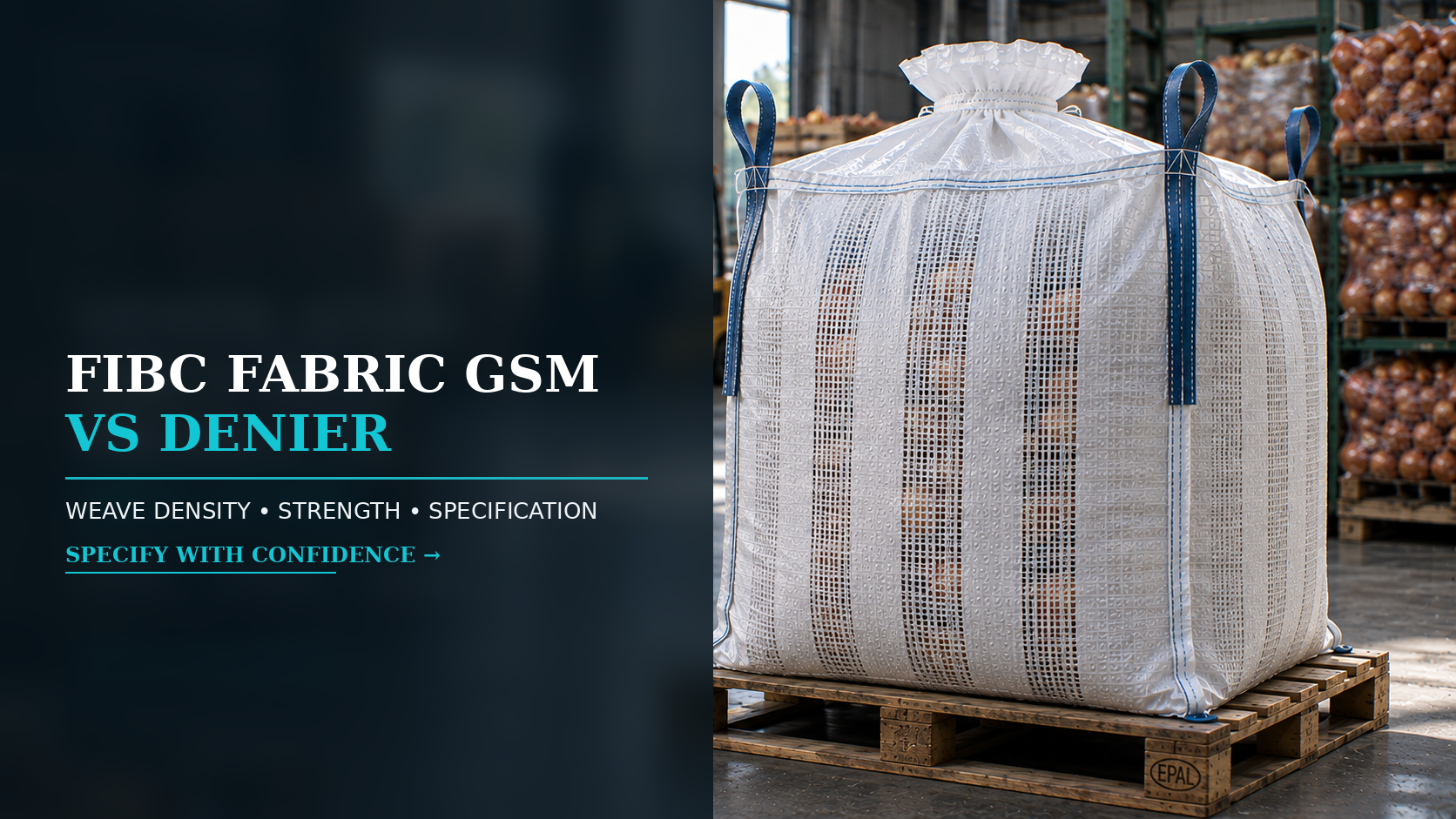
FIBC Fabric GSM vs Denier vs Weave Density: What Buyers Should Specify
FIBC fabric GSM is one of the most common numbers on a jumbo bag specification, but it is also one of the easiest to misunderstand. A higher GSM means more fabric mass per square metre. It does not automatically prove that one FIBC is stronger, safer or better than another.
To evaluate woven polypropylene correctly, buyers should understand how GSM interacts with tape denier, tape width, weave density, fabric construction, seams and the complete tested bag design.
What Does GSM Mean in FIBC Fabric?
GSM means grams per square metre. It measures the mass of a square metre of woven fabric. A 180 GSM fabric therefore contains more polymer per unit area than a 140 GSM fabric, assuming both values are measured consistently.
However, the ISO 21898:2024 approach to FIBC performance is based on the complete design and testing requirements, not on a simple GSM table.
What Is Denier?
Denier describes the linear mass of the individual polypropylene tapes used to weave the fabric. Two fabrics can reach a similar GSM using different tape sizes and different numbers of tapes per unit width.
What Is Weave Density?
Weave density describes how closely the tapes are packed in the warp and weft directions. A tighter weave can improve coverage and may influence tear behavior, dimensional stability and sifting characteristics.
Why GSM Alone Does Not Determine FIBC Strength
Bag strength depends on how load moves through the whole structure. Fabric tensile properties, loop webbing, sewing pattern, seam strength, bag dimensions and stress concentration around attachments all matter. A heavier body fabric cannot compensate for weak seams or a poorly engineered loop attachment.
That is why buyers should also review our FIBC safety factor guide and FIBC seam types guide.
7 Buyer Checks Beyond GSM
1. Confirm the actual SWL
The Safe Working Load is the maximum intended load for the designed bag. Do not infer SWL from fabric GSM alone.
2. Ask for weave construction
Where technically relevant, ask the supplier for fabric construction details rather than comparing only one weight number.
3. Review the product bulk density
Dense materials can create high localized stresses and reach the SWL before the bag looks full. Use the FIBC bulk density guide when sizing the package.
4. Consider abrasion and particle shape
Sharp or abrasive products may require attention to more than tensile strength. Base construction, coating and liner selection can influence resistance to wear.
5. Check loop and seam design
The strongest fabric still depends on correctly engineered lifting loops and seams.
6. Confirm coating weight separately
If the fabric is coated, clarify whether the quoted GSM includes coating or refers to the woven substrate. This prevents misleading comparisons between suppliers.
7. Compare complete tested designs
For critical applications, compare specifications and performance evidence for the complete FIBC rather than choosing the highest GSM quotation.
How Buyers Can Write a Better Fabric Specification
Instead of writing ‘heavy GSM fabric required,’ define the product, target fill weight, bag dimensions, handling method, safety factor, coating, liner, storage conditions and expected transport environment. Then let the supplier propose an engineered fabric construction and provide supporting test information.
This gives FIBC manufacturers in India a clearer basis for engineering and makes quotations easier to compare.
Common Procurement Mistakes
- Assuming higher GSM automatically means higher SWL.
- Comparing coated and uncoated GSM without clarifying the basis.
- Ignoring seams and loop attachments.
- Using one GSM standard for products with very different bulk densities.
- Increasing fabric weight instead of solving the actual failure mode.
Frequently Asked Questions
Does higher FIBC GSM mean a stronger bag?
Not necessarily. Higher GSM means more fabric mass, but complete bag strength also depends on tape properties, weave, seams, loops and tested design.
What is the difference between GSM and denier?
GSM measures fabric mass per area. Denier measures the linear mass of individual tapes or yarns.
Should coating be included in GSM?
Suppliers may report fabric values differently, so buyers should clarify the basis of the quoted GSM.
Can two FIBC fabrics have the same GSM but different performance?
Yes. Differences in tape dimensions, weave density, polymer quality and construction can produce different performance.
Final Takeaway
FIBC fabric GSM is useful, but it should never be treated as a standalone safety rating. The best specification connects fabric construction to the complete tested bag, product characteristics and real handling conditions.