
FIBC Lot Traceability: Batch Codes, Labels and Records Buyers Should Specify
FIBC Lot Traceability: Batch Codes, Labels and Records Buyers Should Specify
An FIBC can leave a factory in good condition and still become difficult to manage if its identity is lost between production, filling, warehousing and delivery. Pallets may be split, bags may move between storage zones, labels may be damaged, and a quality question may arrive weeks after dispatch. If the buyer can identify only the supplier and general bag model, the investigation may have to cover far more stock than necessary.
FIBC lot traceability connects a physical bag or defined group of bags to records showing what was made, how it was checked and where it moved. It does not require every buyer to install an expensive software platform. It does require a consistent identifier, readable marking, controlled records and agreement about what each code means. This guide explains what to specify and how to test the system before routine supply begins.
1. Why FIBC Traceability Matters After Dispatch
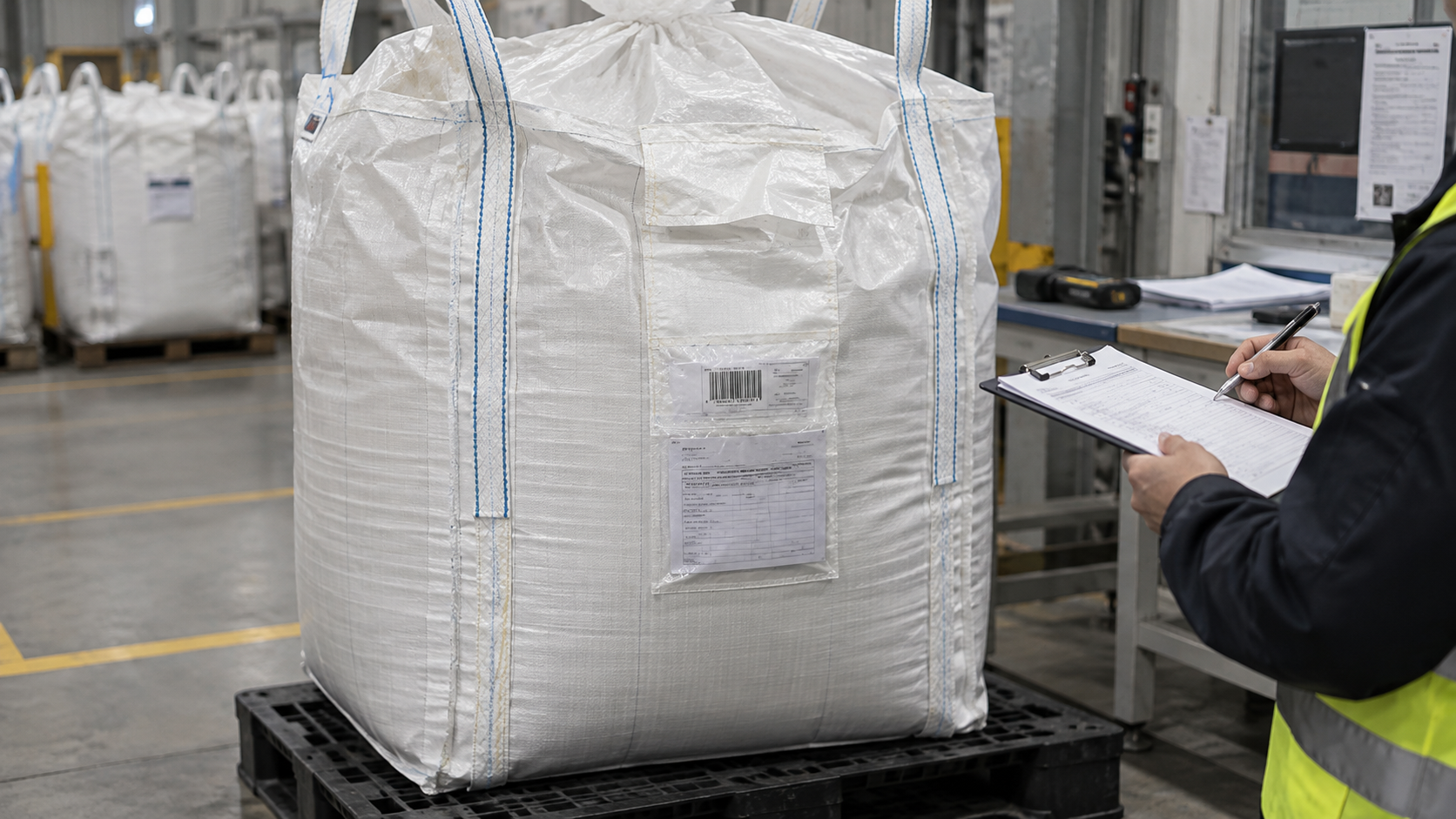
Most packaging records are easiest to retrieve while an order is still on the production floor. The challenge starts after the bags move. A customer may receive several deliveries of the same design, store them in different warehouses and consume them across multiple filling lines. Later, a seam concern or label mismatch may be reported. Without a reliable link between the physical bags and production records, the supplier and buyer may not know which stock is affected.
A useful system narrows the question from “Which bags did this supplier make last month?” to “Which lot and dispatch contain bags carrying this identifier?” That supports faster containment, focused inspection and better inventory decisions. Traceability does not prove a bag is defect-free; it helps teams find the right evidence when a decision is needed.
2. Decide Exactly What Must Be Traceable
Define the object that the code identifies. A product model, manufacturing batch, individual FIBC, pallet and container shipment are different levels. A model code identifies a design; it does not necessarily identify the production run that made a particular bag.
For many repeat programmes, batch identification is a practical starting point. If the buyer needs the history of each physical bag, individual serial numbers may be appropriate. If the main need is to locate a pallet or container, a logistics-unit identifier can be linked to the bag lots inside it. State the required level in plain language: identify each bag, each lot, each pallet or each shipment. Do not use “traceable” without defining the level.
3. Select the Right Identification Granularity
Identification can distinguish a bag design, a production lot, one physical bag or a shipment grouping. More detail can improve investigation speed, but every unique number must be generated, printed, captured, stored and checked. If a buyer never scans individual serials, serialising every bag may add cost without improving control.
| Level | What it distinguishes | Typical use |
|---|---|---|
| Product code | Design and approved specification | Order matching |
| Production lot | One defined manufacturing group | Quality investigation |
| Individual serial | One physical bag | Unit-level history |
| Pallet or shipment ID | A logistics unit or consignment | Warehouse and dispatch control |
Agree the granularity with procurement, quality, warehouse and the supplier before label artwork is approved.
4. Create a Consistent FIBC Lot Code
A useful code is unique within the system, easy to read and supported by a written format. An illustrative pattern could be UW-FIBC-261108-L03-0042, where segments represent a product family, date code, line or shift reference and sequence. This is an example only, not a UWON-assigned production code.
Document the code owner, date format, sequence reset rules and duplicate-prevention method. If the same identifier appears on two labels, both must point to the same record. Avoid unnecessary customer or personal data in a code that may be visible throughout the supply chain.
For organisations using GS1 logistics labels, GS1 says it does not prescribe a universal batch-number structure and gives a maximum length of 20 alphanumeric characters for a batch number on a GS1 Logistic Label. That guidance applies to that GS1 context, not to every FIBC code. See GS1 batch-number guidance.
5. Specify the Minimum Data on Each Bag Label
The label should identify the bag without making the fabric panel unreadable. Depending on the agreed design and application, buyers may specify supplier identity, product or drawing reference, purchase-order reference, production lot, date code, and a scannable identifier. The exact fields must match the approved specification.
Technical information such as safe working load, safety factor, dimensions, bag type and handling instructions must be accurate and authorised. Never copy values from an unrelated bag. Request a label proof and check spelling, units, code readability, revision status and visibility after filling or wrapping.
6. Keep Internal Traceability Separate From Regulated Markings
A buyer-defined lot code is an internal identification tool. It does not prove that an FIBC meets a performance standard, passed a required test or is approved for a dangerous-goods service. Those claims depend on the applicable design, test evidence, marking and documentation.
Where regulated marks apply, identify who is authorised to create and verify them. Do not cover required marks with warehouse labels, place a barcode across a seam or lifting feature, or use an internal sticker as a substitute for a required mark. Plan compatible label locations in the approved layout. For general FIBC handling, consult the FIBCA safe handling guidelines and the instructions for the specific bag.
7. Connect the Bag ID to Manufacturing Records
A code has little value if the supplier cannot resolve it. The production record should link the lot or serial to the approved specification and evidence needed for an investigation. Depending on process and risk, this may include incoming material references, fabric or component batches, cutting and sewing records, production date, line or shift, inspection results, nonconformance disposition and final release.
Not every field belongs on the bag. The label is the lookup key; the controlled record is the evidence. Agree which records can be retrieved, who can access them and how long they are retained. If fabric, liner, seam method or construction changes, the lot history should show which approved revision was used. See the FIBC supplier change-control guide.
8. Record Critical Tracking Events Across Production
Traceability is stronger when records describe events, not only a final label. GS1 describes Critical Tracking Events as activities during an object’s lifecycle, such as receiving, packing, shipping and transporting; Key Data Elements describe each event. Buyers can use this framework without assuming that every supplier must adopt a particular GS1 technology.
For an FIBC programme, useful events may include material receipt, bag assembly, inspection, release, packing, dispatch, customer receipt and movement into a filling location. Each event should capture the identifier, date, location, responsible role, quantity and resulting status where relevant.
| Event | Useful record | Purpose |
|---|---|---|
| Production release | Lot, specification revision, date, quantity | Identify the approved version |
| Final inspection | Sample, result, inspector, disposition | Link a quality decision to the lot |
| Packing | Lot, pallet ID, quantity, label check | Prevent mixed or unidentified pallets |
| Dispatch and receipt | Shipment, destination, quantity, exceptions | Connect factory stock to customer stock |
Read the GS1 Global Traceability Standard overview for the event-and-data-element model.

9. Design Labels for Industrial Handling Conditions
Labels face abrasion, dust, moisture, handling contact and sometimes outdoor storage. A label that scans on a sample table may become unreadable after warehouse or container transit. Test the actual material, print contrast, attachment method and placement under representative conditions.
Choose a location operators can see without moving a loaded bag or reaching near a suspended load. Keep labels clear of loops, seams, spouts and filling connections. If two labels are used, both must show the same identifier. Retain human-readable characters so the code can still be checked when a scanner, phone or network is unavailable.
10. Use Barcodes and QR Codes as Data Carriers, Not Magic
A barcode or QR code can reduce manual entry and speed up receipt, picking and stock checks. It can encode an identifier or open a digital record. It cannot fix poor master data, prevent duplicate numbers by itself or guarantee that the linked information is correct.
Decide what the code should do. A barcode may identify a lot or pallet in a warehouse system; a QR code may open a controlled page with the approved specification or inspection status. Define access permissions, link ownership and what happens if a URL changes. Do not expose confidential customer or production information through a public link.
GS1 India describes identification, data capture and data sharing as separate parts of traceability, including barcodes and two-dimensional codes as capture methods. See its traceability overview. A QR code is not proof of FIBC compliance, and a business should not claim GS1 compliance unless the relevant identifiers and standards are actually implemented.
11. Link Bags to Pallets, Containers and Shipments
Bag or lot identification should connect to the logistics records used by the buyer. If a pallet contains several lots, the packing list must show the split. If one lot is divided across several pallets, each pallet record should preserve that relationship. The shipment record should list the pallet identifiers and quantities loaded.
When a pallet is broken down in a warehouse, update the record so it no longer appears to contain the original group. Receiving staff should be able to scan or read a pallet ID and retrieve the bag lots inside it. Organisations using GS1 logistics identifiers may use the Serial Shipping Container Code for a logistics unit; confirm the right identifier with logistics partners rather than printing a GS1 symbol without a valid allocation and process.
12. Control Reprints, Corrections and Duplicate IDs
Labels may need replacement because they are damaged, misprinted or attached to the wrong pallet. A replacement must not create a second identity for one bag or silently transfer an old lot number to new stock. Define who can authorise a reprint, how the original is invalidated and how the correction is recorded.
Use a controlled sequence or database check to prevent duplicate IDs. Retain void records and reasons. If a pallet is relabelled after repacking, preserve the relationship between the old pallet ID, new ID and bag lots. If two physical bags carry the same serial number, quarantine them until the identity is resolved.
13. Use Traceability to Investigate Claims and Contain Risk
When a complaint arrives, record the identifier shown on the bag, purchase order, receipt date, warehouse location, filling line and available photographs. Establish whether the issue affects one bag, a pallet, a lot or several deliveries. Segregate affected stock while the facts are checked; do not place unrelated lots on hold without a reason.
The supplier can retrieve the approved specification, production records, inspection results, packing list and dispatch details. The buyer can compare the physical bag with the approved sample and receiving records. Traceability supports a focused response, but it does not replace technical assessment or root-cause analysis. For sampling and lot acceptance, see the FIBC AQL sampling guide and the pre-shipment inspection checklist.
14. Agree Data Ownership, Access and Retention
Agree which records are shared routinely, which are available on request and which remain confidential. A buyer may need the lot identifier, quantity, specification revision, inspection release and dispatch reference on routine documents, while detailed manufacturing records may be supplied during an investigation or audit.
State who can request records, the expected response time and the format of delivery. Retention periods should reflect the contract, risk, applicable law and product or transport requirements; do not assume one universal period applies to every FIBC. Also agree how electronic records are backed up, how changes are logged and what happens if a supplier changes its software.
15. Test the System Before Approving the FIBC
Do not approve traceability by reviewing a label PDF alone. Run a sample exercise. Start with one physical bag and ask the supplier to retrieve its lot, approved specification, inspection status and shipment. Then reverse the exercise: choose a lot record and identify the pallets and destinations associated with it.
- Each sample bag has a legible ID matching the controlled record.
- The ID is not duplicated across unrelated bags or lots.
- The lot record identifies the approved specification and revision.
- Inspection status and nonconformance disposition can be retrieved.
- Label placement does not obstruct handling features or required marks.
- Barcode or QR scanning works with the buyer’s actual device, if used.
- Pallet and shipment records reconcile to physical quantities.
- Reprinted labels are controlled and linked to the correction record.
- The supplier can retrieve agreed evidence within the response time in the quality agreement.
Record the test result, open gaps and corrective actions. If the supplier cannot resolve a sample identifier during approval, do not assume the system will work during a live complaint. The FIBC RFQ checklist helps capture packaging requirements before quotation and approval.
16. Frequently Asked Questions About FIBC Lot Traceability
Does every FIBC need an individual serial number?
No. The required level depends on risk, customer requirements and the ability to maintain accurate records. A production-lot code may be sufficient for many repeat programmes. Individual serialisation is useful when the buyer needs the history of each physical bag and can capture that information throughout its process.
Is a QR code mandatory on FIBC bags?
There is no universal rule that every FIBC must carry a QR code. A buyer may request one for warehouse scanning or access to controlled records. Check any sector-specific legal or customer requirement separately for the product, market and packaging role.
Does a batch number prove that an FIBC passed testing?
No. A batch number identifies a defined group or production record. Inspection status and test evidence must be available in controlled quality records and linked to that identifier. A printed code alone is not proof of conformity.
Can one pallet contain more than one FIBC production lot?
It can if the buyer’s process permits mixed lots and the packing record clearly identifies quantities and bag identifiers. If single-lot pallets are required, state that in the purchase order and verify it at packing and receipt.
What should a buyer request when a traceability complaint occurs?
Start with the bag or lot ID, purchase order, delivery reference, photographs and issue description. Request the linked approved specification, inspection status, relevant production records and dispatch information agreed in the supplier quality arrangement.
Make traceability part of the specification, not an afterthought. State the identification level, label fields, code format, scanning method, record access and response expectations when requesting a quotation. Explore UWON Packaging’s FIBC product range and submit application details through the FIBC specification and RFQ tool so bag design and documentation can be discussed together.
References: GS1 Global Traceability Standard overview; GS1: How traceability works; GS1 India: Traceability; GS1 batch-number guidance; FIBCA FIBC handling guidelines.