
FIBC Market 2026: 7 Jumbo Bag Trends Buyers Need to Know
FIBC Market Update 2026: Why Jumbo Bag Buyers Are Changing Their Specifications
The FIBC market in 2026 is entering an important phase. Jumbo Bags and Flexible Intermediate Bulk Containers continue to support the movement of powders, granules and other dry bulk materials, but buyers are becoming more selective about what they specify.
Recent industry forecasts point to continued growth in the global Jumbo Bags market. Future Market Insights estimates the market at approximately USD 6.9 billion in 2026, with a projected value of USD 10.4 billion by 2036. The report identifies bulk movement across fertilizers, cement, food ingredients, chemicals and minerals as important demand drivers. ([futuremarketinsights.com](https://www.futuremarketinsights.com/reports/jumbo-bags-market))
At the same time, regulatory developments are changing the procurement conversation, particularly in Europe.
The EU Packaging and Packaging Waste Regulation (PPWR) generally begins applying from 12 August 2026. The European Commission says the regulation establishes requirements covering packaging manufacturing, composition and its reusable or recoverable nature, alongside packaging-waste management and prevention measures. ([European Commission](https://environment.ec.europa.eu/topics/waste-and-recycling/packaging-waste_en))
As a result, the FIBC market is moving beyond a simple price-and-capacity conversation.
For many buyers, the question is becoming:
“Does this FIBC specification fit the application, logistics system and evolving market requirements?”
FIBC Market 2026: From Commodity Packaging to Engineered Solutions
For years, many buyers treated Jumbo Bags primarily as a cost-efficient way to transport bulk materials.
That role has not disappeared. However, procurement teams now increasingly evaluate the complete performance of the packaging.
Current market analysis highlights growing interest in stronger fabrics, specialized discharge systems, liner bags, recycling and reuse. ([Research and Markets](https://www.researchandmarkets.com/reports/5462813/2026-fibc-flexible-intermediate-bulk-container))
Consequently, an FIBC quotation increasingly needs to answer more than one question.
- What weight can the bag carry?
- What construction does it use?
- How will operators fill it?
- How will they discharge it?
- Does the material require a liner?
- Does the application require special handling?
- What documentation supports the specification?
- Can the supplier maintain consistent production?
This shift makes technical specification more important for both buyers and FIBC manufacturers in India.
European FIBC Buyers Are Facing a New Regulatory Timeline
One of the biggest developments affecting FIBC packaging Europe is the implementation of the EU PPWR.
The European Commission confirms that Regulation (EU) 2025/40 entered into force on 11 February 2025 and generally applies from 12 August 2026. ([European Commission](https://environment.ec.europa.eu/topics/waste-and-recycling/packaging-waste_en))
Importantly, not every PPWR requirement starts at the same time.
The Commission’s implementation material shows that several requirements and methodologies have later implementation dates, including future measures connected with design for recycling and recycled-at-scale assessment. ([European Commission](https://food.ec.europa.eu/document/download/0308d41e-0c8d-4dab-8518-f8a78e5ffdff_en?filename=fw_eu-platform_20250611_pres-15.pdf))
Therefore, European FIBC procurement should not reduce PPWR to a single statement such as “every Jumbo Bag must be recyclable in exactly the same way.”
Instead, buyers should understand the actual packaging construction and determine which provisions apply to their specific application.
For a deeper look at this issue, read UWON’s article: EU PPWR and FIBC Packaging: Why Buyers Need to Look Beyond “Recyclable”.
Why FIBC Construction Is Becoming More Important
One of the clearest trends in FIBC packaging trends is the move toward application-specific construction.
A buyer transporting agricultural products may need a different FIBC from a manufacturer handling fine powders or a chemical company transporting regulated materials.
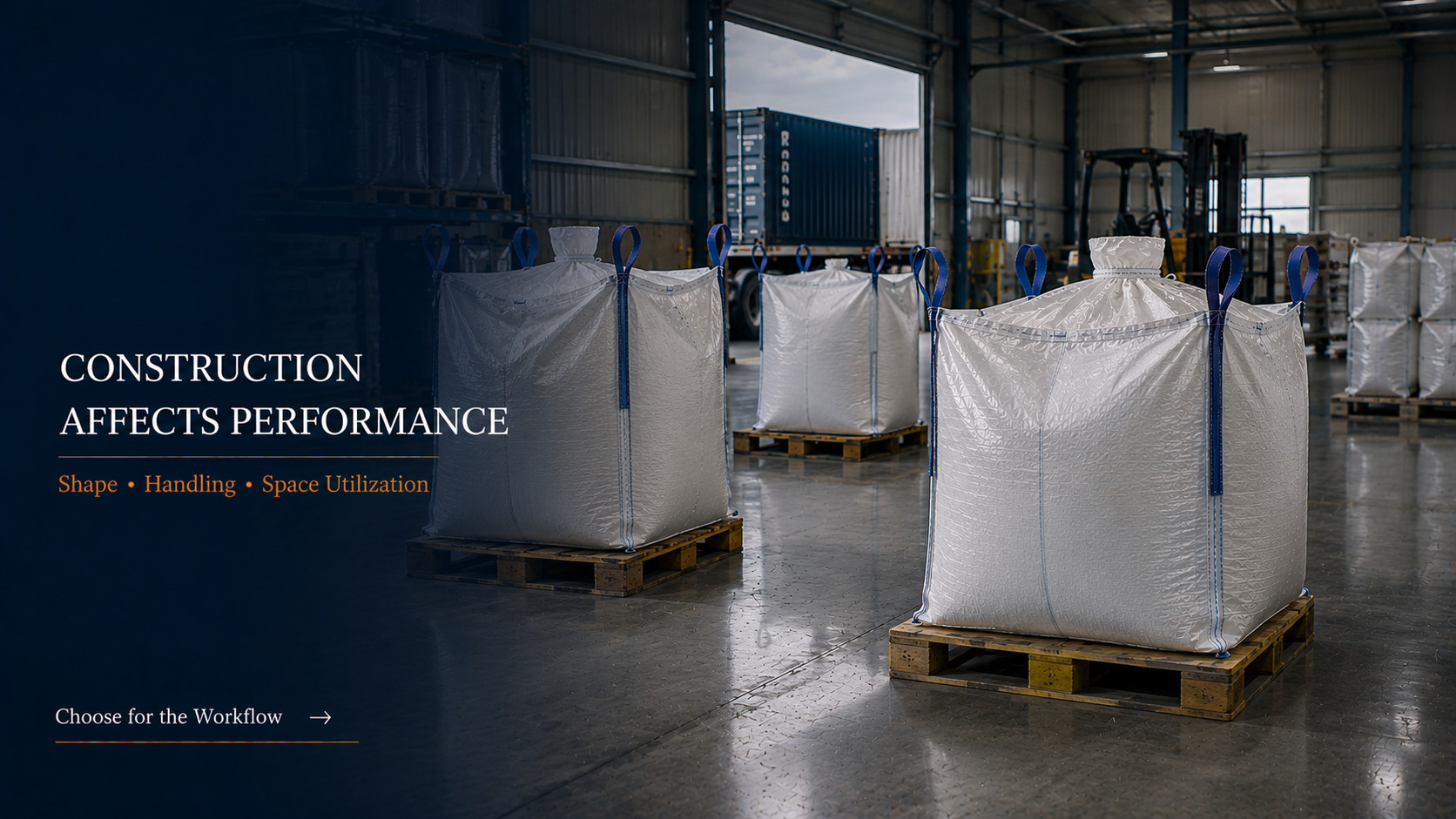
Construction affects shape retention, load distribution, stacking and handling.
For example, U-Panel, 4-Panel, Circular and Baffle FIBCs can provide different physical characteristics.
Baffle FIBCs can maintain a more controlled cubic shape, while other constructions can provide different combinations of manufacturing efficiency, flexibility and load distribution.
Therefore, the cheapest construction is not automatically the most economical option for every supply chain.
UWON’s FIBC range includes multiple constructions designed around different industrial applications.
For a detailed comparison of these constructions, see: FIBC Bag Construction: U-Panel vs 4-Panel vs Baffle Bags — Which Is Right for Your Application?
Buyers Are Looking More Closely at FIBC Specifications
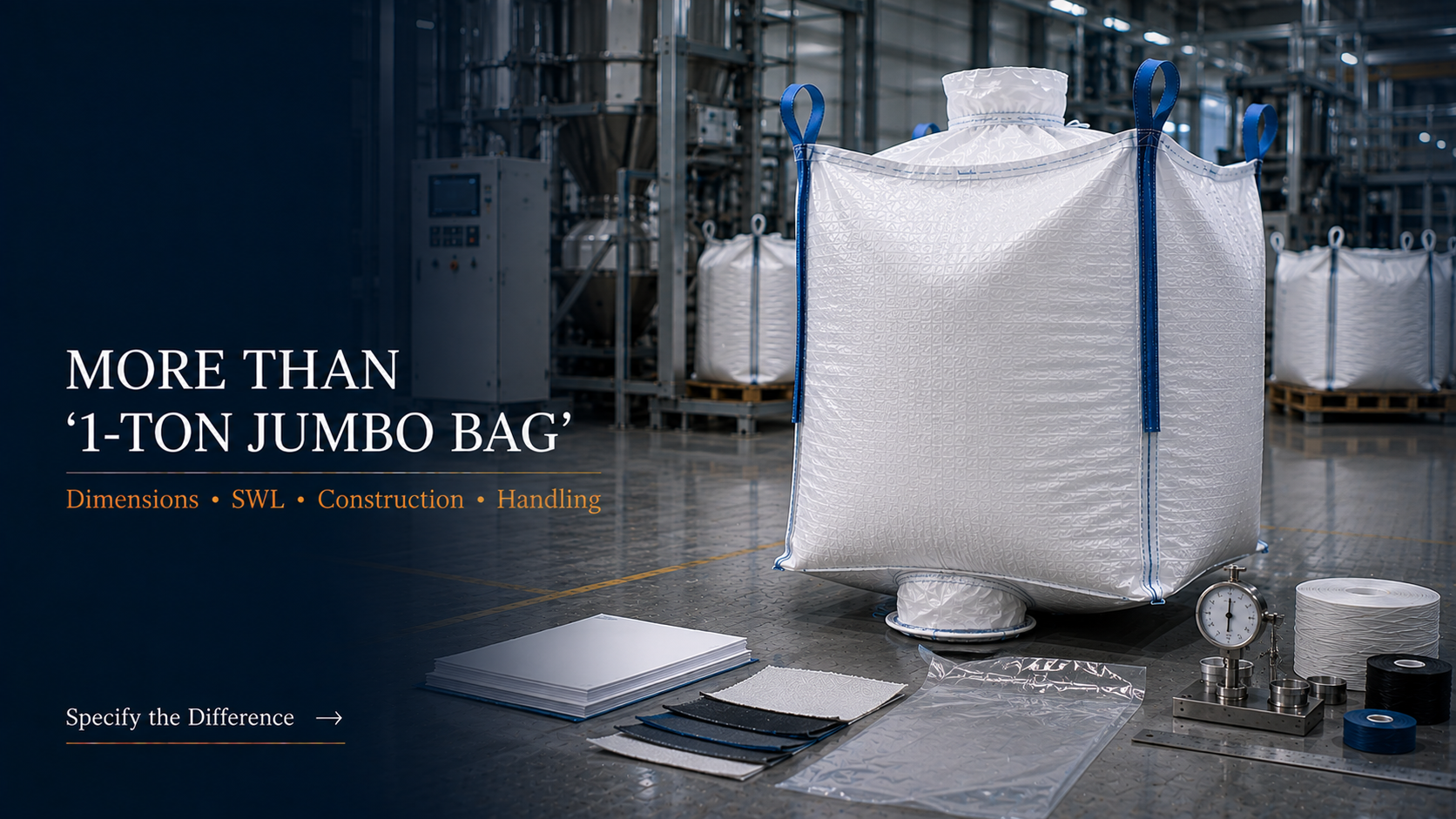
Another important FIBC market trend 2026 is the increasing importance of detailed specifications.
A request such as “1-ton Jumbo Bag” provides very little technical information.
A serious procurement specification can include:
- FIBC construction
- Dimensions
- SWL
- Safety factor
- Fabric GSM
- Lifting-loop configuration
- Filling configuration
- Discharge configuration
- Liner requirement
- Coating or lamination
- Printing requirements
- Application-specific compliance
This approach gives buyers a better basis for comparing suppliers.
It also reduces the risk of comparing two quotations that technically describe different bags.
For buyers who want a practical specification framework, UWON’s guide How to Choose FIBC Bags: 9 Specifications That Matter covers capacity, dimensions, construction, lifting loops, filling, discharge, liners and application requirements.
Why “One-Ton FIBC” Is No Longer a Complete Specification
Consider two bags that both carry 1,000 kg.
The first may use a conventional construction with an open top and flat bottom.
The second may use a Baffle construction, filling spout, discharge spout, liner and specialized lifting configuration.
Both may have the same nominal filling weight.
However, they can perform very differently within a real production and logistics operation.
The second bag may justify its higher purchase price if it improves filling speed, discharge control, stacking or transportation efficiency.
Consequently, buyers should compare total packaging performance rather than empty-bag price alone.
Testing and Supplier Transparency Are Becoming Stronger Buying Factors
Another development in the FIBC industry is greater attention to testing evidence and supplier consistency.
Recent industry reporting has highlighted stronger buyer interest in factory testing data and full-load performance, particularly for international supply chains where handling, stacking and long-distance transportation increase the consequences of bag failure. ([Hesheng](https://www.hs-bulkbags.com/news/global-fibc-market-update-may-2026-standardiz-85538273.html))
For procurement teams, this means a supplier’s ability to explain its testing and quality controls can become a meaningful differentiator.
Buyers can ask:
- What tests does the supplier perform?
- What standard does the specification reference?
- How does the supplier verify lifting performance?
- How are seams controlled?
- How does the supplier maintain batch consistency?
- What happens when a material or construction changes?
This approach becomes especially important when comparing international suppliers.
Sustainability Is Moving From Marketing to Specification
Sustainable FIBC bags are receiving increasing attention, but sustainability claims need technical context.
The market is increasingly discussing recyclability, reuse, recycled content and material selection. Current market analysis also identifies reusable and recycled-content FIBC formats as areas where buyers may place greater value when the necessary collection and sorting systems exist. ([Future Market Insights](https://www.futuremarketinsights.com/reports/fibc-market))
However, buyers should not evaluate an FIBC solely by asking whether the outer woven fabric is polypropylene.
The complete construction may include liners, coatings, laminations, printing systems, additives and other components.
Therefore, the more useful procurement question is:
“What is the complete FIBC construction, and how does it fit the intended end-of-life and application requirements?”
This is particularly relevant for European buyers following the implementation of PPWR.
Custom FIBC Bags Are Gaining Importance
As specifications become more application-specific, custom FIBC bags can offer an advantage over generic designs.
Customization can address:
- Specific bag dimensions
- Product density
- Shape retention
- Filling equipment
- Discharge equipment
- Liner requirements
- Coating requirements
- Lifting configuration
- Printing and identification
- Application-specific handling
That does not mean every application needs a highly customized bag.
Instead, the trend is toward selecting the simplest construction that actually meets the application’s technical requirements.
This can help buyers avoid both under-specification and unnecessary features.
What FIBC Buyers Should Watch Through 2026
The remainder of 2026 is likely to keep the focus on several areas.
1. European Packaging Requirements
PPWR implementation will remain an important topic for companies placing packaging on the EU market. The European Commission is continuing to publish implementation resources and guidance as the regulation takes effect. ([European Commission](https://environment.ec.europa.eu/topics/waste-and-recycling/packaging-waste_en))
2. Detailed Material Documentation
Buyers are likely to ask suppliers for clearer information about materials, liners, coatings and other components.
3. Application-Specific FIBC Design
Construction, lifting, filling and discharge requirements will continue to influence purchasing decisions.
4. Testing and Quality Evidence
Procurement teams will increasingly compare suppliers on the evidence behind their specifications rather than relying only on product descriptions.
5. Reuse and Circularity
Reuse and recycling discussions will become increasingly relevant where the operational system supports them.
However, buyers should distinguish between a packaging design and the infrastructure required to recover, sort, clean or recycle that packaging.
What This Means for FIBC Manufacturers in India
Indian manufacturers serving international markets face an increasingly specification-driven buyer.
Competitive pricing remains important, but it is only one part of the supplier decision.
Export buyers may increasingly evaluate:
- Manufacturing consistency
- Material transparency
- Testing capability
- Product customization
- Documentation
- Compliance support
- Production capacity
- Export experience
For this reason, manufacturers that can clearly connect their product specifications to customer applications may have a stronger position than suppliers competing only on price.
How Buyers Can Prepare for the Next FIBC Order
Procurement teams do not need to redesign every FIBC immediately.
A better approach is to review the current specification and identify gaps.
Start with five questions:
- What exactly are we packing?
- How is the bag filled, lifted, stored and discharged?
- Which construction gives us the right performance?
- What documentation supports the specification?
- Are there new market or regulatory requirements that affect this application?
Then ask the supplier to quote against the same technical specification.
This creates a more transparent comparison and makes price differences easier to understand.
UWON’s Position in the Changing FIBC Market
UWON offers multiple FIBC and Jumbo Bag constructions, including Standard, U-Panel, Circular, 4-Panel and Baffle designs, along with customized filling, discharge and liner configurations.
This allows the specification to begin with the application rather than forcing every customer into one standard bag.
For European buyers, that approach becomes particularly relevant as technical specifications, material transparency and packaging requirements become more important parts of procurement.
Explore UWON Packaging’s FIBC and Jumbo Bag solutions.
Conclusion
The FIBC market in 2026 is not changing because buyers suddenly need different bags.
It is changing because buyers are asking better questions about the bags they already purchase.
Capacity is still important. Price is still important. Delivery is still important.
However, construction, testing, material transparency, handling efficiency and application-specific requirements are becoming increasingly important parts of the buying decision.
Europe adds another layer as PPWR begins applying from 12 August 2026.
For FIBC manufacturers and procurement teams, the direction is clear:
Specify better. Verify more. Compare suppliers on performance, not just price.
That is likely to be one of the defining procurement trends for Jumbo Bags and FIBCs through the rest of 2026.
Talk to UWON Packaging about your next FIBC requirement.
Frequently Asked Questions
What are the main FIBC market trends in 2026?
Major trends include more application-specific FIBC designs, greater attention to testing and supplier consistency, increasing discussion around recycling and reuse, and stronger regulatory considerations in markets such as Europe.
Is the FIBC market growing in 2026?
Current market forecasts indicate continued growth. Future Market Insights estimates the global Jumbo Bags market at around USD 6.9 billion in 2026 and projects it to reach USD 10.4 billion by 2036. ([Future Market Insights](https://www.futuremarketinsights.com/reports/jumbo-bags-market))
Why are FIBC specifications becoming more important?
Because buyers increasingly need bags that match specific filling, handling, storage, discharge, logistics and compliance requirements. A simple capacity specification does not describe the complete FIBC design.
How is PPWR affecting FIBC packaging in Europe?
PPWR generally applies from 12 August 2026 and introduces a harmonised EU framework for packaging and packaging waste. Specific requirements have different implementation timelines, so buyers should evaluate the provisions applicable to their particular packaging and market situation. ([European Commission](https://environment.ec.europa.eu/topics/waste-and-recycling/packaging-waste_en))
Are sustainable FIBC bags becoming more important?
Yes. Recyclability, reuse and recycled-content discussions are becoming more relevant in bulk packaging procurement. However, buyers should evaluate the complete construction and actual recovery system rather than relying on a broad sustainability claim.
Why should buyers compare FIBC manufacturers on more than price?
Two bags with the same nominal capacity can have different construction, fabric, lifting, filling, discharge and liner specifications. Those differences can affect handling efficiency, durability and total packaging cost.