

What Actually Drives the Price of an FIBC Bag
FIBC price is rarely as simple as the number on a quote. Two bags can look identical in a photo yet cost very differently, because that price quietly reflects the fabric, the strength, the safety and a dozen decisions you never see. Understand what sits behind the number, and you stop comparing quotes that were never comparable in the first place.
“Just send me your cheapest bag” is the most expensive sentence in bulk packaging. A cheaper FIBC is not the same bag for less money. It is usually a different, weaker bag that only looks the same until it is under load.
Buyers naturally want to compare suppliers on price. Yet an FIBC is built to a specification, and change the specification and you change the price completely. So a quote that looks 20% cheaper is often not a better deal at all. Instead, it is a different bag with less fabric, a lower safety margin, or no certification.
Below are the seven things that genuinely drive the price of a bulk bag, followed by why the lowest quote is so often the costliest, and how to compare fairly.
Why FIBC price is never just one number
An FIBC is not a commodity like a screw or a sheet of paper. Rather, it is an engineered product with many variables, and each one moves the price. The biggest single driver sits underneath everything: the raw material.
Most bulk bags are woven from polypropylene, a plastic made from oil. So when resin prices rise, every bag gets more expensive, everywhere, at once. On top of that raw material sit the seven choices below, and together they explain almost the entire price of any bag.
The seven things that drive FIBC price
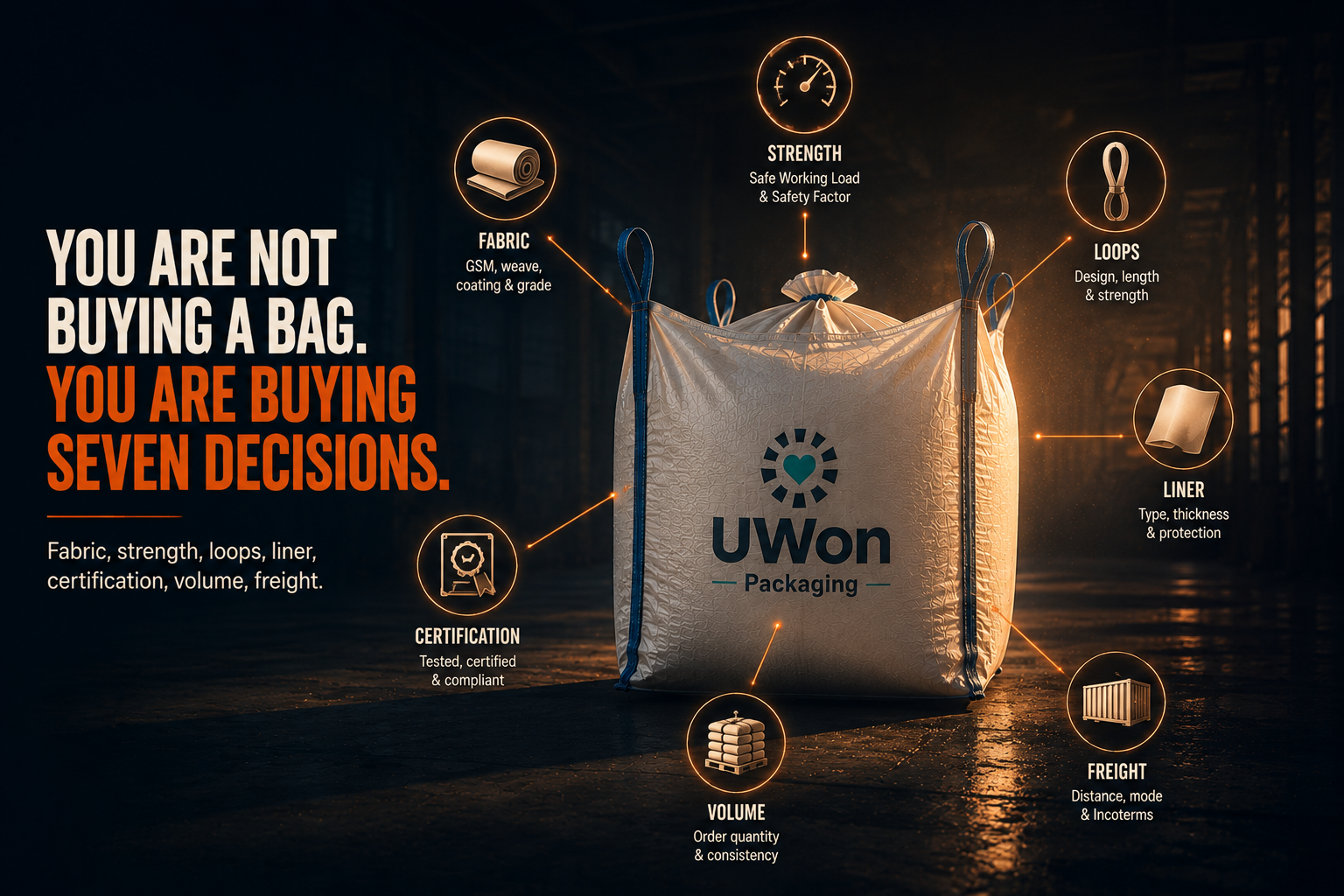
Here is where your money actually goes, from the fabric up.
1. Fabric quality and GSM
Fabric is the biggest cost after raw material. GSM, the weight of the woven fabric per square metre, tells you how much material is in the bag. More GSM means more strength, and more cost. A thin, light fabric looks the same in a photo but carries far less confidence under a full load.
2. Safety factor and safe working load
A higher safety factor means more built in strength, and more strength costs more. A 6:1 multi trip bag uses more material than a 5:1 single trip bag, so it prices higher. Crucially, a suspiciously cheap bag has often quietly dropped to a lower rating than the job actually needs.
3. Loops and construction
The lifting loops and the stitching are where a bag lives or dies. Stronger loops, better sewing and reinforced seams all add cost, and all add safety. Because a loop failure means a total bag failure, this is the last place a serious buyer wants a supplier to cut corners for a lower price.
4. Liner and coating
If your product needs protection from moisture or dust, a liner adds cost. Similarly, a coated fabric, which resists moisture better than uncoated, costs more than a plain weave. Neither is optional when your material demands it, so the “cheaper” uncoated bag can ruin a shipment it was never built to protect.
5. Certifications and testing
Certified production is not free. Food grade, clean room, UN certified and ISO audited manufacturing all cost the supplier money to maintain, and that shows up in the price. However, for regulated goods those certificates are the difference between a shipment that clears and one that is rejected at the port.
6. Order size and MOQ
Volume changes everything. Larger orders spread setup and material costs across more bags, so the price per bag falls. Conversely, small orders below a supplier’s minimum order quantity carry a higher unit price, because the fixed costs of a production run do not shrink just because your order does.
7. Freight and logistics
Finally, the bag has to reach you. For imported FIBCs, sea freight, duties and inland transport can add meaningfully to the landed price, and they move with fuel and shipping rates. So a low factory price with high freight can end up costing more than a slightly higher price shipped efficiently.
In short: FIBC price is driven by raw material, fabric and GSM, safety factor, loops and stitching, liner and coating, certifications, order size and freight. Change any one, and the price changes with it.
Why the lowest FIBC price is often the most expensive
Here is the trap inside “just give me your cheapest.” A lower price almost always means something was removed: less fabric, a lower safety factor, no liner, or no certificate. You do not see the difference in the quote. You see it when a bag bursts, a batch spoils, or a shipment is rejected.
When that happens, the real cost arrives: lost product, a missed deadline, and a customer of your own who quietly loses confidence. Ultimately, the cheapest bag that fails once is far more expensive than the correct bag that never does. This is exactly why reliability, not price, keeps buyers loyal.
“A cheaper bag is not the same bag for less. It is a different bag with something taken out.”
How to compare FIBC prices fairly
The fix is simple: compare like for like. Before you weigh quotes, fix the specification first. Decide the GSM, the safety factor, the liner, the loops and the certifications you actually need, then ask every supplier to quote that exact spec.
Suddenly the comparison is honest. Moreover, if one supplier is far cheaper for the same spec, ask why, because either they have a genuine efficiency or they are quietly quoting a lesser bag. A trustworthy supplier will happily explain exactly what their price includes.
Frequently asked questions
What is a typical FIBC price?
There is no single figure, because it depends entirely on the spec. A basic single trip bag sits at the low end, while a certified, lined, multi trip bag with a high safety factor can cost several times more. Always price against your actual requirement, not a generic bag.
Why do FIBC prices vary so much?
Because the bags themselves vary so much. Fabric weight, safety factor, loops, liner, coating, certifications, order size and freight each move the price. So two quotes can differ widely simply because they are quietly quoting two different bags.
How do I get a lower FIBC price without losing quality?
Order in larger volumes to beat the minimum order quantity, fix your spec so suppliers compete on the same bag, and avoid paying for protection you do not need. However, never chase a lower price by dropping the safety factor or certification your product actually requires.
Does a higher FIBC price always mean a better bag?
Not always. A higher price can simply mean a heavier spec than you need, which wastes money. The goal is the right bag for your job, correctly priced, not the most expensive or the cheapest one on the list.
The bigger picture
Price is the easiest thing to see and the easiest to misread. So look past the number to the specification behind it, and an FIBC becomes a fair, honest purchase. Judge on price alone, and you are simply choosing which corner someone else decided to cut for you.
Want a price you can actually trust? Tell us what you ship and how you handle it, and we will quote the right bag for the job and explain exactly what that price includes. Explore our FIBC range or talk to our team.
Written by UWON Packaging, an FIBC and bulk bag manufacturer and exporter that would rather quote the right bag than the cheapest one. About UWON · Our FIBC range · Talk to our team