
FIBC RFQ Checklist: 25+ Specifications Every Buyer Should Know
FIBC RFQ Checklist: 25+ Specifications Buyers Should Define Before Requesting a Quote
A good FIBC RFQ checklist does more than help you request a price. It helps you make sure every supplier is quoting against the same technical requirement.
That distinction matters. If one supplier interprets “1 MT FIBC” differently from another, comparing the three quotations by price alone can create a false sense of savings. The bags may differ in dimensions, construction, SWL, top and bottom configuration, liner, lifting arrangement, testing requirements or other application-specific details.
This guide is designed as a practical buyer resource for procurement managers, packaging buyers, QA/QC teams, importers, distributors and companies sourcing FIBCs for industrial applications.
The objective is simple: define the requirement clearly before asking suppliers to quote it.
What You’ll Get From This FIBC RFQ Checklist
By the end of this guide, you will know what information to provide when requesting an FIBC quotation, from product characteristics and capacity to dimensions, construction, filling, discharge, lifting, liners, safety, testing, documentation, quantity and delivery.
- FIBC RFQ basics
- Product and load requirements
- Bag dimensions and construction
- Fabric and coating
- Filling and discharge configuration
- Lifting requirements
- Liner requirements
- Electrostatic considerations
- Certification and testing
- Printing and documentation
- Quantity and logistics
- Sample approval
- Supplier comparison
- Copy-paste FIBC RFQ template
- 25-point buyer checklist
- Frequently asked questions
Why “Quote 1 MT FIBC Bags” Is Not Enough
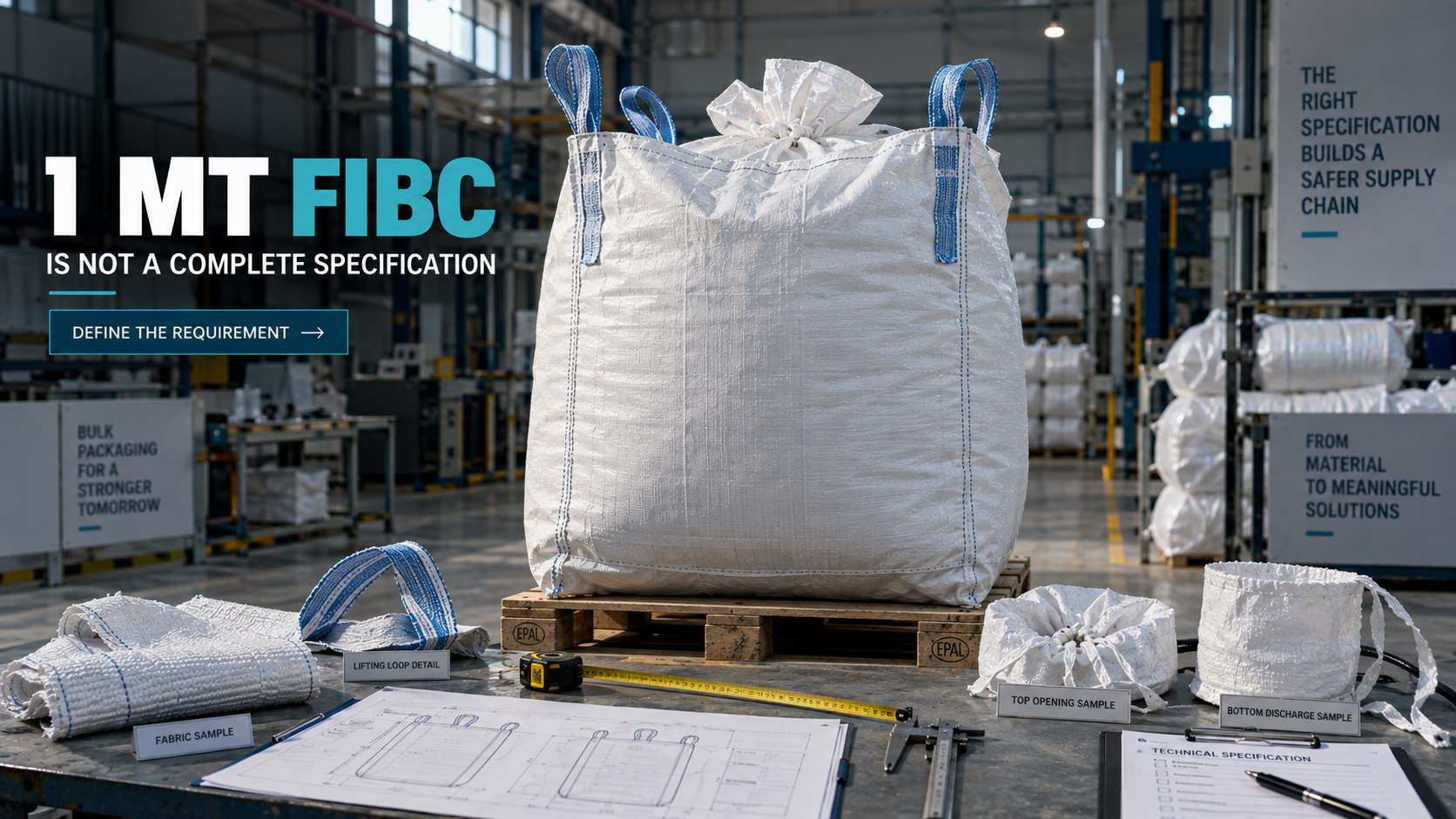
Imagine sending the same enquiry to three FIBC suppliers:
“Please quote 5,000 pieces of 1 MT FIBC bags.”
Supplier A sends one price.
Supplier B sends another.
Supplier C sends a third.
At first, it looks like a straightforward price comparison.
But are all three suppliers actually quoting the same bag?
Not necessarily.
“1 MT FIBC” does not, by itself, define the complete technical requirement. A supplier may still need information about:
- Product being packed
- Bulk density
- Target filling weight
- SWL
- Safety factor
- Bag dimensions
- Construction
- Fabric specification
- Top construction
- Bottom construction
- Lifting arrangement
- Liner
- Coating or lamination
- Filling equipment
- Discharge equipment
- Electrostatic requirements
- Testing and certification requirements
- Printing and marking
- Quantity
- Destination and delivery requirements
This is why a strong FIBC RFQ checklist should be treated as a technical baseline, not simply as a request for a unit price.
An FIBC RFQ Is More Than a Price Request
The purpose of an RFQ is to create a common technical baseline between buyer and supplier.
A typical procurement process can look like this:
Buyer requirement → Supplier interpretation → Quotation → Sample → Approval → Production → Inspection → Delivery
If the requirement is unclear at the beginning, the ambiguity can continue through the entire process.
A good RFQ therefore answers one fundamental question:
“What exactly should every supplier be pricing?”
That is the foundation of effective FIBC procurement.
1. Start With the Product You Are Packing
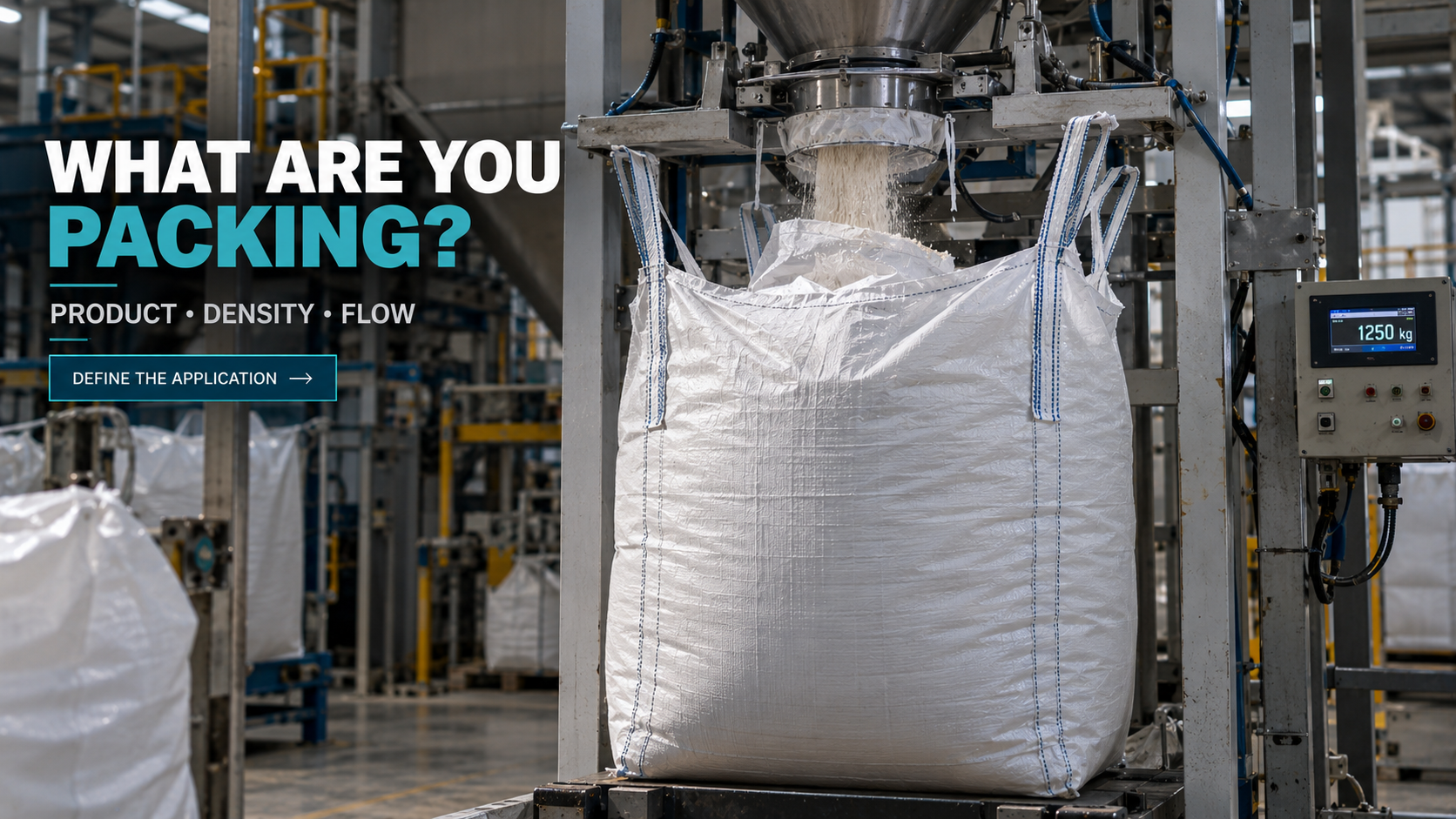
The first question in an FIBC RFQ should not be “What bag do I want?”
It should be: “What material will the FIBC contain?”
The supplier needs enough information to understand the application before recommending or quoting a configuration.
What material will go inside the FIBC?
Examples can include powders, granules, pellets, flakes, agricultural products, minerals, chemicals, food ingredients and other dry bulk materials.
The material itself can influence the required FIBC configuration. Therefore, simply describing a product as “powder” or “chemical” may not provide enough information for a final specification.
What is the bulk density?
Bulk density matters because two materials can occupy different volumes while having the same target filling weight.
For example, a nominal 1,000 kg filling requirement does not tell a supplier how much physical volume the material will occupy. Bulk density helps connect the product requirement to the bag’s dimensions and usable capacity.
Is the material free-flowing?
The filling and discharge behaviour of the product can influence the choice of top and bottom configuration.
Buyers should tell the supplier if the material has characteristics such as:
- Compaction
- Moisture sensitivity
- Dust generation
- Abrasive behaviour
- Flow difficulties
- Product retention concerns
Does the material create special handling requirements?
Some applications require additional consideration because of product safety, contamination control, food-contact requirements, dangerous goods regulations or electrostatic risk.
Do not select a special FIBC configuration simply from the product name. The actual application and applicable requirements should determine the specification.
2. Define the Required Capacity and SWL
A buyer should distinguish between the amount of product they intend to put into a bag and the FIBC’s specified Safe Working Load.
SWL is part of the technical specification of an FIBC. ISO 21898:2024 addresses FIBC materials, construction, design, type testing, marking and safe-use guidance for FIBCs intended for non-dangerous solid materials. :contentReference[oaicite:1]{index=1}
What should the RFQ specify?
- Target filling weight
- Required SWL
- Applicable safety factor requirement
- Whether the bag is intended for single use or a defined reuse application
- Handling conditions
Do not assume that a target fill weight alone defines the required SWL.
Capacity is not the same as dimensions
Two FIBCs can have similar external dimensions while behaving differently because of construction, product density, filling level and internal configuration.
The quotation should therefore connect the required capacity with the actual application rather than treating “1 MT” as a complete bag specification.
3. Specify the FIBC Dimensions Correctly
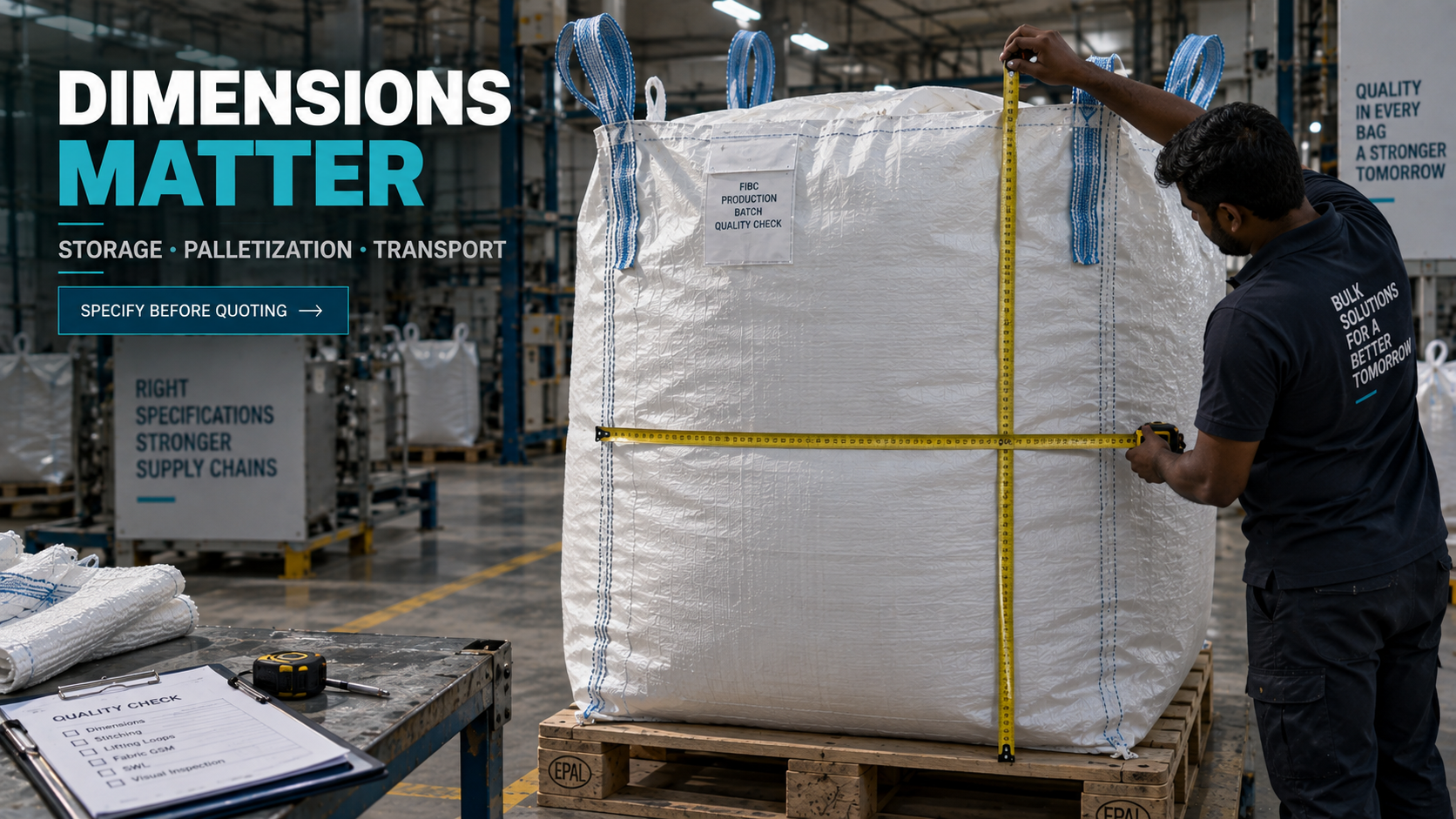
Dimensions should be agreed before comparing quotations.
Depending on the application, the RFQ may need to define:
- Length
- Width
- Height
- Required tolerances
- Filled dimensions where relevant
- Baffle requirements
Why dimensions matter beyond appearance
FIBC dimensions can affect:
- Palletization
- Warehouse utilization
- Container loading
- Filling equipment compatibility
- Discharge equipment compatibility
- Stacking arrangements
- Transportation efficiency
A buyer should therefore specify dimensions based on the complete handling system rather than selecting a size simply because it is commonly available.
4. Specify the FIBC Construction

Construction should be selected according to the application’s functional requirements.
U-Panel FIBC
A U-Panel construction can be suitable for applications where the required bag geometry, handling characteristics and manufacturing configuration align with the buyer’s needs.
Four-Panel FIBC
Four-panel construction provides another approach to creating the required bag shape and handling configuration.
Circular FIBC
Circular or tubular constructions can be considered where the desired bag geometry and manufacturing design make them appropriate.
Baffle FIBC
Baffle FIBCs use internal baffles to help the filled bag retain a more controlled shape. This can be useful where storage, palletization or available space makes shape retention important.
No construction should be described as universally “best”. The appropriate design depends on the product, filling method, handling system, dimensions, storage requirements and other application conditions.
Explore UWON’s FIBC product range to compare available construction options.
5. Define Fabric Requirements
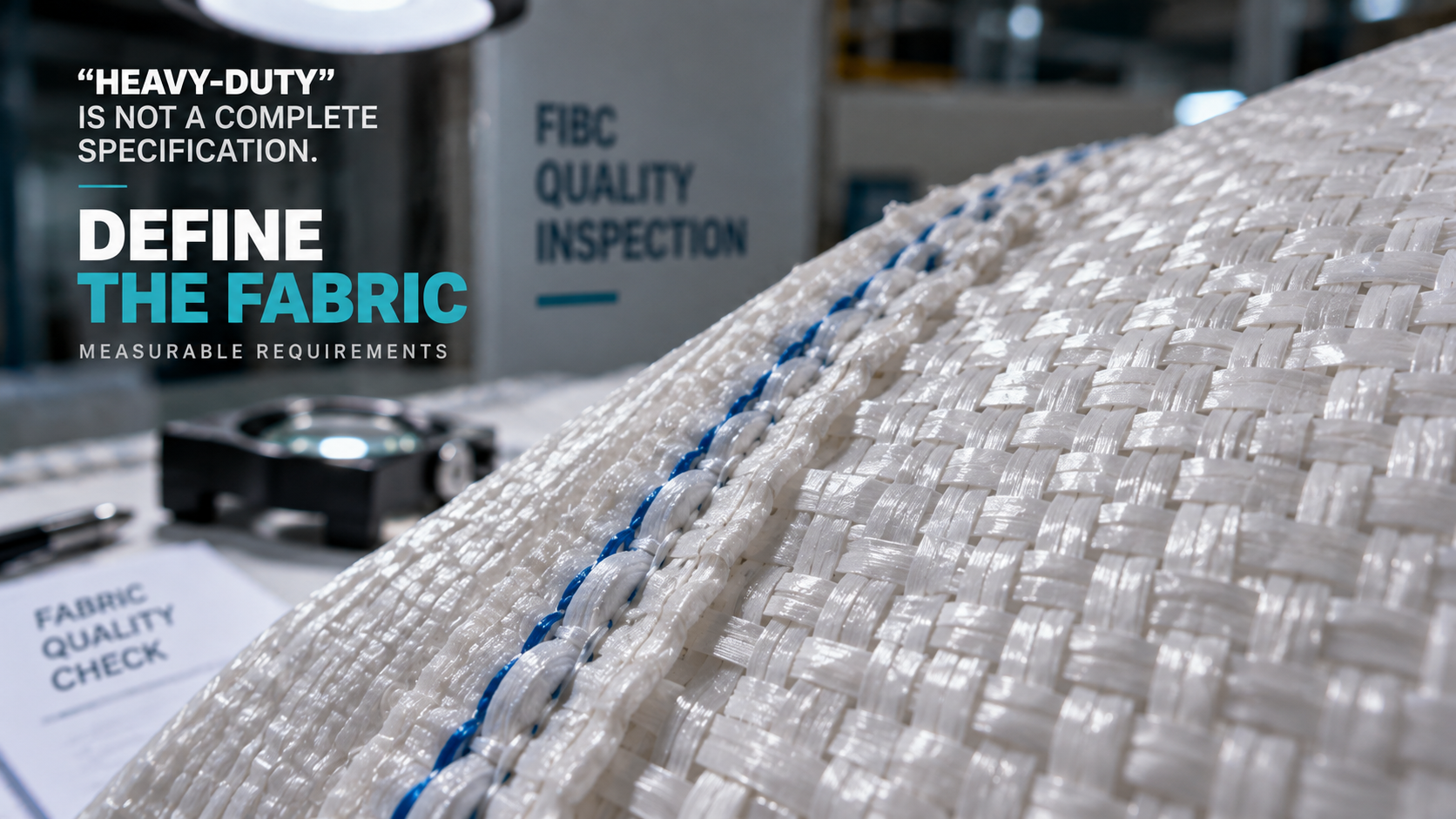
“Heavy-duty FIBC” is not a complete technical specification.
A useful RFQ should define measurable fabric requirements wherever they are important to the application.
Depending on the requirement, this can include:
- Woven polypropylene fabric
- Fabric weight or GSM
- Yarn/denier specification
- Weave construction
- Coated or uncoated fabric
- Laminated or unlaminated fabric
- UV stabilization requirement
- Fabric colour
The exact values should be established from the required performance and application. Buyers should not copy a fabric specification from another FIBC simply because the bags look similar.
Why measurable specifications matter
A phrase such as “strong fabric” leaves too much room for interpretation.
A defined specification gives the buyer and supplier a measurable reference for quotation, sampling, approval and production.
6. Specify How the FIBC Will Be Filled
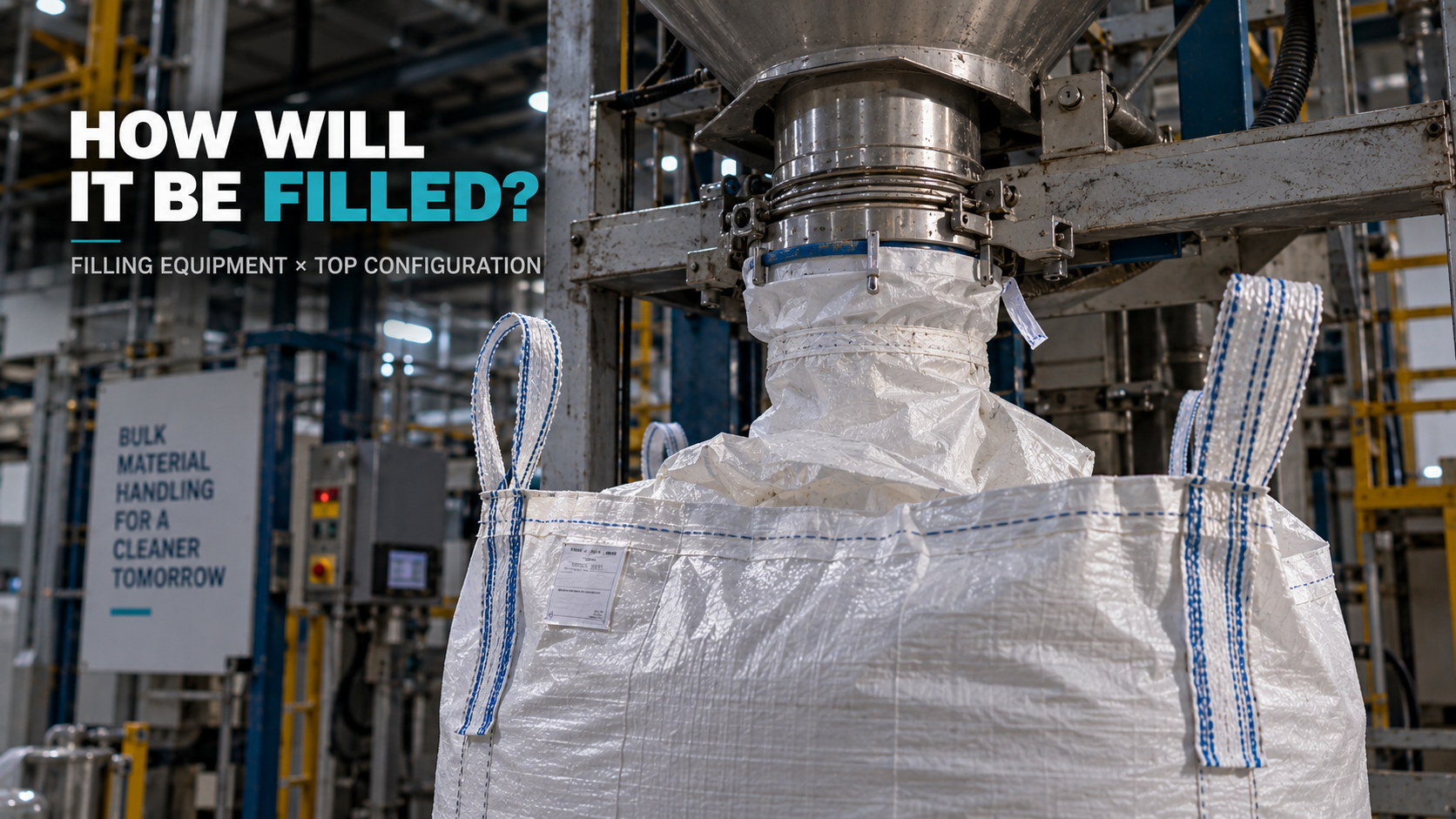
The top construction should match the filling process.
Possible configurations can include:
- Open top
- Duffle top
- Filling spout
- Conical or application-specific top arrangements
- Custom filling configurations
Ask one critical question
How does your filling equipment interface with the FIBC?
The answer can determine the required opening dimensions, spout configuration, closure arrangement and other details.
A bag that looks correct on a quotation sheet can still create operational problems if the filling interface does not match the equipment.
For application-specific configurations, buyers can review UWON’s FIBC with filling spout solutions.
7. Specify How the FIBC Will Be Emptied
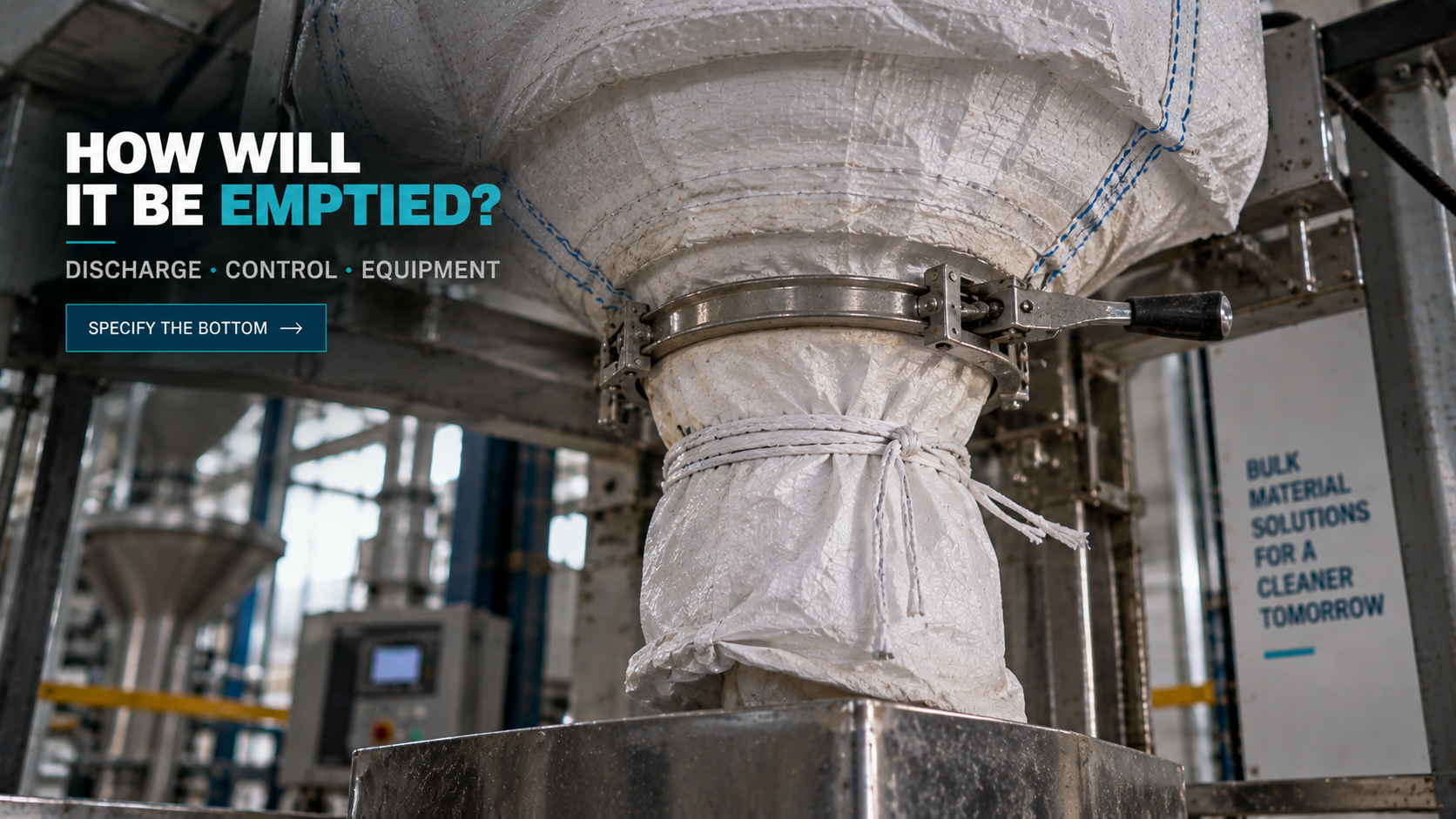
The discharge configuration is just as important as the filling configuration.
Common requirements can include:
- Flat bottom
- Discharge spout
- Controlled discharge arrangements
- Closure or flap arrangements
- Application-specific bottom construction
A bag can be suitable for filling and still create problems during unloading if its bottom configuration does not match the discharge process.
The RFQ should therefore describe how the material will be removed from the FIBC and what equipment will be used.
See UWON’s FIBC with discharge spout solutions for application-specific options.
8. Specify the Lifting Configuration
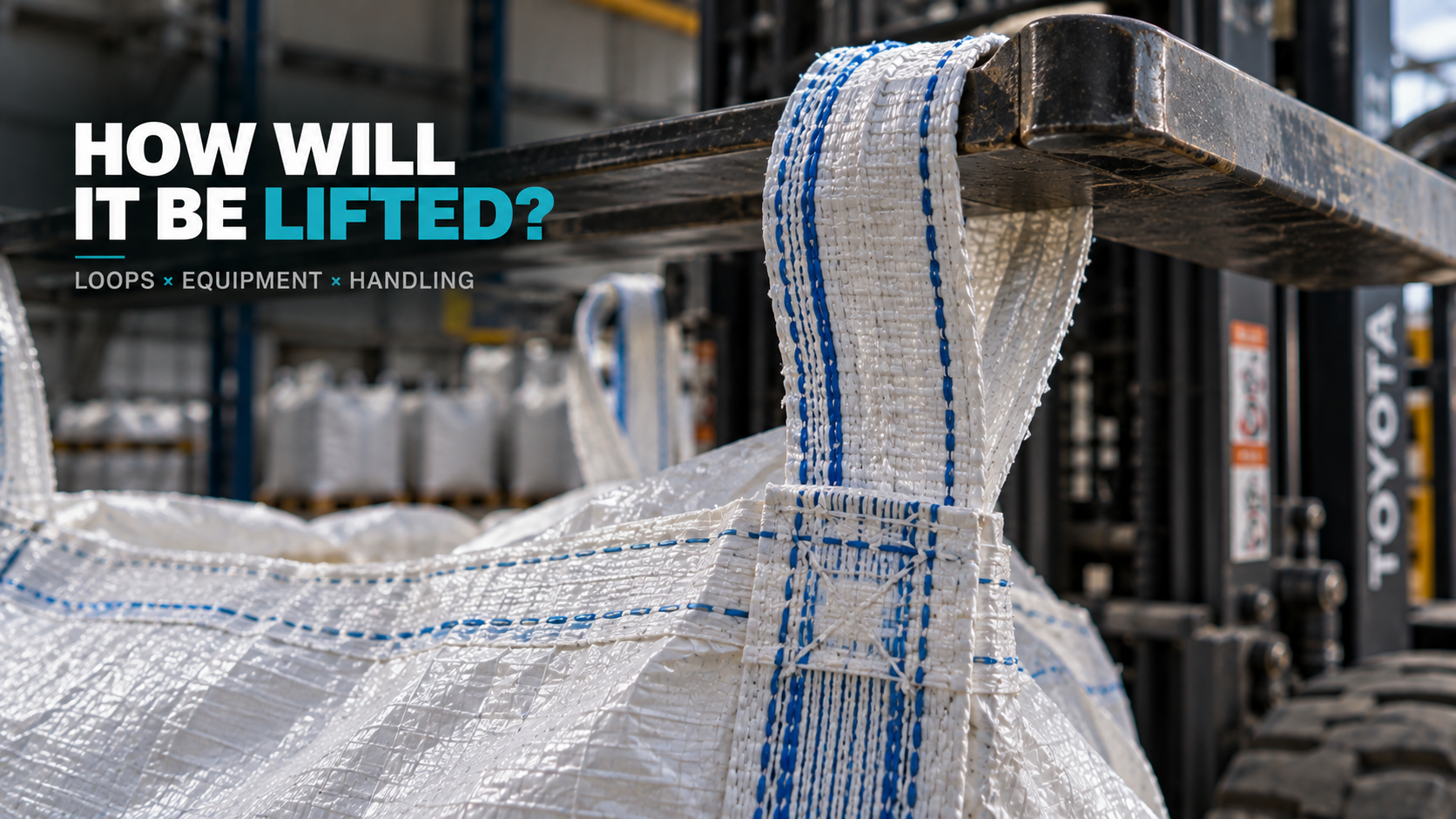
The lifting arrangement must be compatible with the actual handling equipment.
Depending on the application, an RFQ may need to define:
- Four-loop configuration
- Cross-corner arrangement
- Corner-loop arrangement
- Sleeve or other lifting arrangements
- Required lifting equipment compatibility
Ask the handling question before asking for a price
Will the FIBC be lifted by forklift, crane, hoist, automated handling equipment or another system?
The answer helps the supplier understand the required lifting arrangement and the operating environment.
9. Does the FIBC Need a Liner?
A liner should be treated as an application decision, not an automatic FIBC accessory.
Potential reasons for considering a liner include:
- Moisture protection
- Fine-powder retention
- Contamination control
- Product-contact requirements
- Product compatibility
- Specific filling or discharge requirements
Possible arrangements include loose liners and form-fit liners, but the correct choice depends on the material and process.
Questions to include in the RFQ
- Is a liner required?
- What material should the liner use?
- Does the liner contact the product?
- Does the liner need to match the filling and discharge arrangement?
- Are destination-market or customer requirements applicable?
10. When Do You Need Coating or Lamination?
Coating and lamination should be specified only when they serve a defined application requirement.
Depending on the product and process, they may be considered for:
- Moisture protection
- Fine-particle retention
- Surface characteristics
- Product compatibility
The RFQ should identify the desired performance rather than simply stating “laminated FIBC” without explaining why the feature is required.
11. Does the Application Require Electrostatic Protection?
Electrostatic requirements should be identified before the FIBC is specified.
The assessment can depend on factors such as:
- Product characteristics
- Dust or combustible atmosphere considerations
- Filling and discharge conditions
- Grounding arrangements
- Applicable electrostatic requirements
Type A, B, C and D classifications should not be treated as interchangeable labels or as substitutes for mechanical FIBC specifications.
Where electrostatic protection is relevant, the buyer should provide the supplier with the application and applicable requirements so that the appropriate FIBC design can be evaluated.
UWON’s Type D FIBC information can be reviewed as part of application-specific evaluation.
12. Identify Required Certifications and Compliance
Certification should be specified according to the application and destination market.
Potential requirements can include:
- ISO 21898-related requirements
- UN requirements where applicable
- Food-contact requirements
- Customer-specific specifications
- Market-specific regulatory requirements
- Electrostatic standards where applicable
- Testing documentation
Do not make certification a checkbox without defining the requirement
For example, it would be incorrect to state that every FIBC automatically needs UN certification.
UN-certified FIBCs are relevant where the intended application involves dangerous goods and the applicable dangerous-goods requirements call for approved packaging.
Likewise, ISO 21898:2024 is specifically for FIBCs intended to contain non-dangerous solid materials in powder, granular or paste form and covers materials, construction, design, type testing and marking requirements. :contentReference[oaicite:2]{index=2}
The buyer should therefore identify the actual regulatory or customer requirement instead of simply writing “certified FIBC”.
13. If the Product Is Food-Related, Define the Requirement
“Food grade” is not enough as a complete RFQ specification.
A food-related FIBC RFQ should clarify:
- Intended food application
- Whether the FIBC directly contacts the product
- Liner requirements
- Required declarations or documentation
- Destination-market requirements
- Customer-specific requirements
The buyer should identify the exact regulatory and customer requirements applicable to the product and destination rather than assuming that one generic “food-grade” claim covers every requirement.
14. Specify Printing and Marking Requirements
Printing should be treated as part of the technical specification when the artwork or marking affects approval and production.
The RFQ can define:
- Printing panels
- Number of colours
- Artwork requirements
- Logo placement
- Batch or lot information
- Handling markings
- Customer-specific markings
- Labels or identification requirements
Attach approved artwork wherever possible. Avoid relying on verbal descriptions such as “same printing as previous order” when multiple bag designs are in circulation.
15. What Documentation Should Be Included in the RFQ?
Documentation should be discussed before production rather than after the bags are manufactured.
Depending on the project, an RFQ may need to reference:
- Technical specification
- Bag drawing
- Approved artwork
- Testing requirements
- Certificate requirements
- Inspection requirements
- Packing requirements
- Traceability requirements
A controlled specification gives both buyer and supplier a reference point for sample approval, production and inspection.
16. Tell Suppliers the Quantity
Quantity affects more than the final number on the purchase order.
Tell suppliers whether the requirement is:
- Sample quantity
- Trial quantity
- Initial production quantity
- Annual requirement
- Forecast volume
- Scheduled deliveries
Quantity can influence quotation structure, production planning, setup considerations and logistics.
For that reason, an annual forecast can be useful even when the immediate purchase order is smaller.
17. Include Destination and Delivery Requirements
International FIBC procurement needs logistics information from the beginning.
Include, where applicable:
- Country
- Port or delivery location
- Applicable Incoterm
- Required delivery date
- Container-loading expectations
- Palletization requirements
- Outer packaging requirements
A factory price without delivery context does not necessarily tell you the final procurement cost.
18. Define the Sample Approval Process
One of the most overlooked questions in FIBC procurement is:
What exactly are you approving when you approve the sample?
A sample approval can cover:
- Dimensions
- Construction
- Fabric
- SWL
- Lifting loops
- Top construction
- Bottom construction
- Liner
- Printing
- Workmanship
- Testing requirements
A sample should not become an informal reference that everyone remembers differently.
A sample should become a controlled specification.
19. Define Quality Expectations Before Production
Quality expectations should be agreed before manufacturing starts.
Depending on the project, the buyer may define inspection requirements for:
- Dimensions
- Fabric
- Stitching
- Lifting loops
- Top and bottom construction
- Printing
- Contamination
- Workmanship
- Packaging
Do not invent an inspection percentage simply because another supplier uses one. If an inspection level, sampling plan or acceptance criterion is required, define it explicitly in the purchase specification.
Don’t Have Every Specification? Start With These 8
Not every buyer has a complete FIBC specification sheet when they first approach a manufacturer.
If you are starting from scratch, provide these eight items first:
- Product
- Bulk density
- Target filling weight
- Required dimensions or available space
- Filling method
- Discharge method
- Handling method
- Destination and application
From there, the supplier’s technical team can help determine which additional specifications need to be defined.
10 Red Flags in an FIBC RFQ
1. “1 MT bag, please quote.”
There is not enough technical information to guarantee equivalent quotations.
2. “Heavy-duty FIBC required.”
Define measurable performance requirements instead of relying on a marketing description.
3. “Food-grade bag.”
Specify the actual food-contact, liner and documentation requirements.
4. No product information.
The supplier cannot properly evaluate the application without knowing what the FIBC will contain.
5. No filling or discharge method.
Top and bottom configurations depend heavily on the actual process.
6. No lifting method.
The FIBC needs to work with the equipment that will actually handle it.
7. No required dimensions.
Bag geometry can affect filling, storage, palletization and transport.
8. Certification mentioned without defining the requirement.
Identify the actual regulatory, customer or market requirement.
9. Comparing prices without comparing specifications.
A cheaper quotation may simply represent a different bag.
10. Approving samples without a controlled specification.
A sample should become a documented reference for production and inspection.
The 25-Point FIBC RFQ Checklist

Product
- Product identified
- Bulk density defined
- Target filling weight defined
- Application explained
Bag
- Dimensions defined
- Construction defined
- Fabric requirement defined
- SWL defined
- Safety factor requirement defined where applicable
Configuration
- Top defined
- Bottom defined
- Lifting arrangement defined
- Liner requirement defined
- Coating/lamination requirement defined
Safety and compliance
- Electrostatic requirements assessed
- Certification requirements identified
- Testing requirements identified
- Handling conditions explained
Commercial
- Quantity defined
- Destination defined
- Delivery requirement defined
- Incoterm defined
- Packaging/palletization defined
Approval
- Technical drawing/specification available
- Sample requirement defined
- Artwork approved
- Inspection criteria defined
Frequently Asked Questions About FIBC RFQs
What information should be included in an FIBC RFQ?
A complete FIBC RFQ should describe the product, application, bulk density, target filling weight, dimensions, construction, SWL, safety factor where applicable, top, bottom, lifting arrangement, liner, coating, filling and discharge process, safety requirements, testing, certification, quantity and delivery requirements.
Is “1 MT FIBC” enough to request a quotation?
No. It identifies the intended filling weight but does not define the complete FIBC specification. Suppliers may still need information about dimensions, construction, fabric, lifting, filling, discharge, liner, testing and application requirements.
What is SWL in an FIBC?
SWL, or Safe Working Load, is a key FIBC performance specification. The required SWL should be defined according to the intended load and handling application rather than assumed solely from a nominal bag capacity.
What safety factor should an FIBC have?
There is no single safety-factor value that should be assumed for every application. The required design and performance criteria should be established according to the applicable standard, intended use and agreed specification.
How do I specify FIBC dimensions?
Define the required length, width and height, together with any relevant tolerances or filled-dimension requirements. Also explain how the bag will be filled, stored, palletized and transported.
How do I choose the correct top and bottom configuration?
Start with the actual filling and discharge equipment. The top should interface with the filling process, while the bottom should match the method used to empty the FIBC.
When does an FIBC need a liner?
A liner may be appropriate when the application requires moisture protection, fine-powder retention, contamination control, product-contact management or another defined performance characteristic. The decision depends on the product and process.
What information should I provide about the product being packed?
Provide the product type, bulk density, target filling weight and relevant handling characteristics. If applicable, also identify moisture sensitivity, abrasiveness, food-contact requirements, dangerous-goods considerations or electrostatic risk.
What is the difference between an FIBC sample and a technical specification?
A physical sample shows what has been produced or proposed. A technical specification defines the agreed requirements that the production must meet. A controlled sample should therefore be linked to a documented specification.
How can I compare quotations from different FIBC suppliers?
Compare equivalent technical fields first: product, weight, dimensions, SWL, construction, fabric, top, bottom, loops, liner, testing, certification, printing, quantity, delivery and commercial terms. If the specifications differ, the prices are not directly comparable.
What certifications should I request from an FIBC supplier?
Request the certifications, test reports and declarations that apply to the actual product, application and destination market. Do not assume that one certification applies to every FIBC.
What information is needed for an international FIBC quotation?
In addition to the technical specification, provide the destination country or port, required delivery date, applicable Incoterm, quantity, packaging requirements and any container-loading expectations.
What should I do if I don’t know all the FIBC specifications?
Do not guess. Provide the supplier with the product, application, target weight, available dimensions, filling method, discharge method, handling method and destination. A qualified supplier can help identify the remaining technical requirements.
A Better RFQ Creates a Better Comparison
The objective of a good FIBC RFQ checklist is not to make the RFQ unnecessarily long.
It is to remove ambiguity.
When buyers clearly define the product, load, construction, handling, filling, discharge, compliance and delivery requirements, suppliers can quote against the same technical baseline.
That creates a much better procurement process:
Better specification → clearer quotation → better comparison → fewer surprises.
If you are sourcing FIBCs and are not sure which specifications to include, UWON Packaging can help you define the requirement before quotation.
Explore UWON’s FIBC products or review the company’s industry-specific packaging solutions.
Buyer reminder: Where a requirement depends on the application, do not copy a specification from another FIBC. Define the operating requirement first and then establish the appropriate technical specification with your supplier.