
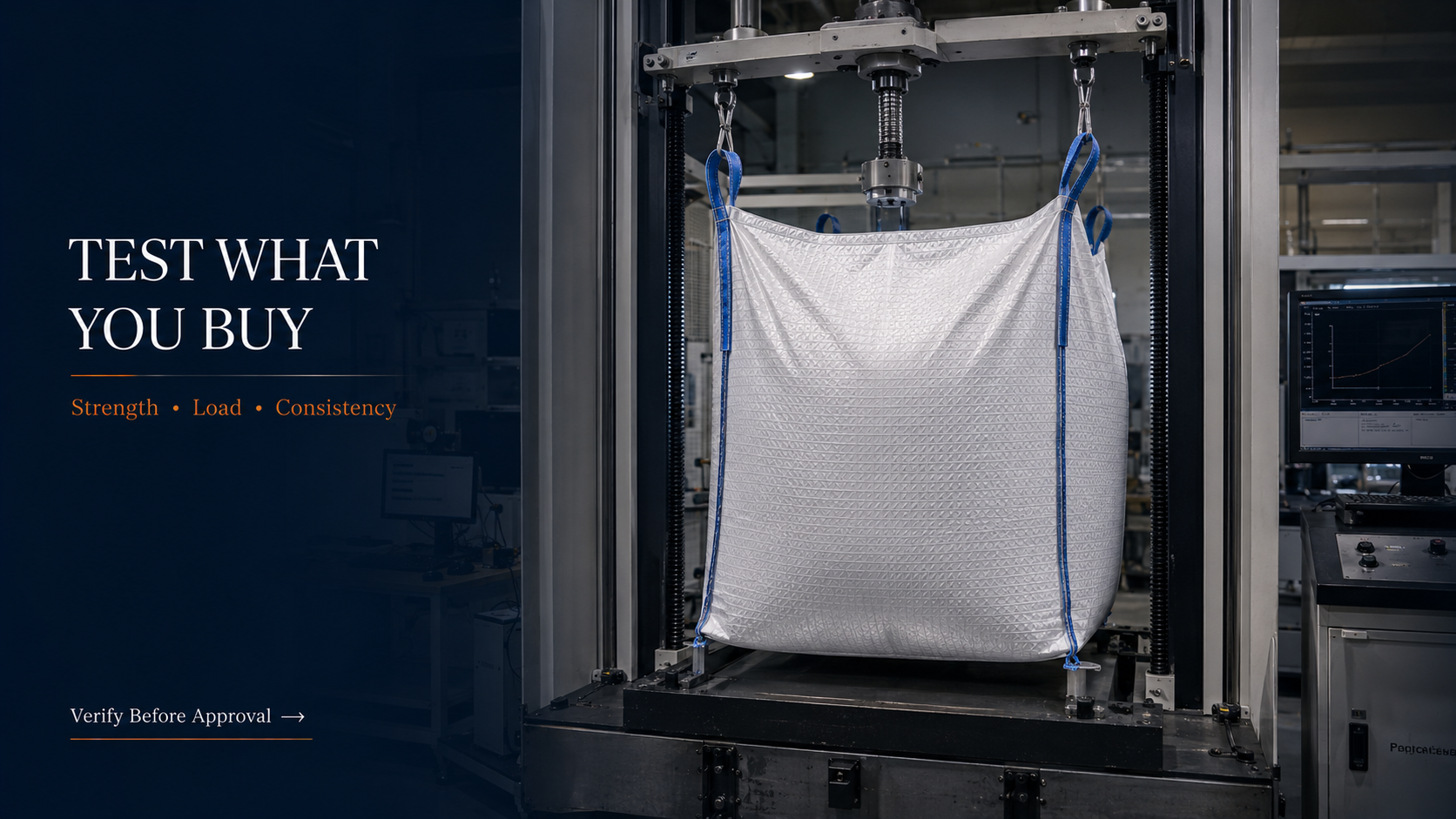
FIBC Testing: 8 Essential Tests for Safer Bulk Bags
FIBC Testing: 8 Tests Buyers Should Check Before Approval
FIBC testing is one of the most important steps buyers can use to evaluate the quality and consistency of bulk bags before approving a supplier. A bulk bag may look identical to another FIBC on the outside, yet differences in fabric strength, seams, lifting attachments and manufacturing consistency can significantly affect performance.
For procurement teams, this creates an important challenge. A supplier may provide a certificate, specification sheet or sample bag, but that information does not always show how consistently the manufacturer produces every batch.
Therefore, buyers should look beyond price and basic certification. The better approach is to understand which FIBC tests matter for the application, what the results demonstrate and how the supplier controls production consistency.
The current ISO 21898:2024 standard specifies material, construction, design, type-test and marking requirements for FIBCs intended for non-dangerous solid materials. It also provides guidance on FIBC selection and safe usage.
Why FIBC Testing Matters Before Supplier Approval
FIBCs are load-bearing packaging systems. During filling, lifting, stacking, transportation and discharge, different parts of the bag experience different stresses.
For example, the fabric carries the bulk material, seams connect structural components, lifting loops transfer load during handling and the bottom construction must withstand discharge operations.
Consequently, testing should evaluate the complete FIBC rather than focusing on only one component.
FIBCA’s buyer guidance also encourages purchasers to define important requirements such as product characteristics, SWL, safety factor, construction and application before selecting a bulk bag supplier.
See the FIBCA FIBC Design Guide.
1. Tensile Strength Testing
Tensile strength testing evaluates how much pulling force the FIBC fabric or relevant component can withstand before it breaks.
Fabric strength matters because the woven polypropylene body carries the weight of the material throughout the handling cycle.
However, buyers should not assume that a higher fabric GSM automatically guarantees better FIBC performance.
The overall bag performance also depends on:
- Fabric construction
- Yarn or tape quality
- Coating or lamination
- Seam construction
- Sewing quality
- Lifting-loop attachment
- Bag design
For this reason, tensile strength should form part of a broader FIBC quality testing program rather than serve as the only quality indicator.
Buyers should ask the supplier whether fabric strength is tested against the agreed specification and whether the manufacturer maintains records of those results.
2. Seam Strength Testing
The strongest fabric cannot compensate for a weak seam.
Seams connect the panels, lifting components, bottom construction and other parts of the FIBC. During lifting and transportation, these areas can experience significant stress.
FIBC seam strength testing helps evaluate whether the sewn connection can withstand the required load.
Important variables can include:
- Stitch pattern
- Stitch density
- Thread quality
- Thread tension
- Seam design
- Reinforcement
- Operator consistency
Therefore, buyers should not evaluate an FIBC only by inspecting the fabric. Ask the supplier how it controls and verifies seam performance during production.
This becomes particularly important for bulk bag manufacturers producing large quantities, because a supplier must maintain consistent sewing quality across the entire production run.
3. Top and Bottom Attachment Testing
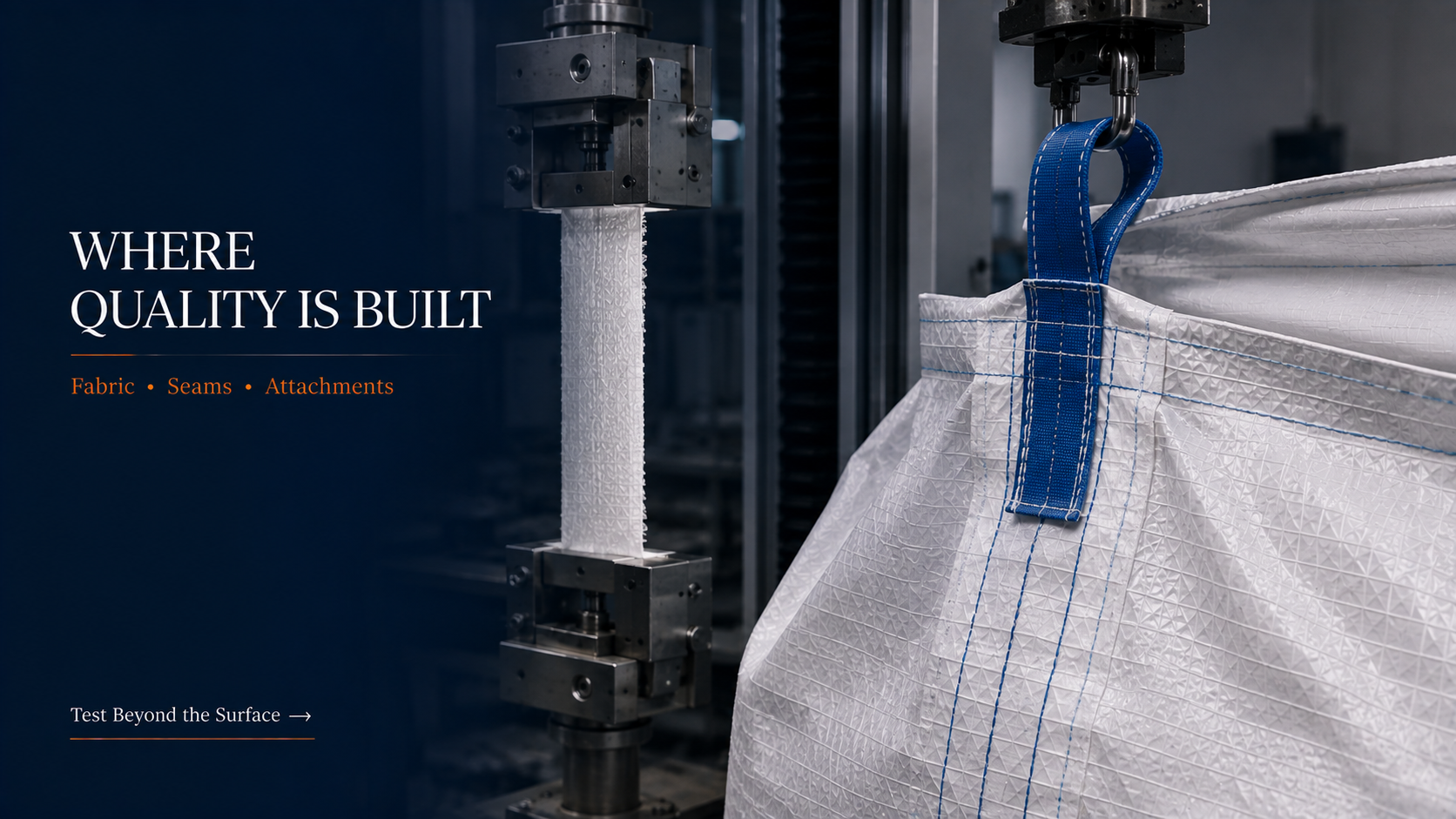
The lifting system connects the FIBC to the equipment used to move it. Therefore, the attachment between the lifting loops, belts, seams and bag body deserves specific attention.
Similarly, the bottom construction must withstand the forces associated with filling, storage and discharge.
Depending on the FIBC design, buyers may need to evaluate:
- Top lifting-loop attachment
- Lift-belt stitching
- Reinforcement patches
- Bottom seam construction
- Discharge-spout attachment
- Top and bottom fabric connections
FIBCA defines the Safe Working Load (SWL) as the amount of load an FIBC is designed to carry. It also defines safety factor as the ratio describing how many times the FIBC can handle its SWL, with 5:1 and 6:1 commonly used industry ratios. Review FIBCA’s FIBC terminology.
Consequently, attachment testing should relate directly to the bag’s intended SWL and lifting configuration.
4. Top Lift and Drop Testing
Top lift testing evaluates whether the filled FIBC can withstand the intended lifting load without unacceptable failure.
This test becomes especially important because lifting places significant forces on the loops, belts, seams and reinforced sections.
Drop testing evaluates how the FIBC responds when it experiences a sudden impact associated with handling or transportation.
A drop event can place stress on:
- Bag fabric
- Seams
- Lifting attachments
- Bottom construction
- Closures
- Product containment
For this reason, buyers should ask which tests the supplier performs for the specific FIBC design and application instead of assuming that one general certificate covers every production condition.
FIBCA’s published testing information includes top-lift, cycle top-lift, stack and drop testing as examples of performance evaluation used for FIBCs.
5. Load and Stacking Performance
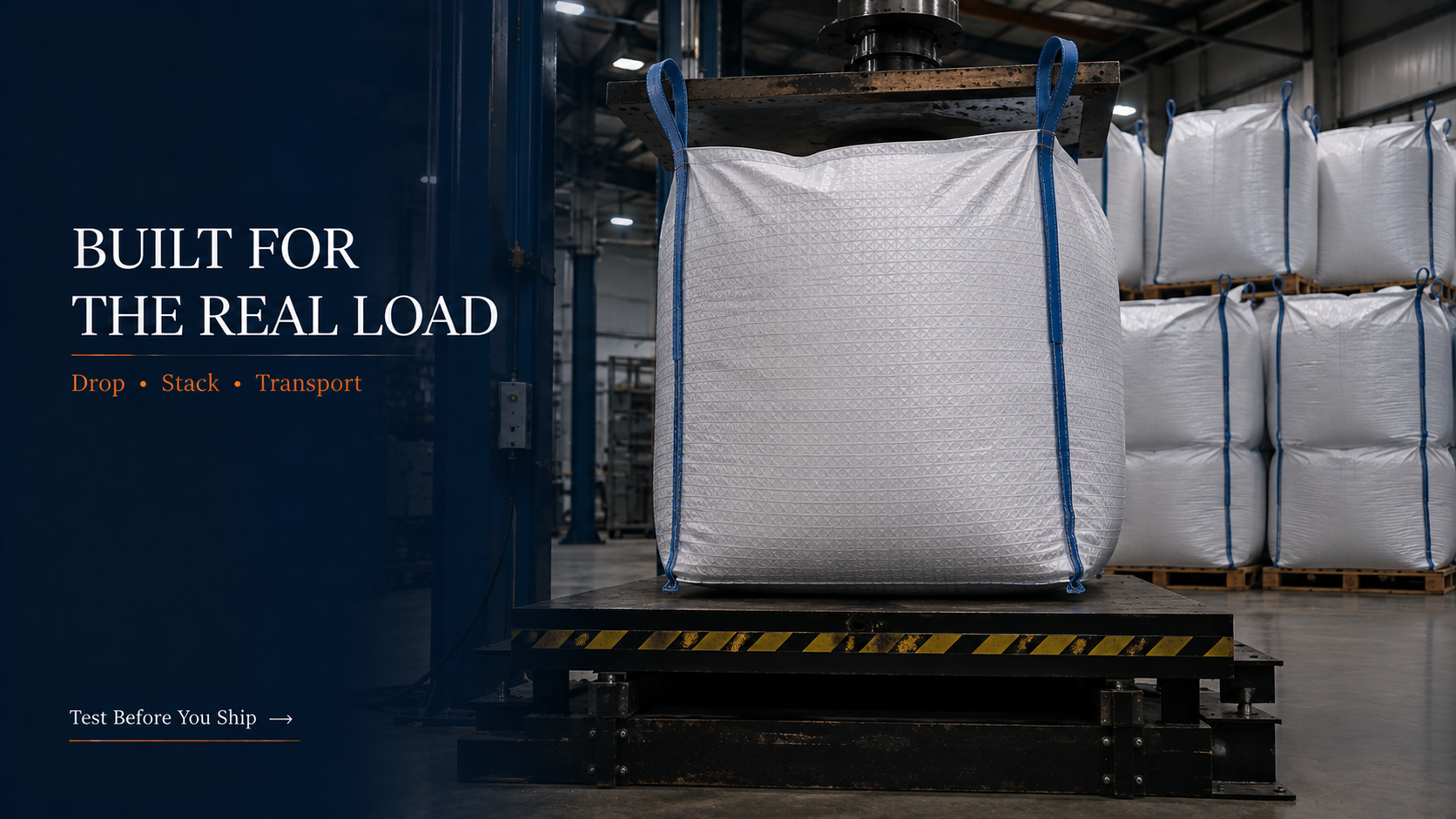
FIBCs often spend significant time in storage or transportation after filling. Therefore, a bag must perform not only during lifting but also while carrying its load in a stacked configuration.
FIBC stacking tests evaluate how the bag and its structure respond to compressive loading and storage conditions.
Buyers should consider:
- Maximum filled weight
- Stacking height
- Storage duration
- Bag dimensions
- Bag construction
- Product density
- Warehouse conditions
Construction can influence stacking behaviour. For example, baffle FIBCs use internal panels to maintain a more cubic shape and improve stacking stability, while four-panel constructions provide defined geometry for applications that require consistent shape retention.
Explore UWON Baffle FIBC Bags and UWON 4-Panel FIBC Bags for examples of constructions designed around shape retention and stacking requirements.
6. SWL and Safety Factor Testing
Safe Working Load and safety factor are among the most important specifications buyers should establish before approving an FIBC supplier.
SWL defines the rated load the bag is designed to carry. The safety factor describes the relationship between the test requirement and the bag’s rated working load.
For example, FIBCA identifies 5:1 and 6:1 as commonly used FIBC safety-factor ratios. However, buyers should select the appropriate rating according to the application, applicable requirements and intended use rather than automatically choosing the highest number.
UWON’s current product specifications also list 5:1 and 6:1 safety-factor options across several FIBC constructions.
For example, its Standard FIBC Bags and 4-Panel FIBC Bags list 5:1 / 6:1 safety-factor configurations.
Therefore, buyers should ask the supplier to confirm the SWL and safety factor for the exact bag configuration being quoted.
7. UV Testing for Outdoor Applications
UV testing becomes relevant when FIBCs may experience prolonged exposure to sunlight or outdoor environmental conditions.
Ultraviolet radiation can degrade polypropylene fabric over time and reduce its mechanical performance.
However, UV requirements should reflect the actual storage and transportation environment.
Ask the supplier:
- Will the FIBC remain indoors or outdoors?
- How long will it remain exposed?
- What UV protection does the fabric contain?
- What test method does the supplier use?
- What exposure duration applies to the specification?
- Does the reported result apply to the actual fabric construction?
FIBCA notes that UV additives and environmental conditions can affect FIBC performance differently and recommends avoiding prolonged outdoor exposure where possible. Its UV guidance also discusses accelerated weathering testing for FIBC fabrics.
Read FIBCA’s UV exposure guidance.
Therefore, UV testing should be considered when the application genuinely requires it rather than added as a generic specification to every FIBC.
8. Why Batch Testing Matters for Consistency
A supplier can have a valid certificate and still face production variation.
This is where the difference between certification and ongoing quality control becomes important.
A certificate may demonstrate that a particular product or design met a defined requirement. However, buyers also need confidence that current production continues to match the approved specification.
Batch-level quality checks can help identify changes in:
- Fabric GSM
- Tensile strength
- Seam performance
- Loop attachment
- Dimensions
- Moisture or coating characteristics
- Overall construction
FIBCA states that, in closed-loop reuse programs, FIBCs should be randomly selected for top-lift testing according to a frequency determined by the manufacturer and/or user, with testing conducted against the latest ISO 21898 standard.
This illustrates an important procurement principle: testing should support ongoing performance control, not only initial product approval.
Why Supplier Certificates Alone Are Not Enough
Certificates are useful. However, they should form only one part of the supplier evaluation.
A serious procurement review should also consider:
- Recent test reports
- Testing frequency
- Batch traceability
- Material specifications
- Production controls
- Inspection procedures
- Third-party laboratory involvement where required
- Corrective-action processes
For example, an old test report may demonstrate that a sample passed a test at one point in time. It does not automatically prove that every current production batch performs identically.
Therefore, buyers should ask for evidence that connects testing with the actual production process.
Price vs Consistency: What Buyers Often Miss
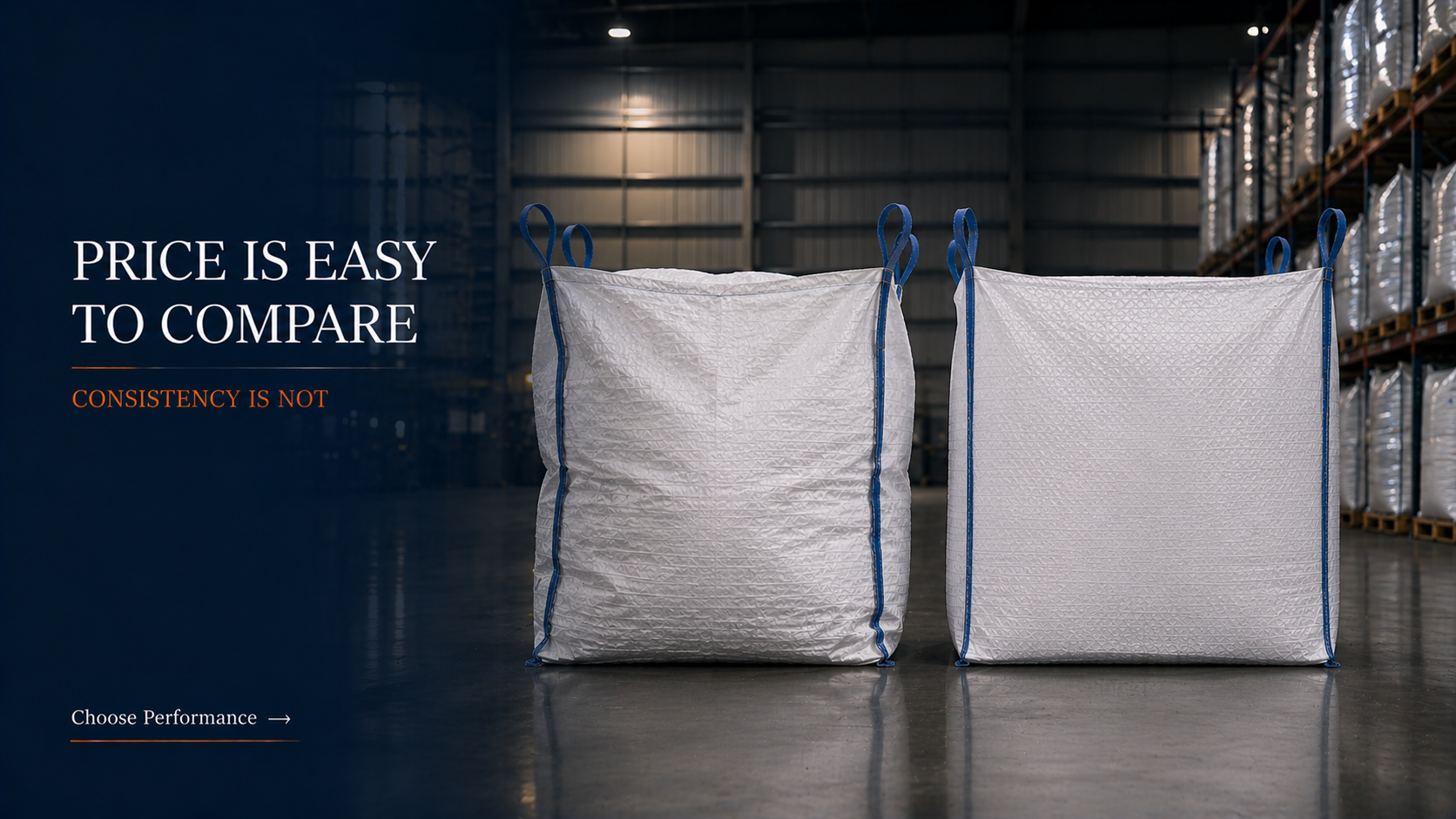
Price is easy to compare. Consistency is much harder to see.
Two FIBCs may have the same dimensions, stated capacity and printed specifications while producing different results in actual testing.
Small manufacturing differences can affect performance, including:
- Fabric GSM variation
- Yarn quality
- Stitch density
- Thread quality
- Loop attachment
- Coating consistency
- UV stabilisation
- Production-process control
Consequently, the lowest quoted price does not necessarily represent the lowest total procurement cost.
A bag that fails during filling, lifting, stacking or transport can create product loss, downtime, repacking costs, shipment delays and customer complaints.
This is why FIBC testing and consistency should become part of the procurement conversation rather than being treated as a technical detail after price negotiation.
What Buyers Should Ask an FIBC Supplier
Before approving a bulk bag supplier, ask these questions:
- Which FIBC tests do you perform on this bag design?
- What is the specified SWL?
- What safety factor applies?
- Do you test tensile strength?
- How do you verify seam strength?
- How do you test lifting-loop and top attachment performance?
- Do you conduct drop testing?
- How do you evaluate stacking performance?
- Is UV testing required for my application?
- How frequently do you conduct production testing?
- Can you provide recent test reports?
- Can the test report be linked to the production batch?
- Which laboratory performed third-party testing, if applicable?
- How do you handle failures or deviations?
These questions help buyers distinguish between a supplier that simply provides documentation and a supplier that actively manages product consistency.
How to Evaluate FIBC Manufacturers in India
When comparing FIBC manufacturers in India, procurement teams should evaluate more than manufacturing capacity and quoted price.
A stronger supplier evaluation should cover:
| Evaluation Area | What Buyers Should Check |
|---|---|
| Material quality | Fabric GSM, yarn quality and material specifications |
| Structural strength | Tensile, seam and attachment performance |
| Load performance | SWL, safety factor and top-lift performance |
| Impact performance | Drop-test requirements where applicable |
| Storage performance | Stacking and compression requirements |
| Environmental performance | UV protection when required |
| Quality system | Inspection frequency and process controls |
| Traceability | Batch identification and test records |
For this reason, the best FIBC manufacturers are not necessarily the suppliers offering the lowest initial quotation. They are the suppliers that can demonstrate repeatable performance against an agreed specification.
How UWON Uses Testing to Support FIBC Quality
UWON states that its FIBC production process includes rigorous quality checks, multi-stage inspection and testing for strength and durability.
Its product specifications also publish technical parameters such as capacity, safety factor, fabric GSM, UV protection, liner options and loop configurations.
For example, UWON’s standard FIBC specifications include 5:1 / 6:1 safety-factor options, defined fabric GSM ranges and UV-protection specifications.
Explore UWON Packaging’s FIBC quality approach.
For procurement teams, this type of specification-based approach provides a stronger starting point for comparing suppliers because buyers can evaluate measurable requirements rather than relying only on general claims such as “premium quality.”
Build Testing Into the Purchase Specification
The best time to discuss FIBC testing is before placing the purchase order.
Instead of asking for a generic bulk bag, define the requirements in the technical specification.
Include:
- Bag dimensions
- Safe Working Load
- Safety factor
- Fabric GSM
- FIBC construction
- Lifting configuration
- Top and bottom design
- Required tensile performance
- Seam requirements
- Drop-test requirements
- Stacking requirements
- UV requirements where relevant
- Testing frequency
- Documentation requirements
- Batch traceability
By defining these requirements before production, buyers create a measurable basis for supplier comparison.
As a result, procurement teams can move the discussion from “Which supplier is cheaper?” to “Which supplier can consistently meet the required specification?”
Final FIBC Testing Checklist
Before approving an FIBC supplier, confirm that the supplier can clearly address the following:
- Fabric tensile strength
- Seam strength
- Top lifting attachment performance
- Bottom attachment and discharge construction
- Top-lift testing
- Drop testing where required
- Stacking performance
- SWL and safety factor
- UV testing where relevant
- Production inspection
- Batch testing
- Test-report traceability
- Corrective-action procedures
If a supplier can clearly explain these points and provide appropriate evidence, buyers can make a much more informed purchasing decision.
Conclusion
FIBC testing is not simply a technical formality. It gives buyers a way to verify whether a bulk bag can deliver the required performance under its intended operating conditions.
Tensile strength, seam strength, lifting attachments, drop performance, stacking, SWL, safety factor and UV resistance can all matter depending on the application.
However, testing becomes even more valuable when buyers connect it with production consistency. A single certificate can provide useful evidence, but recent test reports, batch-level records and process controls provide a stronger picture of ongoing supplier performance.
Therefore, when comparing FIBC suppliers, do not evaluate price in isolation. Compare price, specification, testing, consistency and traceability together.
That is how procurement teams can reduce the risk of buying a bulk bag that looks right on paper but performs differently in the real world.
Frequently Asked Questions
What is FIBC testing?
FIBC testing evaluates the materials, construction and performance of a bulk bag against specified requirements. Depending on the application, testing can include tensile strength, seam strength, top-lift, drop, stacking, SWL, safety-factor and UV-related testing.
What is the most important FIBC test?
There is no single test that is most important for every application. Buyers should select tests according to the FIBC design, SWL, handling method, storage conditions, transportation requirements and intended use.
What is FIBC tensile strength testing?
Tensile strength testing evaluates how much pulling force the relevant FIBC material or component can withstand before failure. It helps verify whether the fabric meets the required strength specification.
Why is FIBC seam strength testing important?
Seams connect major structural components of the FIBC. Strong fabric cannot compensate for weak stitching, so seam performance is an important part of overall FIBC structural reliability.
What is an FIBC top lift test?
A top lift test evaluates how the filled FIBC performs when lifted through its designated lifting system. The test can help assess the performance of lifting loops, belts, seams and reinforced areas.
What are FIBC SWL and safety factor?
SWL, or Safe Working Load, is the load an FIBC is designed to carry. The safety factor describes the relationship between the bag’s rated working load and the applicable test requirement. FIBCA identifies 5:1 and 6:1 as commonly used FIBC safety-factor ratios.
When does an FIBC need UV testing?
UV testing becomes relevant when an FIBC may experience prolonged exposure to sunlight or outdoor environmental conditions. Buyers should define the expected exposure and required UV performance with the supplier.
Are supplier certificates enough to approve an FIBC?
Certificates are useful, but buyers should also consider recent test reports, production inspections, batch traceability, material specifications and the supplier’s process controls. Together, these provide a stronger view of ongoing consistency.
What should buyers ask FIBC manufacturers in India about testing?
Ask about tensile and seam testing, top-lift performance, SWL, safety factor, drop and stacking tests, UV testing where relevant, testing frequency, recent test reports, batch traceability and third-party laboratory verification where applicable.