
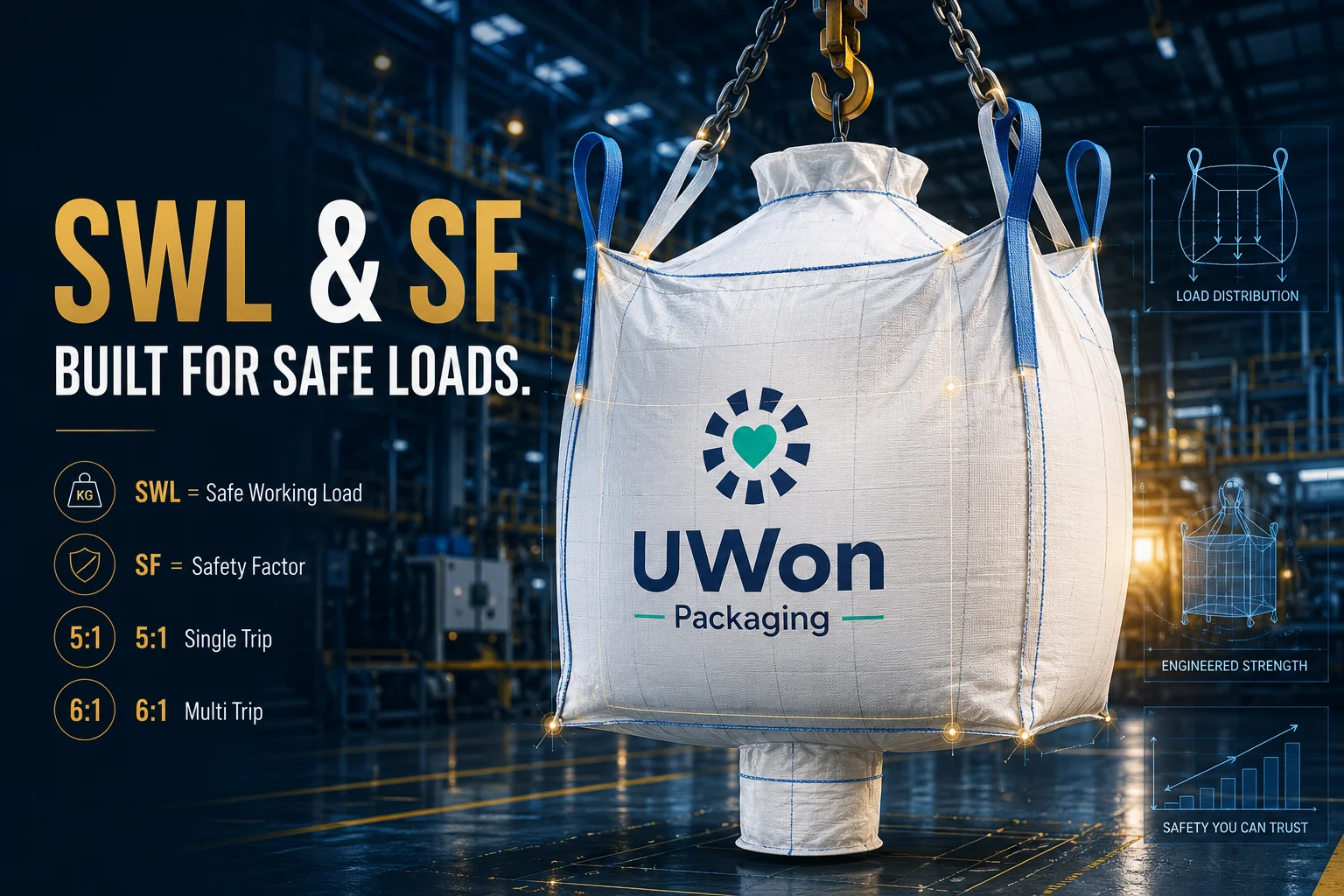
What Is SWL and SF in FIBC Bags? A Complete Industrial Guide
The terms SWL and SF in FIBC bags are among the most important specifications in bulk packaging. However, many buyers, procurement teams, and logistics operators still misunderstand how these ratings actually work. As a result, incorrect bag selection often leads to product damage, worker safety risks, rejected shipments, and even warehouse accidents.
In the FIBC industry, small specification mistakes create large operational risks. The real problem is not only the bag itself it is how the bag behaves under real loading conditions, transportation pressure, stacking stress, and repeated handling cycles.
An FIBC bag may look strong from the outside. However, without understanding Safe Working Load (SWL) and Safety Factor (SF), businesses cannot accurately determine whether the bag is suitable for their application.
This guide explains:
- What SWL means in FIBC bags
- What SF means and why it matters
- The difference between SWL and SF
- Standard FIBC safety classifications
- Real-world industrial applications
- Common buyer mistakes
- How to choose the correct FIBC bag safely
Understanding FIBC Bags First
Flexible Intermediate Bulk Container bags are designed for storing and transporting dry flowable materials in bulk quantities. These bags are widely used across industries such as chemicals, agriculture, food processing, minerals, pharmaceuticals, and construction.
Most FIBC bags are made from woven polypropylene fabric. However, their actual load performance depends on multiple engineering factors. These include fabric GSM, stitching quality, loop construction, coating type, and filling method.
Here is what happens in real scenarios:
- Improper lifting design – Causes loop tearing during forklift handling
- Wrong SWL selection – Leads to overloading and seam failure
- Low SF for harsh operations – Increases accident risks
- Poor-quality manufacturing – Reduces load-bearing consistency
An FIBC bag works under dynamic stress conditions. Therefore, understanding its load rating system is essential before procurement.
The SWL and SF ratings act as the engineering foundation of bulk bag safety. Without these ratings, buyers cannot evaluate operational suitability properly.
In addition, international packaging standards require FIBC bags to undergo testing before commercial use. These tests validate lifting performance, drop resistance, stacking stability, and top-load endurance.
For example, a chemical manufacturer transporting dense mineral powder may require a completely different SF rating compared to a food company storing lightweight grains.
The operational environment changes everything.
What Is SWL in FIBC Bags?
SWL (Safe Working Load) – refers to the maximum weight an FIBC bag can safely carry during normal usage conditions.
This rating is usually expressed in kilograms or pounds.
For example:
- 500 kg SWL
- 1000 kg SWL
- 1500 kg SWL
- 2000 kg SWL
If a bag has an SWL of 1000 kg, it means the bag is designed to safely transport materials weighing up to 1000 kg under recommended operating conditions.
However, SWL does not represent the breaking point of the bag.
That distinction is extremely important.
Here is how this becomes a problem:
- Buyers assume SWL equals breaking strength
- Operators overload bags beyond rated capacity
- Warehouse teams ignore dynamic lifting stress
- Procurement focuses only on cost reduction
- Transport vibrations increase effective load pressure
A 1000 kg SWL bag may actually break at much higher loads during testing. However, safe industrial operation requires staying within the certified SWL limit.
The SWL rating is determined through standardized testing procedures. These tests simulate actual industrial handling conditions.
Several factors affect SWL performance:
- Fabric strength – Determines overall body load resistance
- Loop construction – Handles lifting pressure distribution
- Seam quality – Prevents structural splitting
- Filling method – Impacts internal pressure balance
- Material density – Changes stress concentration points
In real warehouse operations, bags rarely experience perfectly stable conditions. Forklift jerks, crane movements, stacking compression, and transportation vibrations all increase stress levels.
Therefore, SWL is designed as a safe operational limit rather than an absolute maximum capacity.
Real-World Example
A cement manufacturer uses 1000 kg SWL FIBC bags for export shipments. However, operators consistently fill bags to 1200 kg to reduce shipping frequency. Over time, lifting loops begin tearing during container loading because repeated overload cycles exceed safe stress tolerance.
The issue is not immediate failure. The issue is gradual structural fatigue.
What Is SF in FIBC Bags?
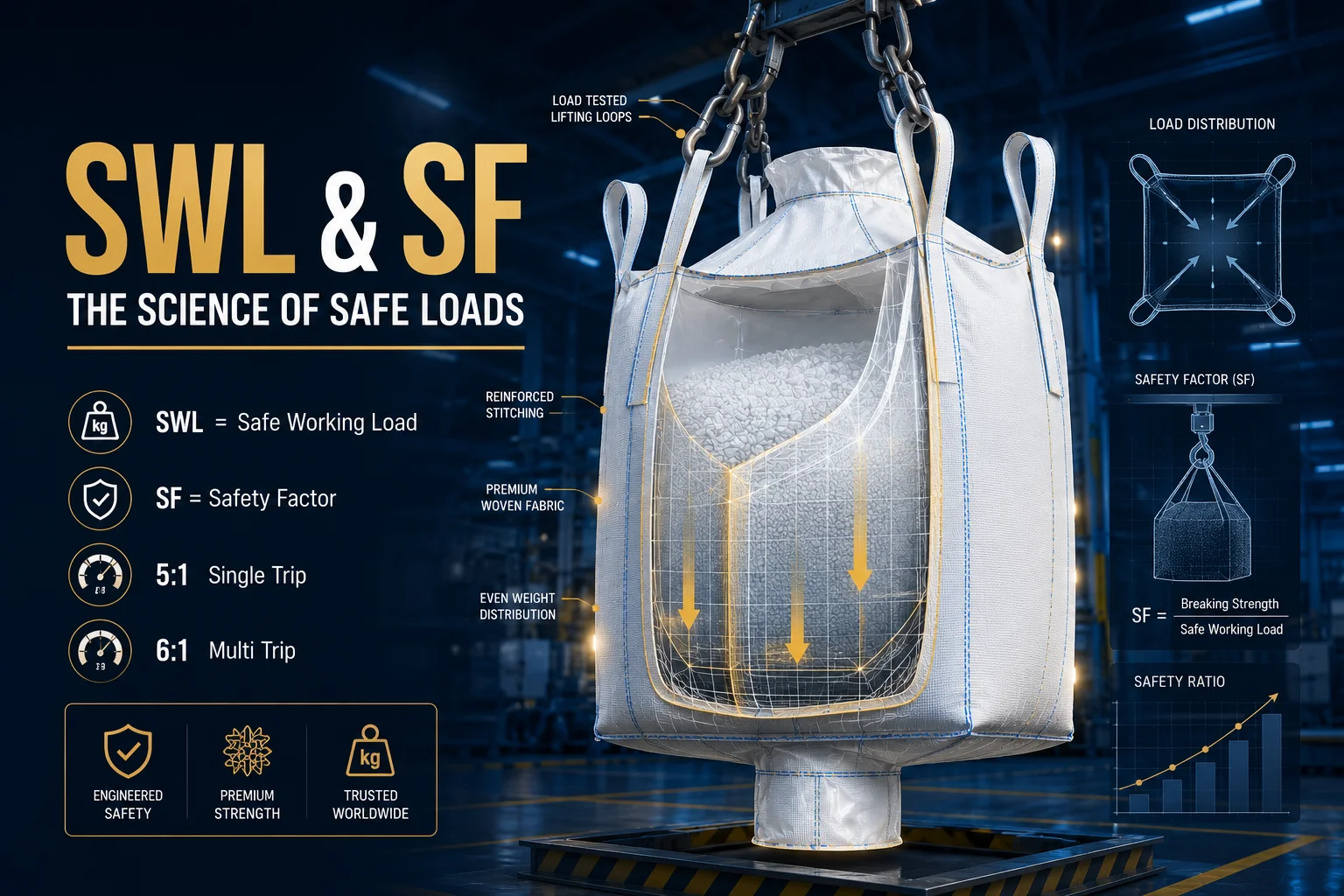
SF (Safety Factor) refers to the ratio between the bag’s tested breaking load and its certified Safe Working Load.
In simple terms:
SF indicates how much stronger the bag is compared to its rated working capacity.
This means the bag can withstand five times its safe operating load during standardized testing however, this does NOT mean users should load the bag five times higher during actual operations. that misunderstanding creates serious industrial hazards.
Here is what happens in real scenarios:
- Users misunderstand SF as usable load margin
- Repeated overload weakens stitching
- Bag fatigue reduces long-term reliability
- Handling shocks exceed design assumptions
- Unsafe lifting practices increase accident probability
SF exists to account for real-world uncertainties. These include sudden impacts, uneven loading, environmental stress, and operational inconsistencies.
The safety factor acts as a protective engineering buffer.
In addition, different SF ratings are designed for different usage patterns. Some bags are intended for single use. Others are designed for multiple usage cycles.
The SF rating directly reflects that operational intent.
Real-World Example
A fertilizer company uses reusable FIBC bags in rough handling conditions. Forklift operations are aggressive, stacking heights are inconsistent, and transportation routes are uneven. A low SF bag begins failing after several cycles. After switching to a higher SF design, operational damage decreases significantly.
The material did not change.
The safety margin changed.
Standard SF Ratings in FIBC Bags
The FIBC industry commonly uses several standard safety factors.
| Safety Factor (SF) | Usage Type | Typical Application |
|---|---|---|
| 5:1 | Single-trip bags | One-time transportation |
| 6:1 | Multi-trip bags | Reusable industrial handling |
| 8:1 | Specialized heavy-duty applications | High-risk environments |
These classifications are widely recognized in industrial packaging standards.
Difference Between SWL and SF
Many procurement teams confuse SWL and SF because both relate to bag strength. However, they measure completely different things.
| Parameter | SWL | SF |
|---|---|---|
| Meaning | Safe operating weight | Strength reserve ratio |
| Unit | Kilograms or pounds | Ratio (5:1, 6:1) |
| Purpose | Defines carrying limit | Defines safety margin |
| Operational Use | Daily loading control | Engineering reliability |
| User Impact | Prevents overloading | Prevents catastrophic failure |
Understanding this difference is essential for safe bag selection.
Here is how this becomes a problem:
- Low-cost sourcing ignores SF
- Warehouse teams only check SWL
- Export buyers misunderstand reuse capability
- Heavy materials create unexpected stress
- Operational conditions exceed laboratory assumptions
The SWL tells operators how much they can safely load.
The SF tells engineers how much protection exists against failure.
Both specifications must work together.
For example, two bags may both have 1000 kg SWL ratings. However, one may have 5:1 SF while the other has 6:1 SF. Their operational reliability is completely different.
The higher SF bag offers better durability and greater resistance to handling stress.
Therefore, industrial applications with repeated use cycles usually require higher SF ratings.
Real-World Example
A mining operation initially purchases low-cost 5:1 SF bags for repeated material transport. After several loading cycles, bags begin showing seam stress and loop deformation. Switching to 6:1 SF multi-trip bags improves operational lifespan and reduces replacement costs.
Lower upfront cost created higher long-term expense.
Why SWL and SF Matter in Industrial Operations
FIBC bags operate inside highly demanding environments. These conditions include mechanical handling, stacking pressure, environmental exposure, and transport movement.
As a result, load safety becomes a critical operational issue.
Here is what happens in real scenarios:
- Forklift acceleration creates shock loading
- Uneven filling shifts internal pressure
- Moisture exposure weakens material behavior
- Improper stacking increases bottom stress
- Sharp materials damage fabric structure
A bag failure affects more than product loss.
It can create:
- Worker injury risks
- Production downtime
- Shipment rejection
- Regulatory violations
- Warehouse contamination
- Cleanup expenses
- Brand reputation damage
In addition, industries handling hazardous or regulated materials face even stricter compliance expectations.
The real operational challenge is consistency.
A bag must perform reliably across multiple handling points including filling plants, warehouses, trucks, ports, and customer unloading facilities.
Therefore, SWL and SF are not only technical specifications. They are risk management tools.
Real-World Example
A chemical exporter experiences repeated bag instability during container stacking. Investigation reveals incorrect bag selection for material density. After redesigning the bag with appropriate SWL and SF ratings, shipment damage decreases substantially.
Packaging failure was actually an engineering mismatch.
Key Insight: The Real Problem Is Application Mismatch
Many FIBC failures are not caused by defective manufacturing alone.
The larger issue is incorrect application selection.
- A strong bag can still fail in the wrong environment
- High-density products create concentrated stress
- Aggressive handling increases dynamic loading
- Multi-trip use demands higher safety margins
- Poor filling practices reduce structural stability
The real problem is not the bag it is the application strategy behind the bag.
Factors That Affect SWL and SF Performance
1. Material Density
Dense materials generate higher stress concentration.
For example:
- Sand
- Minerals
- Metal powders
- Cement
- Chemicals
These products behave differently compared to lightweight agricultural materials.
Here is how this becomes a problem:
- Dense products increase seam pressure
- Internal shifting creates instability
- Bottom discharge areas face excess stress
- Sharp particles damage woven fabric
- Compaction changes lifting dynamics
A 1000 kg lightweight product and a 1000 kg dense mineral may create very different operational stress behavior.
Therefore, product characteristics must always influence bag selection.
Real-World Example
A mineral processor uses standard agricultural FIBC bags for dense powder export. Bottom seams begin failing during stacking because the product density exceeds intended stress distribution.
2. Lifting and Handling Method
Handling style directly affects bag safety performance.
Forklift handling creates dynamic movement. Crane lifting creates vertical stress concentration. Automated systems create repetitive loading cycles.
Each method changes force distribution.
Here is what happens in real scenarios:
- Uneven lifting damages loops
- Sudden forklift movement creates shock loads
- Incorrect tine spacing weakens bag geometry
- Dragging bags damages fabric
- Repeated lifting increases fatigue
Therefore, bag design must match actual operational handling systems.
Real-World Example – A warehouse repeatedly uses narrow forklift tine spacing. Over time, lifting loops deform because load distribution becomes uneven.
Why This Matters
Choosing the wrong SWL or SF affects the entire supply chain.
- Product damage increases operational cost
- Worker safety risks increase liability
- Export rejection harms customer relationships
- Frequent bag replacement reduces efficiency
- Packaging inconsistency affects production planning
Bulk packaging is not only a procurement decision.
It is an operational reliability decision.
Common Mistakes Buyers Make
Ignoring Real Operating Conditions
Many buyers only focus on static weight.
However, operational conditions create additional stress.
Here is what happens in real scenarios:
- Transport vibration increases effective pressure
- Humidity affects material behavior
- Stacking changes compression load
- Repeated reuse weakens components
- Outdoor exposure reduces durability
Ignoring these conditions creates avoidable failures.
Choosing Lowest-Cost Bags
Low-cost sourcing often sacrifices engineering quality.
Critical issues include:
- Lower fabric GSM
- Weak stitching
- Poor UV resistance
- Inferior loop construction
- Inconsistent testing standards
The short-term savings often create larger long-term operational costs.
Real-World Example
An exporter switches to cheaper FIBC suppliers without testing verification. Shipment claims increase because bags fail during overseas handling.
Final Insight
SWL and SF are not just technical numbers printed on an FIBC label.
They represent:
- Operational safety
- Packaging reliability
- Handling durability
- Compliance readiness
- Supply chain protection
A properly selected FIBC bag improves operational stability across the entire logistics cycle.
However, incorrect selection creates hidden risks that usually appear during transport, stacking, or lifting.
Conclusion
Understanding SWL and SF in FIBC bags is essential for safe and efficient bulk packaging operations.
- SWL defines the safe carrying capacity
- SF defines the engineered safety margin
- Both specifications must match the actual application environment
In addition, businesses should evaluate:
- Material density
- Handling conditions
- Reusability requirements
- Transportation stress
- Storage practices
The strongest packaging strategy always begins with correct engineering selection.
Small mistakes in bulk packaging create large operational risks. Therefore, selecting the correct SWL and SF combination is not only a technical decision — it is a business protection strategy.