
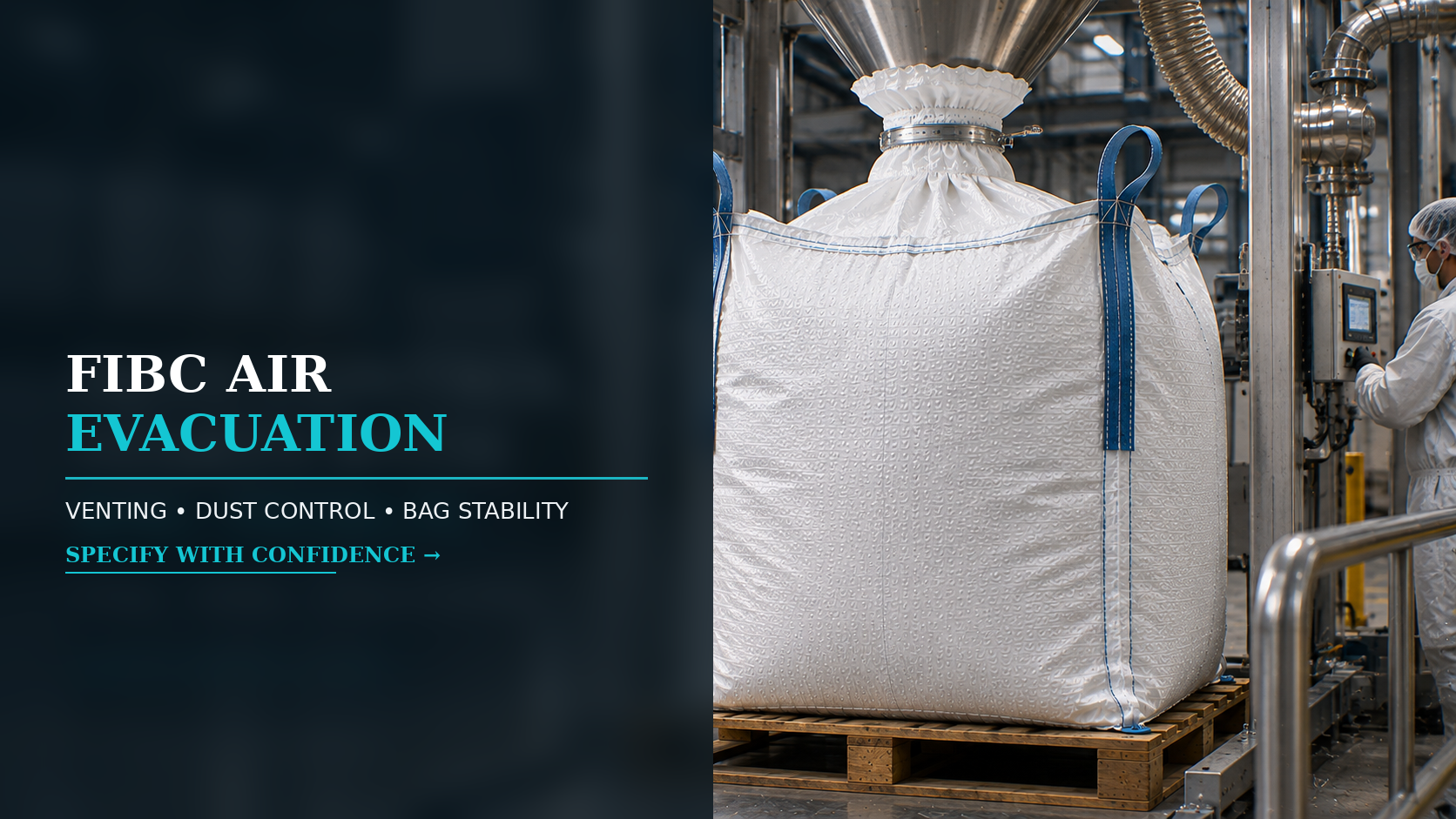
FIBC Air Evacuation During Filling: Venting, Dust Control and Bag Stability
FIBC air evacuation during filling is easy to overlook until a bag inflates like a balloon, dust escapes around the filling head or the liner folds into the product stream. Fast filling lines can introduce a large volume of displaced air, especially with fine powders. If that air cannot leave in a controlled way, filling becomes slower, dirtier and less predictable.
The solution depends on the product, fill rate, bag fabric, coating, liner and filling connection. Buyers should treat air evacuation as part of the FIBC specification rather than a last-minute machine adjustment.
Why Air Builds Up During FIBC Filling
As product enters the bag, the air occupying the internal volume has to escape. Coated fabric and liners reduce natural air permeability. Fine powders can also carry entrained air into the bag, increasing internal pressure and making the filled package appear larger before the material settles.
1. Match Bag Permeability to the Product
Uncoated woven polypropylene allows more air movement than coated fabric. However, an uncoated bag may not provide the dust or moisture control required for the product. Review our coated vs uncoated FIBC guide when balancing breathability and containment.
2. Consider Vented or Perforated Liners
Where a liner is essential but displaced air still needs a controlled escape path, a purpose-designed vented or perforated liner may be considered. The venting pattern must suit the particle size and containment requirement so product does not escape with the air.
3. Control the Filling Connection
A filling spout should interface properly with the filling head. Excessive gaps allow dust to escape, while a poorly sealed connection can make dust extraction ineffective. Spout diameter and length should therefore be specified around the actual machine.
Our FIBC filling and discharge options guide explains the main top constructions.
4. Avoid Liner Ballooning
A loose liner can inflate ahead of the product, fold across the inlet or move toward the top closure. Correct liner attachment, pre-inflation procedures and filling-head design can help keep the liner positioned correctly. See the FIBC liner guide for liner fit and attachment considerations.
5. Control Fill Rate
Increasing the fill rate without increasing air-handling capacity can create instability. The fastest machine setting is not always the fastest complete cycle if operators have to stop, settle the bag or clean escaped dust.
6. Use Dust Extraction Where Required
Fine powders may require a filling station with dust extraction or a dual-purpose filling connection that allows product entry and air removal. The design should prevent excessive negative pressure from pulling liners or fabric into the extraction path.
7. Allow for Product Deaeration and Settlement
Some powders occupy more volume immediately after filling because they contain entrained air. After standing or vibration, the product settles and the bag height decreases. This affects target fill level, headspace and container loading. The FIBC bulk density guide helps buyers connect fill weight and usable volume.
Buyer Questions for Fast Filling Lines
- What is the maximum filling rate?
- Is the product dusty or highly aerated?
- Is the body fabric coated?
- Is a liner required?
- How will displaced air leave the bag?
- What filling-head diameter is used?
- Is dust extraction connected to the filling head?
- Does the product settle significantly after filling?
Sharing these details with FIBC manufacturers in India allows the bag to be engineered around the real line rather than a generic filling spout.
Common Symptoms of Poor Air Evacuation
- The bag inflates excessively before reaching target weight.
- Dust escapes around the top spout.
- The liner balloons or twists.
- Filling must be stopped repeatedly to settle the product.
- Filled bags shrink noticeably after standing.
- The final footprint varies from bag to bag.
Frequently Asked Questions
Why does an FIBC balloon during filling?
Trapped or entrained air can build pressure inside the bag, especially when coated fabric or liners restrict air escape.
Can I simply perforate the liner?
Not without engineering review. Perforation size and pattern can affect product containment and hygiene.
Does faster filling always improve productivity?
No. If air evacuation and dust control cannot keep up, a higher fill rate can increase interruptions and cleanup.
Can dust extraction pull the liner upward?
Yes, if the airflow and liner attachment are not correctly designed.
Final Takeaway
FIBC air evacuation during filling should be specified with the same care as SWL or bag dimensions. Matching permeability, liner design, filling-spout geometry and dust extraction to the product can improve cycle time, cleanliness and filled-bag stability.