
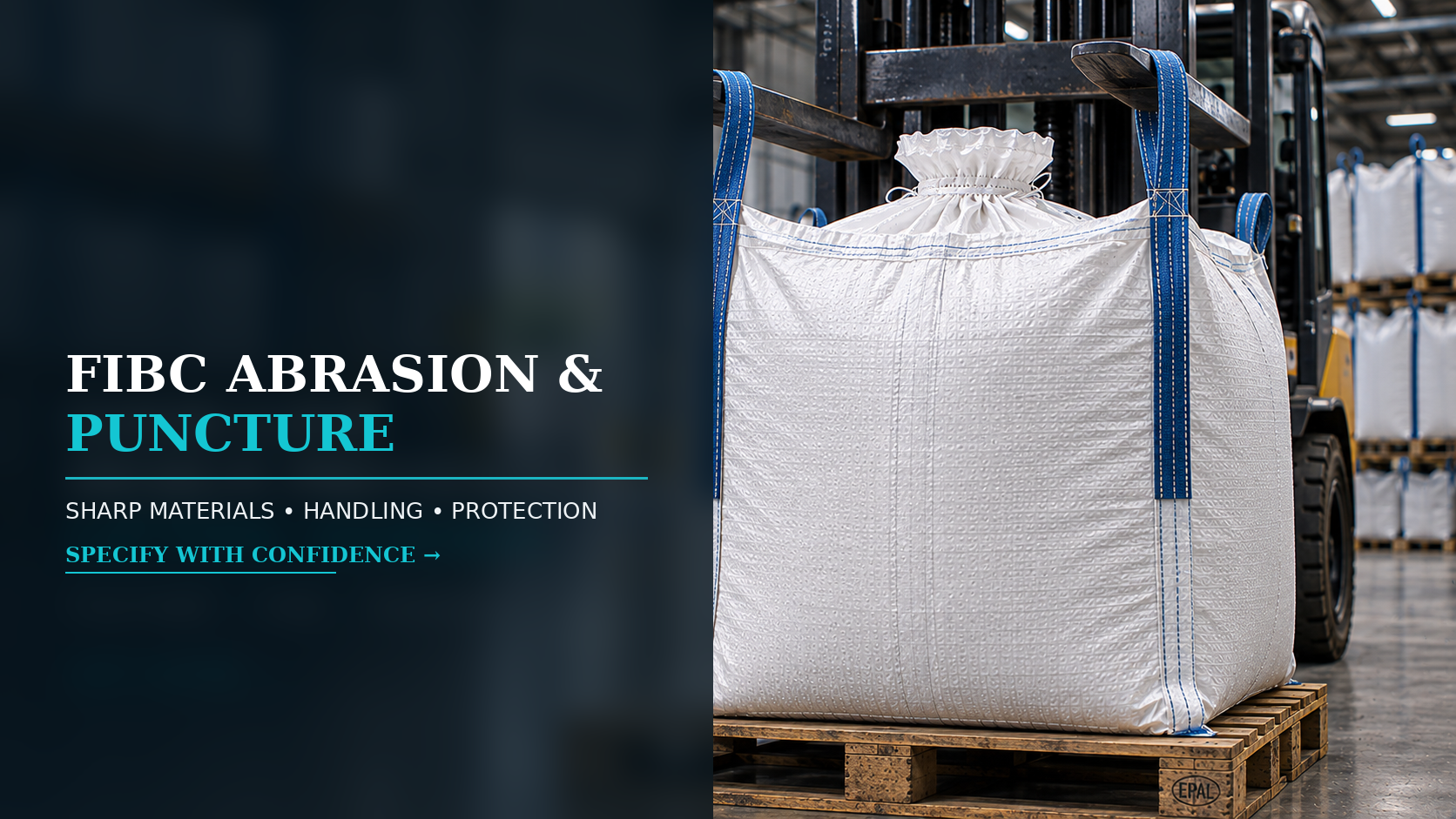
FIBC Abrasion and Puncture Resistance: A Buyer Guide for Sharp Bulk Materials
FIBC abrasion and puncture resistance matters most when the product itself can damage the package. Coarse minerals, sharp granules, metal concentrates, aggregates and irregular particles can rub against the inner fabric during filling, vibration and discharge. At the same time, rough pallets, floors and forklift contact can damage the outside.
For buyers, the answer is not automatically ‘use thicker fabric.’ The real solution is to identify where damage occurs and then strengthen the relevant part of the packaging system.
How Abrasion and Puncture Damage Differ
Abrasion is progressive surface wear caused by repeated rubbing. Puncture is localized penetration from a sharp edge or point. A fabric can resist one failure mode better than another, so the product profile and handling route should be described clearly.
1. Start With Particle Shape, Not Only Bulk Density
Two products with the same bulk density may behave very differently. Smooth plastic pellets are less abrasive than angular mineral particles. Buyers should provide particle size, shape and whether the material contains sharp fragments.
2. Review Fabric Construction and GSM
Fabric weight contributes to durability, but GSM alone is not a complete strength rating. Tape properties, weave density and the overall bag design matter. Our FIBC fabric GSM guide explains how these factors work together.
3. Protect the Base Seam
The base carries the product while the bag is at rest and experiences concentrated forces during lifting and setting down. Abrasive material can increase wear around folds and seams. Seam construction should therefore match the duty cycle and product.
4. Consider a Liner for Product Isolation
A liner can reduce direct contact between the product and woven body, but the liner itself must be compatible with sharp particles. Thin liners can be punctured if the product is highly angular. See our FIBC liner guide for broader liner selection considerations.
5. Eliminate External Damage Sources
Even a heavy-duty FIBC can be cut by a protruding nail, broken pallet board, sharp forklift tine or rough steel edge. Warehouse inspections should remove these hazards before filled bags are moved.
The FIBCA safe handling guidelines advise using smooth lifting devices and pallets without damaging projections.
6. Avoid Dragging Filled Bags
Dragging a filled FIBC across concrete can rapidly abrade the bottom fabric and seams. Bags should be lifted or moved on suitable pallets rather than pushed across the floor.
7. Validate the Complete Bag
If the application is severe, trial fills and handling simulations can reveal wear locations before a large order. The objective is to strengthen the actual weak point rather than add cost everywhere.
Buyer Checklist for Abrasive Materials
- Product name, particle size and shape.
- Bulk density and target fill weight.
- Expected filling drop height.
- Internal liner requirement.
- Base and seam construction.
- Pallet type and surface condition.
- Forklift, crane or telehandler handling.
- Number of intended handling cycles.
- Indoor or outdoor storage.
Application Example: Minerals
Dense mineral products can combine high weight with abrasive particles. A buyer may need stronger body fabric, reinforced base construction and careful pallet control. However, increasing the safety factor without addressing abrasion may not solve the real problem. Review the FIBC safety factor guide before using SF as a general durability shortcut.
What to Ask FIBC Manufacturers in India
When sourcing from FIBC manufacturers in India, ask how the proposed design addresses the specific wear mechanism. Request clear fabric, seam and liner specifications and describe the handling environment. A technically useful supplier should be able to explain why each reinforcement is included.
Frequently Asked Questions
Does higher GSM improve puncture resistance?
It may contribute, but puncture behavior also depends on tape construction, weave, coating, liner and the sharpness of the product.
Can a liner protect an FIBC from abrasive products?
A liner can reduce direct contact with the body fabric, but the liner itself must be suitable for the particle profile.
Why do FIBC bases wear faster?
The base experiences product pressure, floor contact and handling forces, so abrasion can concentrate there.
Should filled FIBCs be dragged?
No. Dragging can abrade the base and damage seams.
Final Takeaway
FIBC abrasion and puncture resistance should be engineered around the product and the handling route. By identifying internal and external damage sources, buyers can specify targeted protection instead of relying on vague ‘heavy-duty’ descriptions.