

FIBC Bags for Wood Pellets: A Buyer Guide to Bulk Packaging, Handling and Storage
FIBC Bags for Wood Pellets: A Buyer Guide to Bulk Packaging, Handling and Storage
Wood pellets are compact biofuel products, but choosing an FIBC for them is not simply a matter of selecting a jumbo bag with a convenient nominal capacity. Pellet grade, bulk density, fines, filling equipment, storage conditions and the receiving plant all influence the right flexible intermediate bulk container. A bag that works at the pellet mill may create problems at a distributor, port or industrial boiler site if the filling and discharge interfaces were never agreed.
This guide gives procurement and operations teams a practical framework for specifying FIBC bags for wood pellets. It is not a claim that one construction suits every grade or every transport route.
1. Why wood pellet packaging needs application-specific design
Two products both called wood pellets can differ in feedstock, dimensions, fines, moisture, bulk density, durability and intended use. Those differences affect how product settles in a bag, how much headspace is needed, how it behaves during conveying and how much dust appears at transfer points.
The bag must also fit the full route: filling from a silo, temporary warehouse storage, forklift movement, container loading and final discharge. Specify the package around the whole chain, not only the filling machine. Record the product, filling method, lifting equipment, storage environment, transport mode and discharge arrangement before requesting a quotation.
2. Begin with the pellet specification, not the bag size
Request a current product specification and representative sample. ISO 17225-2:2021 defines fuel-quality classes and specifications for graded wood pellets made from specified categories of virgin wood, wood-processing by-products and residues, and chemically untreated used wood. It excludes thermally treated biomass pellets such as torrefied pellets. It is a fuel-quality standard, not an FIBC design or packaging certification.
For packaging, collect:
- Pellet diameter and length range, with the measurement method.
- Bulk density as delivered, with test method and sampling conditions.
- Moisture content and acceptance range.
- Fines or dust fraction and the sieve or measurement method.
- Mechanical durability or relevant product-quality results.
- Feedstock, treatment or additive declarations that affect handling.
Do not rely on a generic product name or an old data sheet. If the grade changes, review the bag trial because density and fines can change filling behaviour and filled dimensions.
3. Convert net weight into a realistic bag volume
Payload and volume are related but are not interchangeable. A 1,000 kg target fill must also fit the volume occupied at the actual bulk density. Use this planning equation:
Estimated product volume (m³) = net product mass (kg) ÷ measured bulk density (kg/m³).
For example, at a measured bulk density of 650 kg/m³, a 1,000 kg fill occupies about 1.54 m³ before allowing for bag geometry, settling, headspace and fill height. This is an arithmetic illustration, not a recommended bag size. Use the actual grade’s measured density.
Confirm net mass, tare allowance, filled dimensions, headspace and gross handling load separately. SWL, safety factor, lifting arrangement and any stacking requirement must be established from the intended use and applicable specification. A volume calculation cannot prove structural suitability. See UWON’s FIBC bulk-density guide for more calculation context.
4. Control fines, breakage and product loss
Pellets can generate fines during production, conveying, filling, vibration and repeated handling. Measure fines at the filling point and, where practical, after a representative handling cycle using the same method. This helps separate incoming product quality from damage created downstream.
Inspect for visible dust escape at seams, corners, closures and spout connections. A coating or liner does not solve every leakage issue: nozzle fit, closure design and operator method matter too. Review transfer heights and impact points because unnecessary free fall, abrupt conveyor transitions and rehandling may damage pellets before they reach the bag. Test with the real product, not a substitute material.
5. Choose FIBC construction for the handling route
Evaluate fabric specification, coating or liner, seams, lifting loops, base construction, top closure and discharge features as one system. ISO 21898:2024 specifies materials, construction, design, type testing and marking for FIBCs intended for non-dangerous solid materials in powder, granular or paste form and designed to be lifted from above. Its scope matters: it is not a substitute for dangerous-goods packaging rules when the actual substance and route require them.
Request the approved bag specification and relevant test or conformity evidence. Confirm that the sample and delivered production bags use the same critical materials and construction. If payload, dimensions, fabric, loops or stacking arrangement change, review the approval basis instead of assuming it still applies.
6. Compare standard, U-panel, four-panel and baffle designs
Standard and circular constructions
A standard or circular FIBC may suit applications where the natural filled profile and storage footprint are acceptable. Confirm the actual filled shape rather than relying on empty-bag dimensions.
U-panel and four-panel constructions
Panel-based designs create a defined body shape through their cut-and-sew construction. Compare filled dimensions, seam layout, shape retention and behaviour under the actual product load. A construction name alone does not guarantee a particular stacking result.
Baffle constructions
Internal baffles can help a filled bag retain a more cubic shape and limit outward bulging. That may make pallet or container patterns more predictable, but performance depends on bag dimensions, baffle openings, fabric, fill level and material behaviour. Ask for filled-bag measurements and a trial loading pattern before calculating freight savings.
Review available configurations on UWON’s FIBC products page and specify the required design in the RFQ.
7. Design the filling interface around the plant
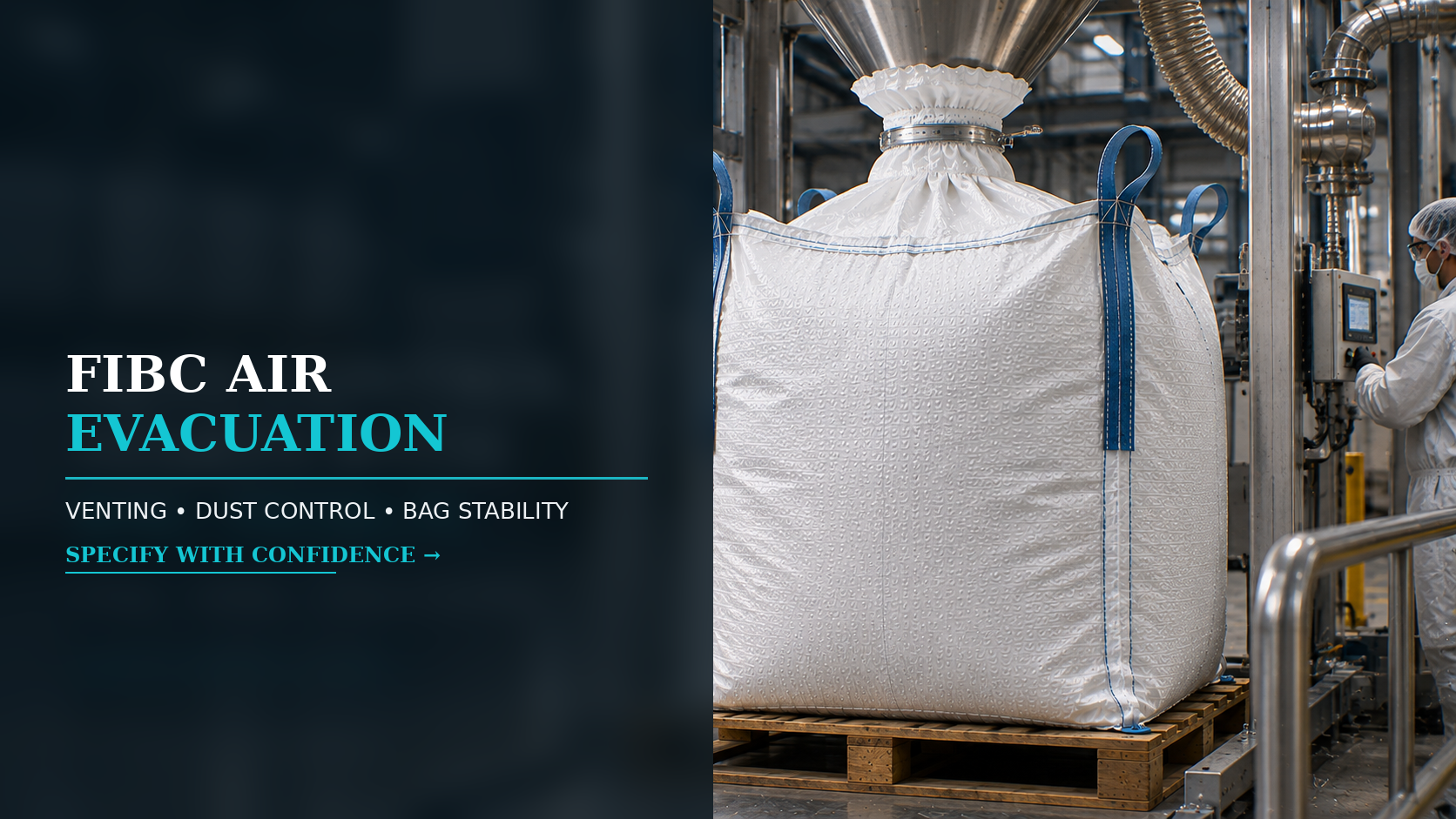
Confirm whether the plant fills through an open top or filling spout. Record nozzle diameter, spout length, connection method, dust extraction, filling rate, weighing method and overhead clearance. The interface should fit the equipment without forcing operators to stretch, cut or improvise around the fabric.
Define how the bag is supported during filling and how the top is closed afterward. The support method must not load loops, seams or fabric in a way that differs from the intended design. During a trial, record filling time, net weight variation, filled height and width, closure quality, dust escape and operator intervention. UWON’s filling-line trial checklist can help structure the review.
8. Decide whether a liner or coating is necessary
Do not add a liner automatically because the product is a biofuel. Identify the risk it is intended to control: moisture ingress, product leakage, contamination, odour transfer or another defined requirement. Then determine whether the risk occurs during filling, short-term storage, transit or at the receiving plant.
A liner can change filling, air release, discharge and package settling. A coating can affect the fabric surface and containment. Check compatibility with the product and equipment. If a moisture barrier is required, state the target performance and test method instead of using vague language such as “moisture proof.” A barrier is not a substitute for dry storage or condensation control. See UWON’s FIBC storage guide.
9. Protect cleanliness and product identity
Packaging controls should prevent foreign matter, mixed grades, water, oil, loose fibres and debris from entering the bag. Define the cleaning standard for the filling area and the acceptable condition of bags before use. Store unused bags away from dirt, rain, standing water, pests and sharp objects.
Keep different pellet grades identifiable through the site’s approved lot or batch system. Labels should remain readable after filling and should not be hidden by lifting or closure operations. Do not describe an FIBC as food-grade or certified for a regulated application unless the exact materials, manufacturing controls and evidence support that claim. Product and transport requirements determine the documentation needed.
10. Specify lifting, palletization and stacking
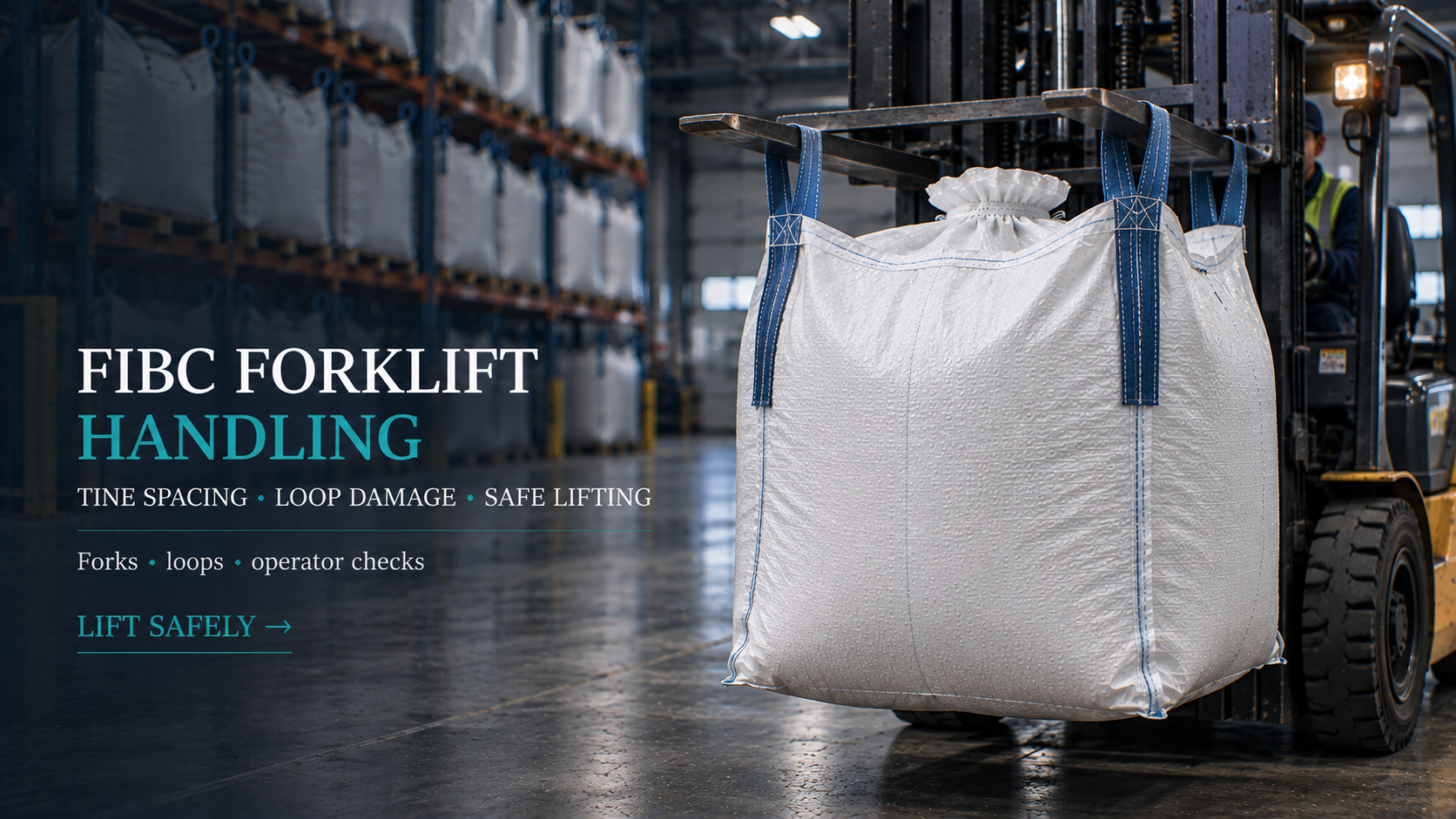
Confirm whether the site uses a forklift, spreader beam, crane hook or dedicated lifting frame. Loops must fit the actual equipment, and the procedure should prevent twisting, side loading, snagging or lifting by an unintended part of the bag. Record SWL and safety factor in the approved specification and markings.
For palletized loads, record pallet dimensions, deck condition, load rating, fork entry and filled bag footprint. Check overhang and stability. If bags are stacked, define the arrangement, maximum height and supporting surface through the applicable handling assessment and approved design. Do not infer stackability from a photograph or an empty bag’s shape.
11. Address dust, fire and carbon-monoxide risks separately
Fine wood dust can present a fire or explosion hazard when dispersed in air under suitable conditions and an ignition source is present. The presence of pellets in a bag does not by itself establish a process hazard classification. The facility should assess actual fines, dust collection, transfer points, electrical equipment, housekeeping and ignition sources under applicable local requirements.
OSHA identifies wood dust among materials that can form combustible dust and notes that particle size, moisture and sample characteristics influence explosibility. Use a competent site assessment; this packaging guide is not a dust-hazard analysis. Avoid uncontrolled compressed-air blowdown of settled dust.
Carbon monoxide is a separate concern. The UK HSE warns that wood pellets can release carbon monoxide in enclosed storage spaces and that entering pellet hoppers or storage areas can be fatal without proper confined-space controls. FIBC packaging does not remove this risk. Never enter a pellet room, container, hopper or enclosed space to investigate a blockage unless the site’s competent confined-space procedure, atmospheric testing and rescue arrangements are in place.
Consult the HSE wood-pellet carbon-monoxide alert and OSHA combustible-dust guidance.
12. Plan warehouse storage and export transport
Define whether filled FIBCs will be stored indoors, under a canopy, outdoors for a limited period or inside a container. Record duration, temperature range, rain and sunlight exposure, floor condition, ventilation and stacking arrangement. Do not treat the bag as a weatherproof warehouse or long-term outdoor storage system unless that use is assessed and supported by the specification.
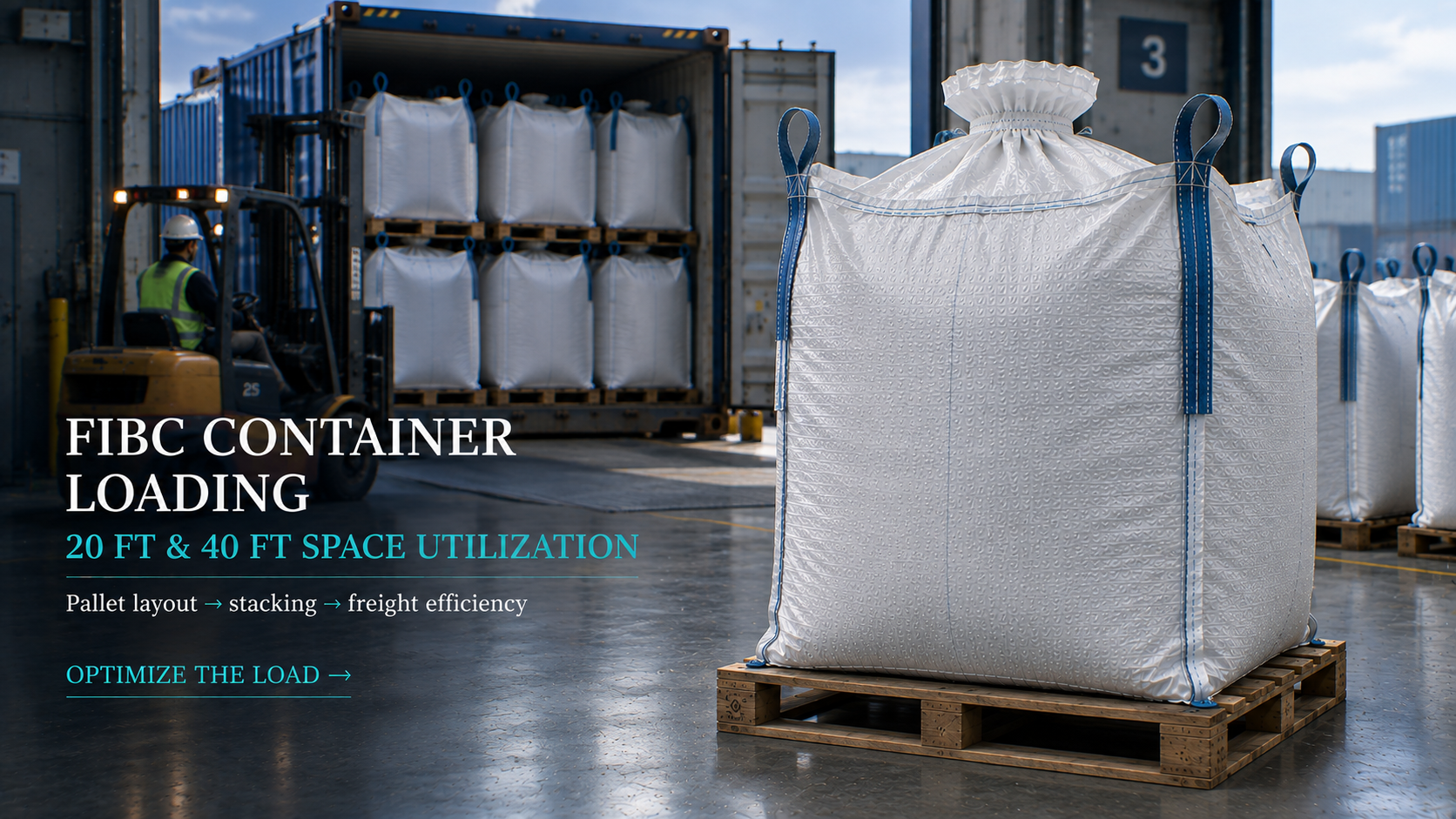
Before container loading, inspect the floor, walls, roof, doors and snag points. Confirm the pattern using actual filled dimensions, pallet requirements, gross payload and securing method. The IMO/ILO/UNECE CTU Code provides non-mandatory guidance for packing and securing cargo transport units by sea and land, including risks from inadequate securing, overloading and incorrect cargo declarations. Use it alongside mandatory rules and carrier instructions. UWON’s container-loading guide can support layout discussions but does not replace a shipment-specific load plan.
13. Validate the design with a filled-bag production trial
Agree a trial protocol with the supplier and filling plant. Identify the bag drawing, fabric and liner specification, lifting arrangement, net fill mass, product lot, filling equipment, pallet and handling method. Record deviations rather than making undocumented adjustments during the test.
A useful trial record includes:
- Bag ID, drawing revision and material batch references.
- Product grade, bulk density, moisture and fines at filling.
- Net weight, filled height, width and length at agreed points.
- Filling time, closure method, dust escape and product loss.
- Loop, seam and base condition after the agreed handling sequence.
- Storage, pallet, lift and discharge observations, with photographs.
- Non-conformities, corrective actions and written approval status.
Set acceptance criteria before the trial. If product, line, bag construction or transport route changes materially, assess whether the original trial remains representative.
14. Put the right information into the supplier RFQ
A useful request for quotation describes the application, not just a price per bag. Include these fields:
| RFQ field | Buyer information |
|---|---|
| Product | Pellet grade, feedstock description, data sheet and treatment declaration. |
| Quality data | Bulk density, moisture, dimensions, fines and test methods. |
| Payload | Target net mass, tolerance and gross-weight limit. |
| Bag design | Construction, filled dimensions, top and bottom arrangement, liner or coating. |
| Handling | Forklift or crane method, loop configuration, pallet and stacking plan. |
| Filling and discharge | Nozzle, support frame, closure and receiving equipment interface. |
| Logistics | Storage duration, transport route, climate exposure and destination. |
| Evidence | Approved drawing, specification, applicable test reports, sample approval and batch identification. |
Ask the supplier to state assumptions and exclusions in writing. If an alternative construction is proposed, request a comparison against the same payload, dimensions, handling and containment requirements. Use UWON’s FIBC RFQ Intelligence tool to structure the application before requesting a quotation.
15. Technical references and scope boundaries
Use primary sources to distinguish fuel quality, packaging design, workplace safety and cargo-unit guidance:
- ISO 17225-2:2021 — graded wood-pellet fuel quality classes and specifications within its stated raw-material scope.
- ISO 21898:2024 — FIBC materials, construction, design, type testing and marking for non-dangerous goods.
- UK HSE safety alert — carbon-monoxide risks in enclosed wood-pellet storage.
- OSHA guidance — combustible-dust hazards and control principles.
- IMO/ILO/UNECE CTU Code — non-mandatory cargo-unit packing and securing guidance.
These documents have different scopes and legal status. ISO 17225-2 is not a packaging approval. ISO 21898 does not replace dangerous-goods rules where they apply. The CTU Code does not replace mandatory national, road, rail, sea or carrier requirements. Confirm the current requirements for the actual product, route and destination with the responsible shipper and competent compliance professional.
16. Frequently asked questions
What size FIBC is suitable for wood pellets?
There is no universal size. Calculate product volume from target net mass and measured bulk density, then confirm filled dimensions, headspace, SWL, handling and storage footprint through a filled-bag trial.
Do wood pellets always need an inner liner?
No. Specify a liner only when a defined moisture, cleanliness or containment requirement justifies it. Check compatibility with filling and discharge equipment.
Are baffle FIBCs always better for wood pellets?
No. Baffles may reduce outward bulging, but the benefit depends on design, fill level, pellet behaviour and loading pattern. Compare filled samples and actual container layouts.
Can FIBCs be stored inside a closed room or container?
Assess ventilation and site risks. HSE warns that wood pellets can release carbon monoxide in enclosed storage spaces. Follow confined-space procedures; do not enter without required controls.
Does ISO 21898 certify a wood-pellet FIBC for every route?
No. ISO 21898:2024 covers FIBCs for non-dangerous goods. The buyer and shipper must separately confirm product classification and applicable transport requirements.
17. Final buyer checklist and next step
Before releasing a purchase order, confirm that the pellet specification is current, bulk density and fines are measured, net payload and volume are reconciled, and the bag drawing matches the filling and discharge equipment. Approve the construction, liner decision, lifting method, pallet arrangement, storage environment and export load plan. Run a filled-bag trial with written acceptance criteria, then control later changes through the approved specification revision.
The most reliable FIBC selection is checked against the actual pellets and the actual supply chain. For a new wood-pellet packaging project, share the product data, target payload, filling method and destination handling details through UWON Packaging’s FIBC RFQ Intelligence. A complete application brief gives the packaging team a stronger basis for evaluating the right bag configuration.