
FIBC Design Guide: 12 Key Specifications for Buyers
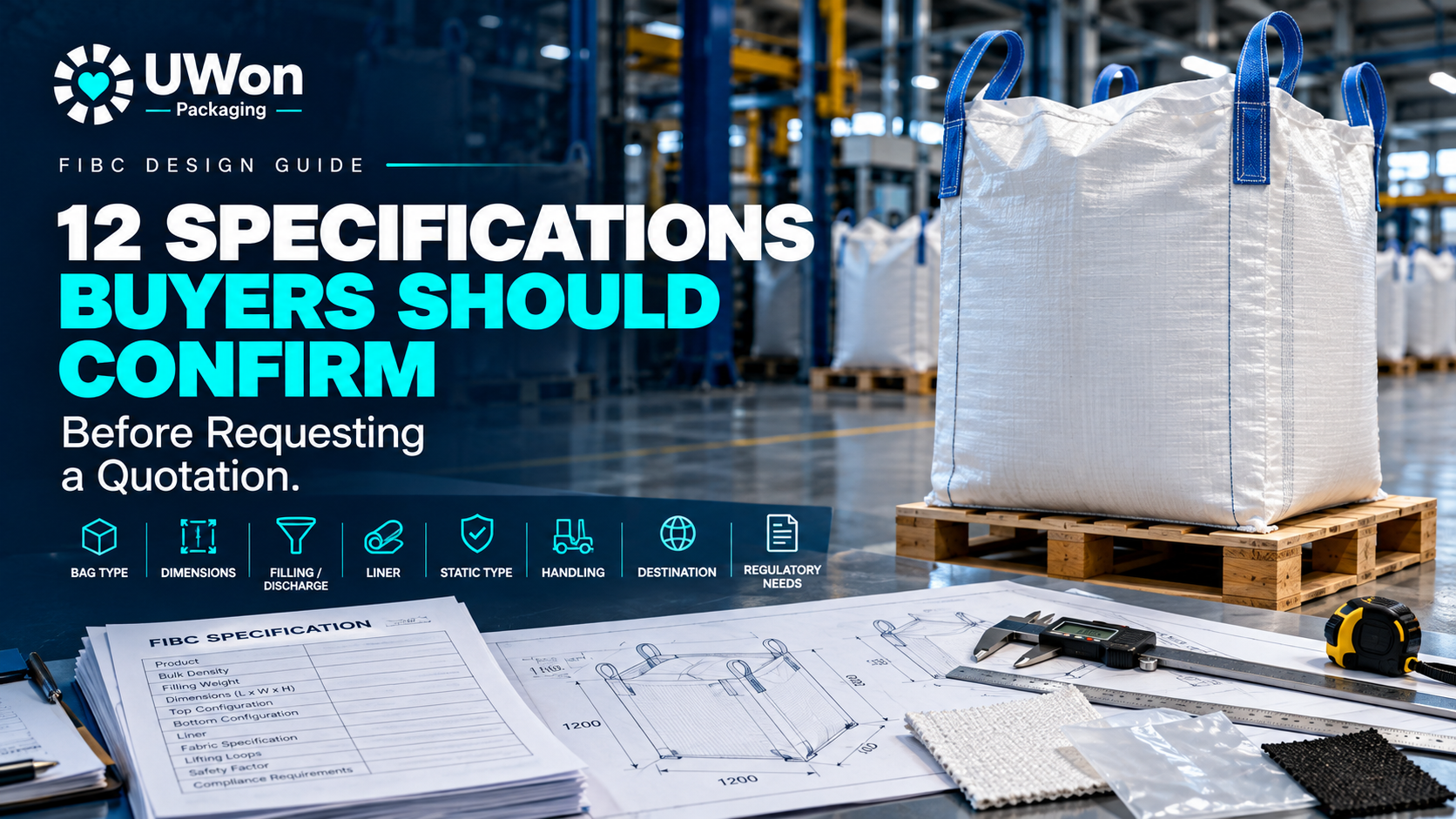
FIBC Design Guide: 12 Specifications Buyers Should Confirm Before Requesting a Quotation
Two FIBC bags can have the same nominal capacity and still be designed for very different applications.
One may be intended for free-flowing plastic granules. Another may need to contain a fine powder, connect to an automated filling line, control dust during discharge or meet specific product-contact requirements.
Both may be described as 1,000 kg bulk bags, but that description alone does not establish whether either design is suitable.
For industrial buyers, an effective FIBC design guide starts with the application rather than the catalogue.
Before requesting a quotation, buyers should establish what the bag will contain, how it will be filled, lifted, stored, transported and emptied, and which technical or regulatory requirements apply.
This guide explains 12 essential FIBC specifications buyers should confirm, why each matters and what information should be shared with a manufacturer.
Why FIBC Design Should Be Defined Before Price Comparison
An FIBC is part of a bulk-material handling system. Its design needs to work with the packed product, production equipment, warehouse conditions and distribution process.
A quotation based only on nominal capacity and quantity may leave the manufacturer to assume important details.
For example, two suppliers might propose different bag constructions, filling spouts, liners or lifting arrangements for the same enquiry.
Those quotations may not represent technically equivalent products.
The Flexible Intermediate Bulk Container Association (FIBCA) Design Guide encourages prospective bulk-bag users to identify critical application information before sourcing a bag. Its purpose is to help buyers prepare for technical discussions with manufacturers, not to automatically produce a finished specification.
The following 12-point framework translates that buyer-first approach into practical design decisions.
1. Product Characteristics and Bulk Density
The first design decision concerns the material being packed.
A manufacturer needs to understand more than the product’s commercial name.
What buyers should confirm
- Product or material name
- Physical form: powder, granules, pellets, flakes or other solids
- Loose and settled bulk density, where relevant
- Particle size and flow characteristics
- Moisture sensitivity
- Dust generation or sifting concerns
- Abrasiveness or relevant material compatibility
- Temperature at filling, where relevant
Why bulk density changes the design
Consider two materials, each requiring a target filling weight of 1,000 kg.
At a bulk density of 1,000 kg/m³, the approximate material volume is 1.0 m³.
At a bulk density of 500 kg/m³, the approximate material volume is 2.0 m³.
The target weight is identical, but the required volume is different.
This can influence the bag dimensions, filled height, filling process and storage arrangement.
These are simplified calculations. Actual design must also consider filling behaviour, usable volume and operating conditions.
Buyer question: Have we defined the packed material well enough to determine the required bag volume and relevant protection needs?
2. Safe Working Load and Intended Use
The next specification is the load the FIBC is designed to carry safely under its defined conditions of use.
The Safe Working Load (SWL) should be clearly identified and distinguished from the buyer’s target filling weight.
What buyers should confirm
- Target net filling weight
- Required SWL
- Applicable safety factor
- Single-trip or intended multiple-use application
- Expected handling and lifting conditions
- Relevant testing and documentation requirements
The intended number of uses should not be decided from a safety-factor number alone. Suitability depends on the complete design, applicable standards, condition of the bag and intended operating environment.
For FIBCs within its scope, ISO 21898:2024 provides requirements relating to materials, construction, design, type testing, marking, selection and safe use.
Buyer question: Is the load rating appropriate for the material, lifting process and intended use?
3. Bag Dimensions, Volume and Filled Footprint
FIBC dimensions should be selected according to product volume and operational constraints, not only a preferred catalogue size.
What buyers should confirm
- Required length, width and height
- Dimensional tolerances
- Usable filling volume
- Expected filled footprint
- Pallet dimensions
- Filling-line height restrictions
- Warehouse and transport clearances
The filled shape matters because flexible bags may change profile when loaded.
A bag that fits a pallet when empty may behave differently once filled with a particular product.
Where the available storage or transport space is limited, the filled dimensions should be validated rather than inferred only from the empty bag dimensions.
Buyer question: Will the filled FIBC fit the equipment, pallet, warehouse and transport space available?
4. FIBC Bag Construction and Body Design
Different FIBC constructions offer different structural arrangements and filled-shape characteristics.
Common designs include:
How buyers should evaluate construction
Start by defining the required performance rather than selecting a construction based only on appearance.
Consider the product’s behaviour, target volume, filled footprint, lifting arrangement and handling process.
For example, baffle construction can be evaluated when maintaining a more rectangular filled profile is important for the application.
However, no construction name automatically establishes the suitability or tested performance of the finished bag.
Buyer question: Which body construction best supports the material and the way the filled bag will be handled?
5. Filling Method and Top Configuration
The top design should be compatible with the actual filling process.
Common arrangements include open tops, duffle tops and filling spouts.
What buyers should confirm
- Manual or automated filling
- Filling equipment and operating method
- Required filling rate
- Filling spout diameter and length
- Equipment connection details
- Dust-control requirements
- Required top closure
- Liner connection, if applicable
For controlled filling applications, an FIBC with filling spout may be evaluated against the existing filling equipment.
FIBCA’s guidance on filling and discharging options also highlights the importance of equipment, clearance, filling rate and operating conditions when selecting these configurations.
Buyer question: Does the bag’s filling arrangement match the actual production line?
6. Discharge Method and Bottom Configuration
The discharge design should be selected around the way the material will leave the bag.
A flat bottom, discharge spout or other bottom arrangement may be appropriate depending on the application.
What buyers should confirm
- Discharge equipment
- Gravity or assisted discharge
- Required discharge rate
- Outlet diameter and length
- Discharge closure arrangement
- Product-flow behaviour
- Dust and spillage-control requirements
- Operator access and equipment clearance
A discharge-spout FIBC should be evaluated as part of the complete unloading system.
Fine powders, free-flowing granules and materials prone to bridging may create different discharge requirements.
Buyer question: Can the product be discharged safely and effectively using the intended equipment?
7. Fabric, Coating and Sift-Control Requirements
The body fabric and seam construction influence the FIBC’s overall performance.
Buyers should avoid relying only on generic descriptions such as “heavy-duty woven polypropylene.”
What buyers should confirm
- Relevant fabric specification
- Required performance characteristics
- Coated or uncoated construction
- Sift-control requirements
- Relevant seam requirements
- UV-related requirements where applicable
- Product compatibility
Fabric GSM alone should not be treated as proof of the complete bag’s strength.
The finished FIBC also depends on the construction, seams, lifting-loop attachments and verified design.
For fine powders, sift-control performance may require particular attention to seams, closures and other potential leakage paths.
Buyer question: What fabric and construction performance is actually required by the packed product?
8. Inner Liner and Product Protection
Not every FIBC requires an inner liner.
When a liner is necessary, its purpose should be defined clearly.
What buyers should confirm
- Whether a liner is required
- Liner material
- Required barrier properties
- Thickness or performance specification
- Loose or secured construction
- Tube or form-fit design
- Top and bottom arrangement
- Filling and discharge compatibility
- Relevant product-contact requirements
A liner intended to address moisture exposure may have different performance requirements from one intended primarily for product separation or contamination control.
The liner and outer bag must function together during filling, handling and discharge.
Buyer question: What specific protection does the product need, and how will the liner deliver it?
9. Electrostatic Classification: Type A, B, C or D
Electrostatic requirements are particularly important where combustible dusts or flammable gases or vapours may be present.
FIBCs are commonly classified into electrostatic Types A, B, C and D, but these classifications must not be treated as interchangeable.
What buyers should confirm
- Whether the packed product can generate combustible dust
- Whether flammable gases or vapours may be present
- The relevant operating environment
- Applicable electrostatic risk assessment
- Required FIBC classification
- Liner compatibility
- Grounding arrangements where applicable
- Required testing and documentation
The correct electrostatic classification should be established through an appropriate risk assessment, not selected solely from a catalogue description.
Buyer question: Has the operating environment been assessed to determine the appropriate electrostatic protection?
10. Lifting Loops, Handling Equipment and Storage
The FIBC must be compatible with the equipment used to lift, move and store it.
What buyers should confirm
- Forklift, crane or other lifting method
- Number and arrangement of lifting loops
- Loop dimensions and clearances
- Handling sequence
- Pallet configuration
- Storage conditions
- Stacking requirements, where permitted
- Relevant site restrictions
The lifting arrangement should be evaluated against the complete bag design and intended handling process.
FIBCA also provides FIBC Safe Handling Guidelines that buyers and operators can consult alongside manufacturer-specific instructions.
Buyer question: Is the complete lifting and handling arrangement suitable for the equipment and operating conditions?
11. Destination, Transportation and Packing Requirements
Transport requirements should be considered during FIBC design, not only after production.
What buyers should confirm
- Delivery destination and country
- Transport mode
- Container or vehicle restrictions
- Palletised or non-palletised shipment
- Storage and transit conditions
- Required outer packing
- Labelling and identification
- Commercial delivery terms
- Required shipping documentation
For export shipments, pallet compatibility, container utilisation, handling arrangements and destination-specific requirements may influence the overall packaging specification.
Buyers should also communicate any relevant restrictions on dimensions, moisture exposure or storage duration.
Buyer question: Is the proposed FIBC suitable for the full distribution route, not just the filling facility?
12. Regulatory Requirements, Testing and Documentation
The final design checkpoint is establishing which regulatory, technical and customer requirements apply to the specific product and destination.
Not every FIBC requires the same certification or documentation.
What buyers should confirm
- Applicable product-contact requirements
- Food or pharmaceutical handling requirements, where relevant
- Dangerous-goods classification, if applicable
- Relevant transport regulations
- Applicable standards and testing requirements
- Required declarations and certificates
- Traceability requirements
- Required markings and labels
- Customer-specific quality requirements
Food-contact applications
For food-related products, buyers should identify the applicable product-contact, hygiene, contamination-control and destination-market requirements.
“Food grade” alone is not a complete technical or regulatory specification.
Dangerous-goods applications
If the packed material is classified as dangerous goods, the buyer should identify the applicable classification and transport requirements before approving the packaging design.
A conventional non-dangerous-goods FIBC should not automatically be assumed suitable for dangerous-goods transport.
For background, see what a UN-certified FIBC means.
Buyer question: Can the supplier demonstrate that the proposed bag and documentation meet the requirements applicable to this particular application?
FIBC Design Specification Checklist: 12 Buyer Questions
Before sending an enquiry to FIBC manufacturers, use the following summary to check whether the critical design information has been collected.
| No. | Design Area | Question to Confirm |
|---|---|---|
| 01 | Product | What are the material properties and bulk density? |
| 02 | Load | What filling weight, SWL and use conditions apply? |
| 03 | Dimensions | What volume, dimensions and filled footprint are required? |
| 04 | Construction | Which bag construction suits the application? |
| 05 | Filling | How will the product enter the bag? |
| 06 | Discharge | How will the product leave the bag? |
| 07 | Fabric | What fabric, coating and sift-control performance is needed? |
| 08 | Liner | What product protection or barrier properties are required? |
| 09 | Static | What electrostatic hazards and classification apply? |
| 10 | Handling | How will the FIBC be lifted, moved and stored? |
| 11 | Logistics | What destination and transport restrictions apply? |
| 12 | Compliance | What testing, regulatory and documentation requirements apply? |
If a requirement is unknown, identify it as an open technical point instead of inserting an assumed value.
Example: Turning Application Information Into an FIBC Design Brief
Consider a buyer preparing a new FIBC requirement for plastic granules.
The initial enquiry may simply state:
1,000 kg jumbo bags for plastic granules. Quantity: 8,000 pieces.
A more useful design brief would identify the following:
- Product: Plastic granules; exact grade and properties to be confirmed
- Bulk density: To be provided
- Target filling weight: 1,000 kg
- SWL: To be confirmed against the application
- Dimensions: To be evaluated using bulk density and pallet constraints
- Construction: Supplier recommendation requested
- Filling: Automated filling; equipment details pending
- Discharge: Receiving process to be confirmed
- Liner: Requirement under review
- Electrostatic conditions: To be assessed
- Handling: Forklift; loop configuration to be confirmed
- Storage: Indoor warehouse
- Destination: To be confirmed
- Quantity: 8,000 pieces
This is not a final technical specification.
It is a structured starting point that shows what is known and what still requires clarification.
That distinction helps prevent incomplete information from being mistaken for an approved bag design.
What If Some FIBC Design Specifications Are Still Unknown?
Buyers do not always need to establish every technical value independently before contacting a manufacturer.
However, they should provide the available application information and identify unresolved requirements clearly.
For an existing enquiry, a structured review can help identify missing information before supplier discussions begin.
The UWON FIBC RFQ Analyzer can be used to review an RFQ for specification gaps and ambiguous requirements. It is a preparation aid, not a substitute for engineering assessment, testing or final specification approval.
For a more detailed field-by-field reference, buyers can also consult the FIBC RFQ checklist.
Frequently Asked Questions About FIBC Design
What information is required to design an FIBC bag?
Important inputs include product characteristics, bulk density, target filling weight, SWL, dimensions, bag construction, filling and discharge methods, fabric, liner, electrostatic requirements, handling conditions, destination and applicable compliance requirements.
How do I choose the correct FIBC bag type?
Start with the material, required volume, filling and discharge equipment, handling conditions and storage constraints. The appropriate construction should then be evaluated against the application.
Does every 1,000 kg FIBC have the same dimensions?
No. Bag dimensions depend on factors including bulk density, target filling volume, construction and operational constraints.
Is a liner necessary for every FIBC?
No. A liner should be specified when the product or application requires particular protection, separation or barrier performance.
What is the difference between Type A, B, C and D FIBCs?
These are electrostatic classifications with different properties and conditions of safe use. The correct type must be selected according to the relevant hazards and operating environment, with reference to applicable standards.
Can I request an FIBC quotation without a technical drawing?
Yes. Buyers can provide the application information available and ask the manufacturer to evaluate a suitable configuration. A final drawing or specification should be reviewed and approved before production.
Which standards should FIBC buyers consider?
Depending on the application, relevant references may include ISO 21898 for FIBCs within its scope and IEC 61340-4-4 for electrostatic requirements. Food-contact, dangerous-goods and destination-specific requirements should be assessed separately.
Why is the FIBCA Design Guide useful?
It helps buyers identify critical application questions before sourcing a bulk bag, particularly when they have not previously developed a complete FIBC specification.
Conclusion: Design the FIBC Around the Application
The correct FIBC specification begins with understanding the packed product and the complete handling process.
Bag construction, dimensions, filling and discharge arrangements, liners, electrostatic classification and compliance requirements should be considered as connected design decisions.
For procurement teams evaluating FIBC manufacturers in India or international suppliers, a clear design brief creates a stronger basis for technical discussion and quotation comparison.
Before requesting a quotation, confirm the 12 specification areas, identify unresolved questions and ensure suppliers are evaluating the same application.
A well-defined FIBC design brief does more than support pricing. It helps establish whether the proposed bulk bag is appropriate for the job it needs to perform.