
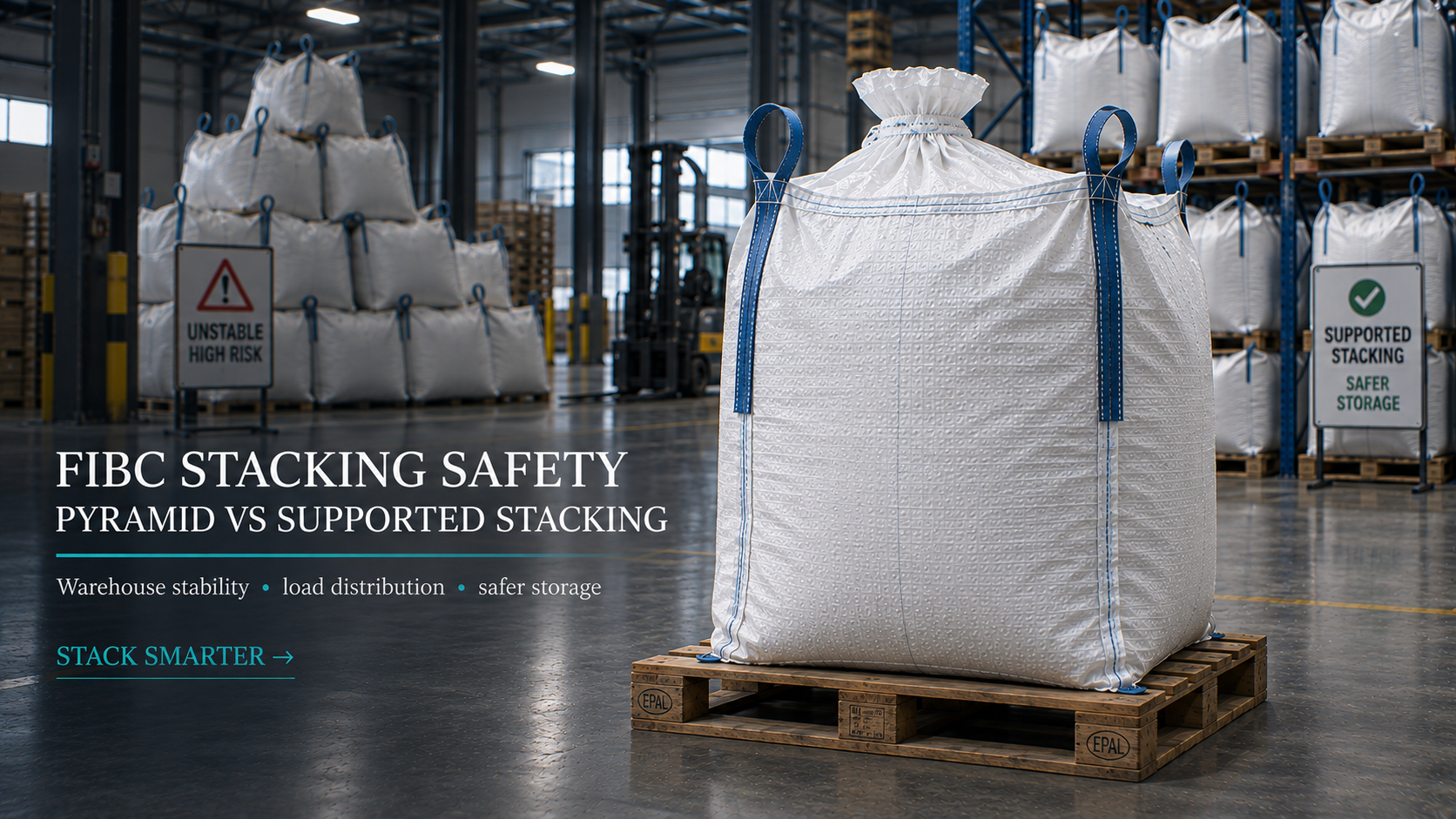
FIBC Stacking Safety: Pyramid vs Supported Stacking for Warehouses
FIBC stacking safety is often treated as a warehouse issue, but the stability of a stack starts much earlier—with bag design, fill consistency, pallet condition and the way the product settles inside the FIBC. A bag that is technically strong enough to carry its Safe Working Load can still become unstable if it is unevenly filled, overhangs the pallet or is stacked on a poor surface.
For buyers, the right question is not simply ‘How many bags can we stack?’ The better question is: ‘Under what conditions can this specific filled FIBC be stacked safely?’ This guide explains the difference between pyramid and supported stacking, the checks that matter before stacking, and the common specification mistakes that create avoidable risk.
Why FIBC Stacking Safety Starts With the Specification
Filled bag stability depends on more than dimensions. Bulk density, product flow behavior, bag construction, top closure, base shape and degree of filling all affect the center of gravity. A free-flowing granular product may settle differently from a cohesive powder, even when both bags have the same nominal size.
That is why buyers should connect warehouse conditions to the original FIBC RFQ checklist. If stacking is expected, say so before production. The supplier can then consider filled footprint, body construction, baffles where appropriate, and the final load geometry.
Pyramid Stacking vs Supported Stacking
Pyramid stacking
In a pyramid stack, each upper FIBC is supported by multiple bags below it so the load steps inward as the stack rises. This reduces the chance that an upper bag sits directly over an unsupported edge. The method is commonly recommended when bags are stacked in an open area without side restraints.
Supported stacking
Supported stacking uses stable walls, racking or another engineered restraint to help prevent lateral movement. The support system itself must be suitable for the filled load. Warehouse teams should never assume that a nearby wall or temporary barrier is a structural stacking support.
The FIBCA safe handling guidelines emphasize correct stacking and safe handling practices for filled FIBCs. Buyers should combine those general principles with the supplier’s specific instructions.
7 Checks Before You Stack Filled FIBCs
1. Confirm the bag is intended to be stacked
Some applications are designed for single-level storage. If stacking is part of the real operating condition, it should be considered during specification and validation.
2. Check the filled shape
A leaning, twisted or unevenly filled bag should not be placed into a stack. A distorted footprint can shift the center of gravity and load neighboring bags unevenly.
3. Inspect the pallet
Pallets should be clean, level, correctly sized and free from nails, broken boards or sharp projections. The bag should not unintentionally overhang the pallet edge.
4. Use a level floor
Even a well-designed FIBC can become unstable on sloped, broken or debris-covered flooring. The base layer determines the stability of everything above it.
5. Avoid damaged bags
Do not stack bags with torn fabric, damaged loops, open seams, product leakage or severe deformation. If the bag has been impacted during handling, isolate it for inspection.
6. Control fill consistency
Uneven fill weights and inconsistent product settling can produce bags with different heights and footprints. That makes a stable stack harder to achieve.
7. Follow the supplier’s stacking limits
Do not convert a general warehouse habit into a universal stacking rule. Product density, bag design and site conditions vary too much.
How Bag Design Affects Stack Stability
Four-panel and U-panel designs can behave differently from circular constructions once filled. Baffle FIBCs are often selected where a squarer footprint is valuable because internal baffles help reduce bulging. If container or warehouse space is a key constraint, review our guide on how baffle FIBC bags improve space efficiency.
Bulk density also matters. A dense product can reach the SWL before the bag appears visually full, while a light material may fill a larger volume. The FIBC bulk density guide explains how fill weight and usable volume should be matched.
Common Warehouse Mistakes
- Stacking bags simply because another product was stacked the same way.
- Allowing filled FIBCs to overhang damaged pallets.
- Using visibly leaning bags in the base row.
- Mixing different bag dimensions or fill heights in one stack.
- Placing stacks where forklifts frequently clip corners or loops.
- Repairing or moving a damaged lower bag while other bags remain above it.
What Buyers Should Put in the RFQ
If filled bags will be stacked, include expected fill weight, product bulk density, storage duration, pallet dimensions, indoor or outdoor conditions, stacking method and maximum intended stack height. This gives FIBC manufacturers in India and other suppliers enough context to discuss the application properly rather than quoting a generic bag.
Frequently Asked Questions
Can all FIBC bags be stacked?
No. Stackability depends on the filled product, bag design, pallet, surface, stability and supplier guidance.
What is safer: pyramid or column stacking?
Unsupported vertical columns can create higher instability risk. Pyramid or engineered supported stacking is generally preferred where stacking is allowed.
Can a baffle bag improve stacking?
A baffle construction can help maintain a squarer filled shape, which may improve space use and stability, but it does not replace proper stacking controls.
Should damaged FIBCs be stacked?
No. Damaged or leaking bags should be isolated and assessed before further handling.
Final Takeaway
FIBC stacking safety is the result of correct bag selection, consistent filling, good pallets, stable surfaces and disciplined warehouse handling. Buyers who define stacking conditions in the original specification are far less likely to discover stability problems after the bags arrive.