

EU PPWR 2026–2030 Timeline: What FIBC Buyers Should Prepare For
EU PPWR 2026–2030 is now a practical planning issue for companies that buy, specify or export industrial packaging into Europe. The Packaging and Packaging Waste Regulation entered into force in 2025 and began applying on a phased basis from 12 August 2026. For FIBC buyers, the regulation should trigger a structured review of packaging design, recyclability, documentation, traceability and supplier readiness.
This guide explains the timeline in buyer language. It focuses on what procurement, quality, operations and export teams should prepare between 2026 and 2030 without treating every requirement as if it applies identically to every FIBC application.
Why EU PPWR 2026–2030 matters for FIBC buyers
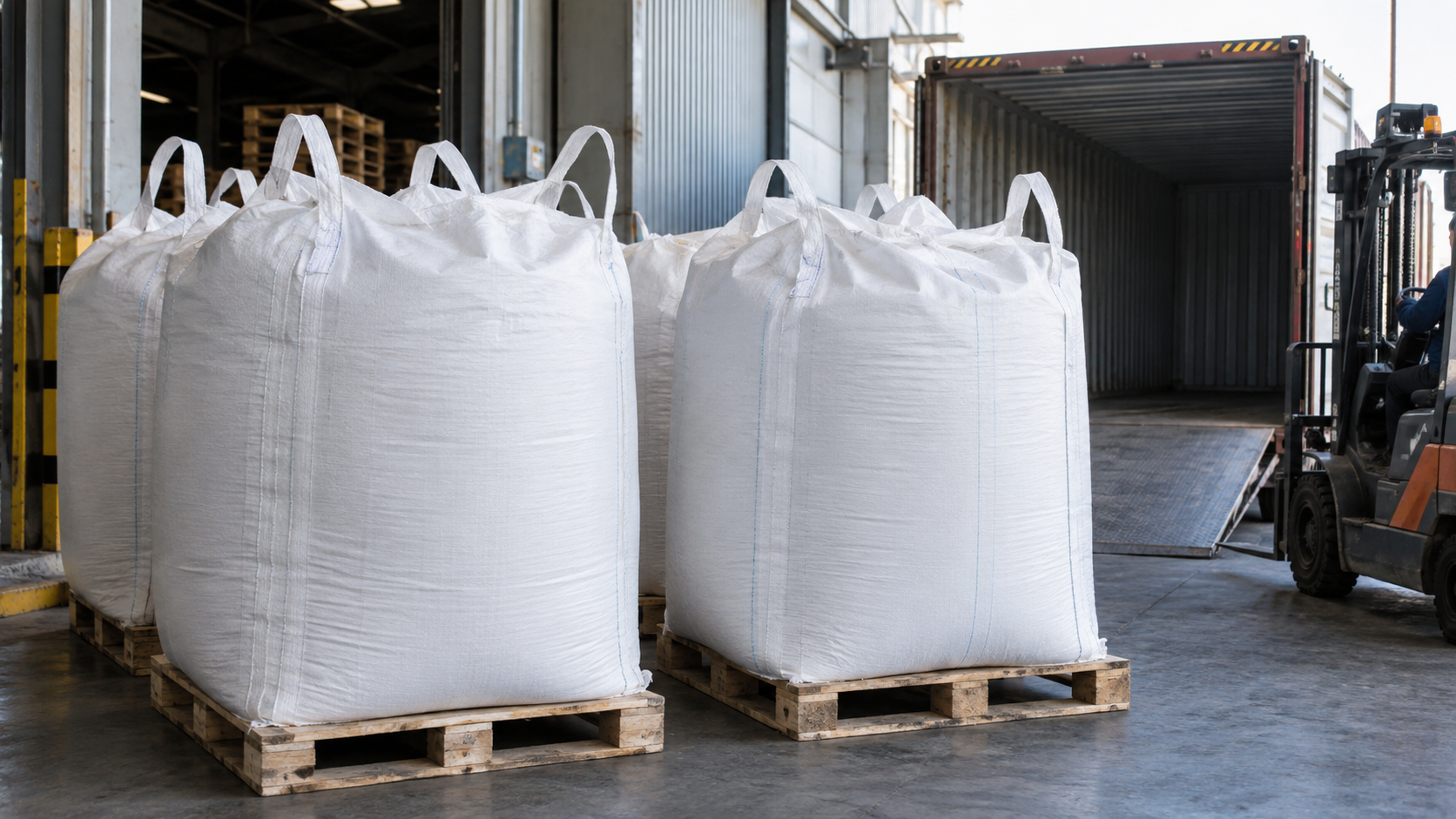
FIBCs are industrial transport packaging used for powders, granules, minerals, chemicals, food ingredients, polymers and agricultural materials. Their performance depends on more than woven polypropylene fabric. Liners, coatings, lifting loops, filling systems, discharge systems, printing and other components can all affect how the packaging is used, recovered and documented.
That is why PPWR preparation should not start with a generic sustainability claim. It should start with the actual packaging specification.
Buyers should already be able to answer:
- What materials are used in the FIBC and liner?
- Which components are essential for the application?
- How is the bag filled, handled and discharged?
- What test and quality documentation is available?
- How is production traceability maintained?
- Which customer or destination-market requirements apply?
For a broader specification framework, use our FIBC RFQ checklist.
2025: the regulation entered into force
The Packaging and Packaging Waste Regulation entered into force on 11 February 2025. This marked the transition toward a more harmonised EU framework for packaging and packaging waste.
For buyers, 2025 should be viewed as the start of preparation. Procurement teams needed to understand which packaging formats were used for EU customers and which suppliers could provide consistent material and technical documentation.
2026: phased application begins
From 12 August 2026, the PPWR began applying on a phased basis. This makes 2026 the right year for FIBC buyers to move from awareness to action.
Start by mapping every FIBC used in EU-facing supply chains. Separate them by application:
- food ingredients,
- chemicals,
- minerals,
- construction materials,
- agriculture,
- plastic resins and polymers, and
- special electrostatic applications.
Then record the bag construction, liner type, coating status, safe working load, safety factor, top and bottom design, loop configuration and documentation set for each SKU.
2027: strengthen supplier and documentation control
By 2027, buyers should have enough visibility to identify gaps. A strong gap review asks whether current packaging information is complete, current and technically useful.
Pay particular attention to:
- liner material and fit,
- mixed-material accessories,
- printing and identification methods,
- food-contact declarations where relevant,
- batch traceability,
- test references, and
- supplier quality controls.
This is also the point to standardise what every approved supplier must provide with a quotation or sample approval.
2028: prepare for stronger labelling and information expectations
The PPWR introduces harmonised labelling requirements on a phased timeline. For industrial packaging buyers, the most useful preparation is better material identification and more consistent internal packaging records.
If procurement, quality and production teams describe the same FIBC differently, future compliance work becomes harder. Standardise terminology for:
- bag construction,
- fabric and coating,
- liner material,
- top and bottom design,
- loop type,
- SWL and safety factor, and
- approved print and markings.
Our FIBC liner guide explains why the inner liner should be treated as part of the full packaging specification.
2029: move from planning to implementation
By 2029, high-risk or high-volume FIBC SKUs should be actively reviewed. This may involve simplifying material combinations, improving documentation, standardising specifications or working with suppliers to reduce unnecessary packaging complexity.
Review especially those bags that:
- use special liners,
- contain food ingredients,
- handle hazardous or electrostatic-sensitive powders,
- are used across multiple EU customers, or
- have frequent specification changes.
2030: the major buyer checkpoint
2030 is one of the key PPWR milestones because major recyclability, reuse and recycled-content measures become increasingly relevant across the packaging market. The exact implications depend on the packaging format and application, but buyers should use 2030 as a backward-planning deadline.
By then, a strong FIBC buyer should have:
- A controlled specification for every major FIBC SKU.
- Supplier documentation requirements built into RFQs.
- Clear material and liner information.
- Traceability expectations defined.
- A practical recyclability and recovery discussion for each application.
- Approved test and quality evidence.
- A supplier-review process that checks compliance readiness, not only price.
How PPWR affects ordinary FIBC buying decisions
One important lesson from PPWR preparation is that good compliance begins with good procurement. A vague FIBC specification creates both operational and compliance risk.
For example, a quotation that says only “1 MT jumbo bag with liner” does not define enough information to compare suppliers properly. Buyers should specify dimensions, SWL, safety factor, construction, fabric, coating, liner, filling, discharge, loops, product characteristics, testing and documentation.
For additional technical buying checks, see our guides on FIBC bag dimensions and FIBC lifting loops.
What a PPWR-ready supplier conversation should include
When evaluating FIBC manufacturers in India or other sourcing markets, buyers should ask the supplier to explain the complete packaging system.
A useful discussion should cover:
- material structure,
- component list,
- liner material,
- traceability,
- production controls,
- testing,
- customer-specific compliance,
- packaging recovery considerations, and
- future design simplification opportunities.
The goal is not to ask for a generic statement that the bag is “PPWR compliant.” The goal is to understand what the supplier can document and how the packaging design fits the actual application.
Common buyer mistakes
Waiting until 2030
Packaging changes take time because they involve samples, testing, customer approval and production validation. Waiting until the final deadline creates unnecessary pressure.
Buying only on price
Price comparisons are meaningful only when suppliers quote the same technical requirement.
Ignoring liners and accessories
The outer FIBC is only one part of the packaging system. Liners and other components can change the material and recovery discussion.
Using outdated documentation
Technical files, declarations and test reports should be current and linked to the actual approved product.
Assuming every application has the same reuse solution
Food, chemicals, minerals and contamination-sensitive materials may require very different practical approaches.
Buyer action plan for 2026–2030
- 2026: map all EU-facing FIBC applications.
- 2027: identify documentation and design gaps.
- 2028: standardise packaging data and material descriptions.
- 2029: implement improvements and supplier controls.
- 2030: maintain a documented, traceable and technically justified packaging portfolio.
Frequently Asked Questions
What is the EU PPWR?
The PPWR is the European Union Packaging and Packaging Waste Regulation. It creates a more harmonised framework covering packaging design, waste reduction, recyclability, labelling, recycled content and reuse-related measures.
When did the PPWR begin to apply?
The regulation entered into force in February 2025 and began applying on a phased basis from 12 August 2026.
Does PPWR apply to industrial packaging such as FIBCs?
The regulation covers packaging broadly, including industrial packaging. The exact obligations can vary by packaging format and use case, so buyers should assess their specific application and destination-market requirements.
What should FIBC buyers do first?
Start by mapping all EU-facing FIBC applications and collecting the complete technical specification, material information, liner details, test records and supplier documentation for each one.
Should buyers ask for a generic PPWR certificate?
A generic statement alone is not enough. Buyers should focus on the specific packaging design, materials, documentation and obligations relevant to their use case.
Final buyer takeaway
EU PPWR 2026–2030 should be treated as a structured preparation timeline, not a last-minute compliance exercise. Buyers who improve specifications, documentation and supplier control now will be in a stronger position as the EU packaging framework continues to develop.
For FIBC buyers, the practical sequence is simple: define the application → document the bag and liner → review supplier capability → improve traceability → prepare for 2030.
For official regulatory information, review the European Commission PPWR page and Regulation (EU) 2025/40 on EUR-Lex.