
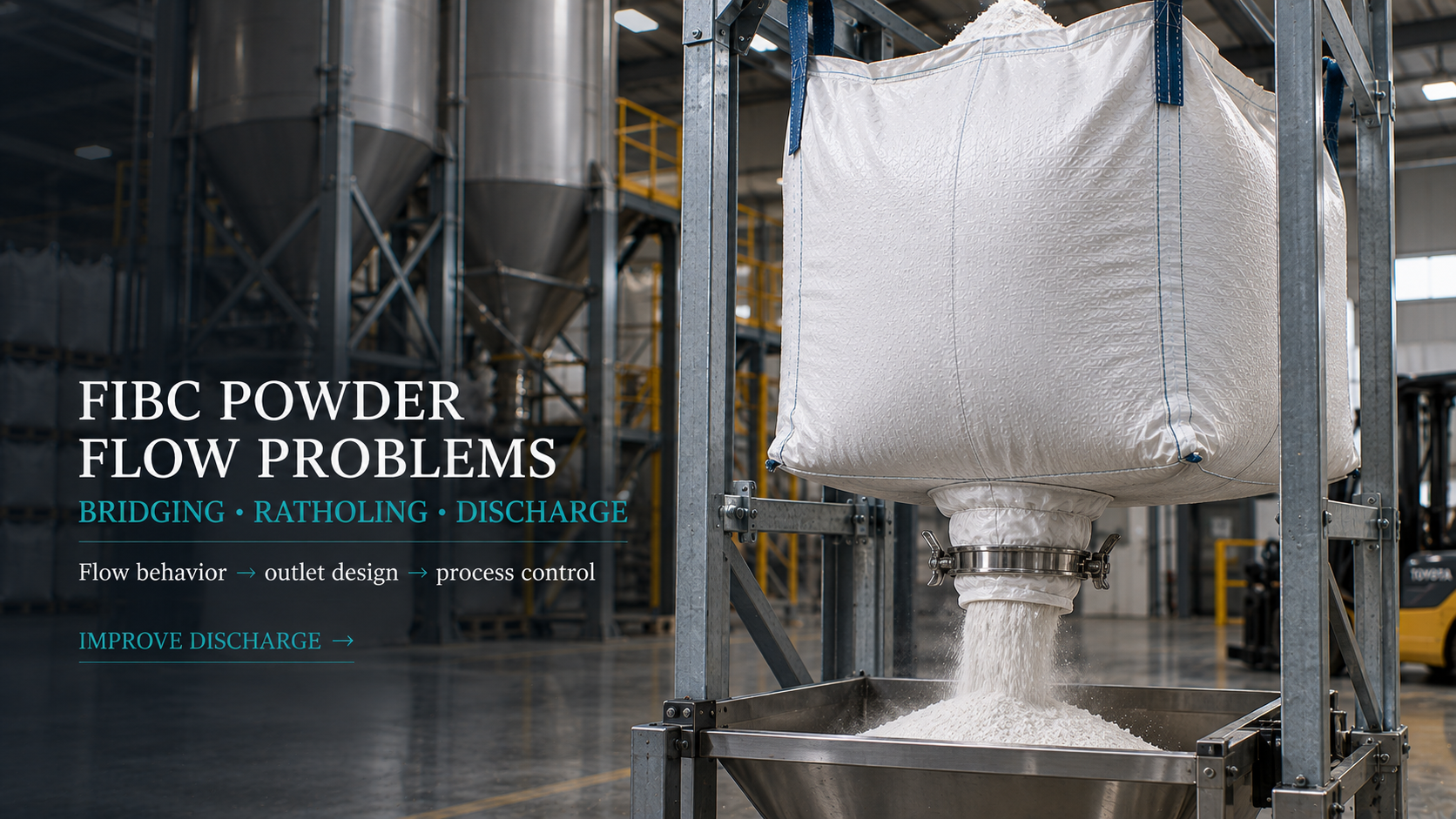
FIBC Powder Flow Problems: Bridging, Ratholing and Discharge Solutions
FIBC powder flow problems often appear only when the bag reaches the discharge station. A product that filled easily can bridge above the outlet, form a stable rathole, discharge in bursts or leave a large heel of material behind. These problems slow production and can tempt operators into unsafe manual intervention.
The cause is rarely the discharge spout alone. Powder flow depends on particle size, moisture, cohesion, aeration, compaction, outlet geometry and the shape of the lower bag. Buyers should therefore specify the product and process together.
What Is Bridging in an FIBC?
Bridging occurs when powder forms a self-supporting arch above the discharge outlet. Flow stops even though material remains in the bag. Cohesive powders, damp products and materials that compact during transport are more likely to bridge.
What Is Ratholing?
Ratholing occurs when a narrow flow channel forms through the center while material remains stationary around the sides. The center empties first, but a significant amount of product can stay behind.
1. Start With Product Flow Properties
Do not describe the contents only as ‘powder’. Include particle size range, bulk density, moisture level, tendency to compact and whether the product is free-flowing or cohesive. If the material changes between seasons or plants, note that variation.
2. Size the Discharge Outlet for the Material
A small outlet can restrict flow and increase bridging risk. A larger outlet may improve flow but can also create an uncontrolled surge. Spout diameter, length and closure type should match both the powder and the receiving equipment.
See our FIBC filling and discharge options guide for the main bottom constructions.
3. Consider a Conical or Tapered Bottom
For difficult-flowing materials, a conical base can help direct product toward the outlet and reduce residual material. The exact geometry should be developed around the powder behavior and the discharge frame.
4. Prevent Liner Interference
An inner liner can collapse, wrinkle or move toward the outlet during discharge if it is not correctly designed and attached. This may restrict flow even when the outer FIBC is correctly sized. The FIBC liner guide explains why liner fit and attachment matter.
5. Control Compaction During Filling and Transit
Vibration and long transport can settle powders into a denser mass. Some materials that flow well immediately after filling become much more difficult to discharge after a long journey. A trial using the real product and transport cycle is valuable for critical applications.
6. Use Discharge Assistance Carefully
Massage paddles, vibration, agitation and controlled aeration are sometimes used in bulk-handling systems. These should be engineered as part of the unloading equipment. Operators should not strike suspended bags or crawl beneath them to restore flow.
7. Keep Operators Away From the Suspended Load
The FIBCA safe handling guidelines advise personnel to stay clear of suspended FIBCs. Flow problems must be solved by design and equipment rather than unsafe manual access under a loaded bag.
Questions Buyers Should Put on the RFQ
- What product will the bag contain?
- What is the bulk density and particle size?
- Does the material bridge or compact?
- What discharge rate is required?
- What hopper or process connection receives the product?
- Is a liner needed?
- What discharge spout diameter and closure are proposed?
- Will a discharge station use massage, vibration or another flow aid?
Including these details gives FIBC manufacturers in India a better basis for recommending a workable design.
How Dust Control Connects to Powder Flow
Increasing outlet size can improve flow but may release product too quickly and create dust. Seam construction, coating and the filling/discharge interface must therefore be considered together. Review our FIBC seam types guide when fine-powder containment is important.
Frequently Asked Questions
Why does powder stop flowing from an FIBC?
Common causes include bridging, ratholing, compaction, an undersized outlet or liner interference.
Will a larger discharge spout always fix bridging?
No. Outlet size is only one variable. Powder cohesion, base geometry and process equipment also matter.
What is a conical-bottom FIBC used for?
It can help direct difficult-flowing product toward the discharge outlet and reduce retained material.
Can vibration be used to empty an FIBC?
Engineered discharge systems may use vibration or other flow aids, but the equipment and bag must be compatible and operators should follow supplier instructions.
Final Takeaway
FIBC powder flow problems are easiest to solve before production. By defining material behavior, outlet geometry, liner design and receiving equipment in the RFQ, buyers can reduce bridging, residue and unsafe discharge interventions.